











 Secure payments
Standard refund policy
Trade Assurance
Secure payments
Standard refund policy
Trade Assurance
| Brand | Micron |
|---|---|
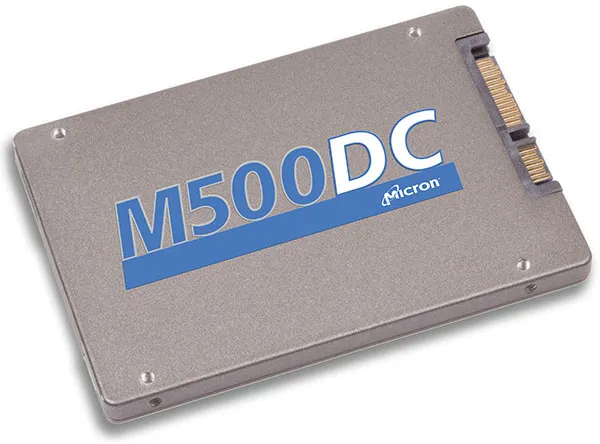
| Model | M500DC |
| Capacity | 800GB |
| Usage Class | Enterprise |
| Host Interface | SATA III |
|---|---|
| Total Interface Bandwidth | 6 Gb/s |
| Form Factor | 2.5" 7mm |
|---|
| NAND Flash | 2D MLC |
|---|---|
| Drive Writes Per Day | 1.3 |
| Total Bytes Written | 1900 TBW |
| Sequential Read | 425 MB/s |
|---|---|
| Sequential Write | 375 MB/s |
| Random Read IOPS | 65000 |
| Random Write IOPS | 24000 |
| Average Latency | μs |
| Mean Time Between Failures | 2 Million Hours |
|---|---|
| Uncorrectable Bit Error Rate | 1.0×10⁻¹⁷ |
| Power Loss Protection | Yes |
The Micron M500DC 800GB (MTFDDAK800MBB-1AE1ZABYY) is best suited for read-intensive to light mixed enterprise workloads such as CDN edge caching, virtualized boot volumes, and web/content delivery nodes, where its 2D MLC NAND and 1.3 DWPD / 1900 TBW endurance provide materially stronger write tolerance and more consistent long-term behavior than typical same-class SATA TLC drives. With up to 425/375 MB/s sequential performance and 65,000/24,000 IOPS, it delivers a balanced SATA III profile for operators who need enterprise-grade reliability and predictable latency without moving to a higher-cost SAS or NVMe tier.
With an endurance rating of 1,900 TBW and 1.3 DWPD, the MTFDDAK800MBB-1AE1ZABYY is built to handle sustained write activity well beyond typical client or light server workloads. In practical terms, for common OS, application, and mixed business-use scenarios, this level of endurance supports many years of stable operation and can be confidently deployed as a system drive without concern over normal write wear. For enterprise reliability, this SSD includes Power Loss Protection (PLP), which helps preserve in-flight data and metadata during an unexpected power interruption, reducing the risk of corruption and unplanned downtime. Its UBER rating of 1.0E-16, together with a 2 million-hour MTBF, reflects enterprise-class data integrity and long-term operational stability that procurement teams can rely on.
1. The SATA III interface, paired with 425 MB/s sequential read performance, speeds up OS boot, VM image loading, and bulk data retrieval in legacy enterprise platforms without requiring a PCIe infrastructure upgrade.
2. Up to 65,000 random-read IOPS enables databases and virtualized workloads to handle fragmented access patterns more efficiently, improving application responsiveness under concurrency.
3. A 1.3 DWPD endurance rating supports sustained daily overwrite activity, making the drive a solid fit for mixed-use servers that need predictable service life and fewer replacement cycles.
4. Built on 2D MLC NAND, the drive emphasizes write consistency, data retention, and long-term reliability over the lower-endurance behavior typical of consumer-grade flash.
5. Typical latency of [latency] µs helps reduce per-transaction storage wait time, supporting steadier QoS for latency-sensitive enterprise workloads such as OLTP and boot storms.
In this family, the nearest lower capacity is 400GB and the nearest higher capacity is 1.6TB, with broadly similar enterprise-class sequential read/write performance and random IOPS. The 800GB model sits at the sweet spot: it offers noticeably more headroom than 400GB for OS images, hot data, and write bursts, while avoiding the higher acquisition cost of 1.6TB when peak performance is already sufficient. It delivers the best balance of usable capacity, predictable latency, and budget efficiency, making it especially well suited for mid-size virtualization clusters or mixed database-and-logging nodes.
Q: Is MTFDDAK800MBB-1AE1ZABYY suitable for a write-heavy database server?
A: Yes. With 1.3 DWPD, 1900 TBW endurance, 2D MLC NAND, and SATA III reliability, MTFDDAK800MBB-1AE1ZABYY is well suited for write-intensive database workloads requiring consistent enterprise-grade performance.
Q: How many full drive writes per day can it actually endure over its warranty period?
A: This model is rated for 1.3 full drive writes per day. For an 800GB SSD, that equals about 1.04TB of writes daily throughout the stated warranty period.
Q: Does it include power loss protection (PLP) and why is that critical?
A: Yes, it includes power loss protection. PLP helps preserve in-flight data and mapping tables during unexpected outages, which is critical for preventing corruption and maintaining application and database integrity.
Q: What RAID level is recommended for this SSD?
A: The recommended RAID level depends on your priority. RAID 1 or RAID 10 is typically preferred for databases, delivering strong redundancy, solid performance, and better fault tolerance than parity-based RAID.