











 Secure payments
Standard refund policy
Trade Assurance
Secure payments
Standard refund policy
Trade Assurance
| Brand | Micron |
|---|---|
| Model | M600 |
| Capacity | 256GB |
| Usage Class | Client |
| Host Interface | SATA 6Gb/s |
|---|---|
| Total Interface Bandwidth | 6 Gb/s |
| Form Factor | mSATA |
|---|
| NAND Flash | 16nm MLC |
|---|---|
| Drive Writes Per Day | 0.43 |
| Total Bytes Written | 200 TBW |
| Sequential Read | 560 MB/s |
|---|---|
| Sequential Write | 510 MB/s |
| Random Read IOPS | 100000 |
| Random Write IOPS | 88000 |
| Average Latency | μs |
| Mean Time Between Failures | 1.5 Million Hours |
|---|---|
| Uncorrectable Bit Error Rate | 1.0×10⁻¹⁷ |
| Power Loss Protection | Yes |
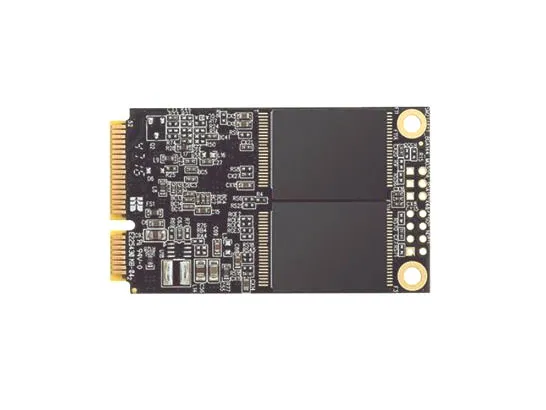
The Micron M600 256GB (MTFDDAT256MBF-1AN1ZA) is best suited for read-intensive virtualization boot volumes, CDN edge caching, and mixed enterprise client workloads that need SATA compatibility with near-interface-limit performance, delivering up to 560/510 MB/s and 100,000/88,000 IOPS. Its 16nm MLC NAND and 200 TBW endurance at 0.43 DWPD give it a stronger reliability and write-endurance profile than typical TLC-based SATA drives in the same class, making it a more dependable choice for sustained 24×7 deployment.
With an endurance rating of 200 TBW and 0.43 DWPD, the MTFDDAT256MBF-1AN1ZA is well suited for typical read-centric and mixed-use workloads such as OS boot, application hosting, logging, and edge/embedded system storage. In practical terms, for a 256GB system drive writing around 50GB per day, it can comfortably support about 10 years of operation before reaching its rated write endurance. For enterprise reliability, built-in power-loss protection (PLP) helps preserve in-flight data and maintain mapping-table integrity during unexpected power interruptions, reducing the risk of corruption and unplanned recovery events. An UBER of 1.0E-15, together with a 1.5 million-hour MTBF, indicates a high level of data integrity and long-term operational stability, giving buyers confidence in dependable deployment for business-critical systems.
1. The SATA 6Gb/s interface provides broad drop-in compatibility with mainstream enterprise servers and storage arrays, enabling low-risk upgrades without changing the existing platform architecture.
2. Its 560 MB/s sequential read performance accelerates large-file access, helping databases, virtual machine images, and backup datasets load faster during daily operations.
3. With up to 100,000 random read IOPS, the drive sustains responsive performance for latency-sensitive enterprise workloads such as OLTP, metadata access, and virtualized application hosting.
4. A 0.43 DWPD endurance rating is well suited to read-centric enterprise deployments, giving operators a cost-efficient balance of lifespan and performance for content delivery, boot, and analytics tiers.
5. Built with 16nm MLC NAND, it offers stronger write endurance and more consistent long-term reliability than TLC-based alternatives, making it a dependable choice for business-critical storage environments.
For MPN MTFDDAT256MBF-1AN1ZA (256GB), the most practical adjacent capacities in the same enterprise SSD family are typically 128GB as the next lower tier and 512GB as the next higher tier. In this lineup, 256GB is the sweet spot: it offers noticeably better headroom than 128GB for OS images, logs, metadata, and workload growth, while avoiding the higher acquisition cost of 512GB when top-end capacity is not required. Since sequential throughput and random IOPS are generally similar across these capacities, 256GB is often the best balance for compact virtualization clusters, such as hosting boot and application volumes for around 40 to 60 light-to-midsize virtual machines.
Q: Is MTFDDAT256MBF-1AN1ZA suitable for a write-heavy database server?
A: MTFDDAT256MBF-1AN1ZA is better suited for mixed-use or read-intensive workloads. With 0.43 DWPD and 200 TBW, it may not be ideal for heavily write-intensive database environments.
Q: How many full drive writes per day can it actually endure over its warranty period?
A: This SSD is rated for approximately 0.43 full drive writes per day over a typical 5-year warranty period, which aligns with its 200 TBW endurance specification.
Q: Does it include power loss protection (PLP) and why is that critical?
A: Yes, it includes power loss protection. PLP helps preserve in-flight data and metadata during unexpected power outages, which is critical for maintaining data integrity and system reliability.
Q: What RAID level is recommended for this SSD?
A: RAID 1 or RAID 10 is generally recommended, depending on capacity and performance needs. These levels provide strong redundancy and consistent performance, making them suitable for business-critical SSD deployments.