











 Secure payments
Standard refund policy
Trade Assurance
Secure payments
Standard refund policy
Trade Assurance
| Brand | Micron |
|---|---|
| Model | M600 |
| Capacity | 256GB |
| Usage Class | Client |
| Host Interface | SATA 6Gb/s |
|---|---|
| Total Interface Bandwidth | 6 Gb/s |
| Form Factor | M.2 2280 |
|---|
| NAND Flash | 16nm MLC |
|---|---|
| Drive Writes Per Day | 0.43 |
| Total Bytes Written | 200 TBW |
| Sequential Read | 560 MB/s |
|---|---|
| Sequential Write | 510 MB/s |
| Random Read IOPS | 100000 |
| Random Write IOPS | 88000 |
| Average Latency | μs |
| Mean Time Between Failures | 1.5 Million Hours |
|---|---|
| Uncorrectable Bit Error Rate | 1.0×10⁻¹⁷ |
| Power Loss Protection | Yes |
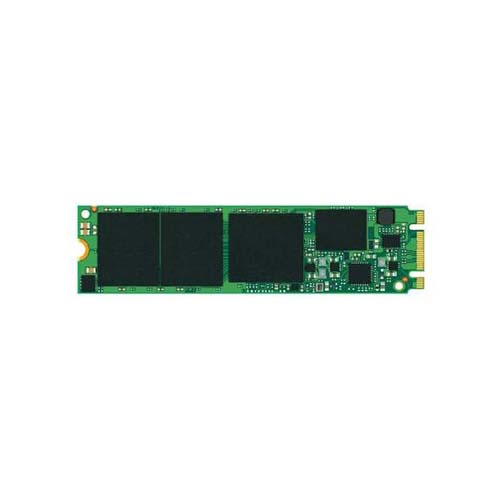
The Micron M600 256GB (MTFDDAV256MBF-1AN12A) is a strong fit for read-intensive boot, cache, and edge-server workloads that need consistent SATA performance, combining 560/510 MB/s sequential throughput with up to 100,000/88,000 IOPS in a compact 16nm MLC design. Compared with typical client-grade SATA SSDs in the same capacity class, its 200 TBW endurance and 0.43 DWPD rating make it a more dependable choice for always-on systems that require higher write tolerance and steadier long-term responsiveness.
With an endurance rating of 200 TBW and 0.43 DWPD, the MTFDDAV256MBF-1AN12A is well suited for typical read-centric and mixed-use workloads, including operating system, boot, and general industrial or embedded application storage. In practical terms, this level of endurance is more than sufficient for a system drive under normal daily write volumes, supporting long-term stable operation over many years of deployment. For enterprise-grade reliability, the drive includes power-loss protection (PLP), which helps preserve in-flight data and metadata if power is interrupted unexpectedly, reducing the risk of corruption and unclean shutdown issues. Its UBER of 1.0E-15 and MTBF of 1.5 million hours further indicate a strong reliability profile, giving buyers added confidence in data integrity and dependable field performance.
1. The SATA 6Gb/s interface, combined with 560 MB/s sequential read performance, speeds up OS boot, VM image loading, and large-file retrieval in enterprise servers that still rely on proven SATA infrastructure.
2. With 100,000 K IOPS in random reads, this drive supports highly responsive access to small-block data, helping databases, virtual desktops, and metadata-heavy workloads serve more users with less wait time.
3. A 0.43 DWPD endurance rating makes it a practical fit for read-centric enterprise deployments where predictable reliability matters more than heavy daily overwrite capability.
4. Built on 16nm MLC NAND, the SSD delivers a strong balance of data retention, write stability, and lifecycle consistency that enterprise buyers value over lower-cost consumer flash.
5. A typical latency of [latency] µs helps reduce storage response time at the transaction level, improving application smoothness in latency-sensitive business systems.
Within this product family, the nearest lower capacity reference is 128GB and the next higher capacity reference is 512GB. For mainstream enterprise SSD lines, these adjacent capacities typically deliver broadly similar sequential read/write behavior and comparable random IOPS under standard mixed workloads. At 256GB, this SSD sits in the sweet spot of the series. Compared with 128GB, it gives meaningfully better headroom for OS images, logs, patches, and moderate data growth without forcing early refresh. Compared with 512GB, it preserves most of the practical enterprise performance profile while keeping acquisition cost and fleet standardization more efficient. It is best suited for small-to-mid virtualization clusters, such as boot and utility storage for about 40 to 60 infrastructure-focused virtual machines.
Q: Is MTFDDAV256MBF-1AN12A suitable for a write-heavy database server?
A: MTFDDAV256MBF-1AN12A is better suited for mixed-use or read-intensive workloads. With 0.43 DWPD and 200 TBW, it is not the ideal choice for highly write-heavy database servers.
Q: How many full drive writes per day can it actually endure over its warranty period?
A: This SSD is rated for approximately 0.43 full drive writes per day over a 5-year warranty period, which aligns with its 200 TBW endurance specification for the 256GB capacity.
Q: Does it include power loss protection (PLP) and why is that critical?
A: Yes, it includes power loss protection. PLP helps preserve in-flight data and mapping tables during sudden power failure, which is critical for data integrity and system reliability.
Q: What RAID level is recommended for this SSD?
A: For most server deployments, RAID 1 or RAID 10 is recommended. These levels provide strong redundancy, solid read performance, and better fault tolerance for business-critical applications.