











 Secure payments
Standard refund policy
Trade Assurance
Secure payments
Standard refund policy
Trade Assurance
| Brand | Micron |
|---|---|
| Model | RealSSD P320h |
| Capacity | 350GB |
| Usage Class | Enterprise |
| Host Interface | PCIe Gen2 x4 |
|---|---|
| Total Interface Bandwidth | 16 Gb/s |
| Form Factor | 2.5" 15mm |
|---|
| NAND Flash | 34nm SLC |
|---|---|
| Drive Writes Per Day | |
| Total Bytes Written | 25000 TBW |
| Sequential Read | 1750 MB/s |
|---|---|
| Sequential Write | 1100 MB/s |
| Random Read IOPS | 415000 |
| Random Write IOPS | 145000 |
| Average Latency | 50 μs |
| Mean Time Between Failures | 2 Million Hours |
|---|---|
| Uncorrectable Bit Error Rate | 1.0×10⁻¹⁷ |
| Power Loss Protection | Yes |
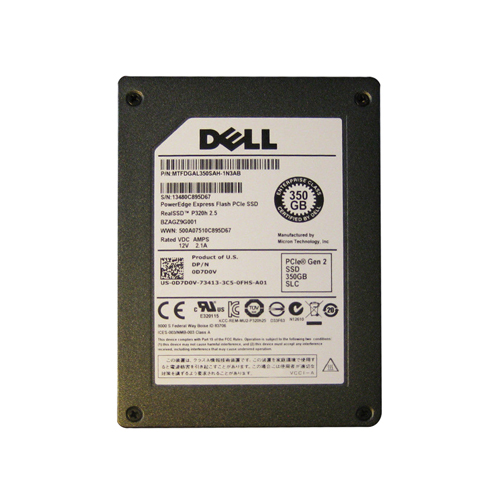
The Micron RealSSD P320h 350GB (MTFDGAL350SAH-1N3AB) is purpose-built for latency-sensitive database logging, high-frequency trading caches, and virtualization metadata tiers, combining 34nm SLC NAND with 25,000 TBW endurance for write profiles that would quickly wear out mainstream enterprise MLC drives. With up to 1,750/1,100 MB/s sequential throughput and 415K/145K random IOPS over PCIe Gen2 x4, it delivers a clear advantage over same-generation SATA SSDs in both transaction density and tail-latency consistency under sustained mixed workloads.
With an endurance rating of 25,000 TBW, the MTFDGAL350SAH-1N3AB is designed to support very write-intensive enterprise workloads over its service life, providing a substantial margin for typical server, storage, or system-disk use. In practical terms, this level of endurance means the drive can comfortably handle sustained daily writes for many years, making it a dependable choice for long-term deployment with low concern about premature wear under normal operating conditions. For enterprise reliability, the drive includes power-loss protection (PLP), which helps preserve in-flight data and protects metadata integrity if power is suddenly interrupted, reducing the risk of corruption and unplanned recovery events. Its UBER of 1.0E-16 indicates a very low unrecoverable bit error rate, supporting high data integrity expectations in business-critical environments, while the 2 million hour MTBF further reflects a design built for stable, continuous operation.
1. The PCIe Gen2 x4 host interface, paired with strong sequential bandwidth, enables faster dataset staging, VM boot, and backup restore operations in legacy enterprise servers.
2. Its high random-read capability is ideal for metadata-heavy databases and virtualized environments, helping sustain responsive performance under deep concurrency.
3. The enterprise endurance profile supports sustained write pressure from logging, caching, and transaction-processing workloads with lower replacement risk over the drive lifecycle.
4. Built on SLC NAND, this SSD prioritizes maximum reliability, stable low-latency behavior, and predictable performance consistency for mission-critical applications.
5. The very low typical latency helps reduce storage wait time per I/O, improving tail-response behavior for real-time analytics and latency-sensitive enterprise services.
For the MTFDGAL350SAH-1N3AB 350GB enterprise SSD, the closest lower capacity in the same family is typically 175GB, while the next higher capacity is 700GB. In enterprise SSD lines, these adjacent capacities usually deliver broadly similar sequential read/write throughput and random IOPS, with differences mainly in usable capacity, endurance, and cost efficiency. At 350GB, this model sits in the sweet spot of the series. Compared with the 175GB version, it gives noticeably better headroom for OS growth, logs, patches, and swap without forcing early capacity planning. Compared with the 700GB model, it preserves most of the enterprise-class performance profile while offering a more balanced cost-per-drive and lower upfront spend. It is well suited for mid-scale deployment, such as hosting boot and utility volumes for about 40 to 60 virtualized application instances in a dense server cluster.
Q: Is MTFDGAL350SAH-1N3AB suitable for a write-heavy database server?
A: Yes. With 34nm SLC NAND, 25,000 TBW, low 50 µs typical latency, and enterprise power-loss protection, this 350GB SSD is well suited for demanding write-heavy database and logging workloads.
Q: How many full drive writes per day can it actually endure over its warranty period?
A: Based on 25,000 TBW and 350GB capacity, it supports about 71,429 full-drive writes total. Assuming a 5-year warranty, that equals roughly 39 DWPD, which is extremely high endurance.
Q: Does it include power loss protection (PLP) and why is that critical?
A: Yes, it includes PLP. This is critical because it helps protect in-flight data and metadata during unexpected power failures, reducing corruption risk and improving storage reliability in enterprise environments.
Q: What RAID level is recommended for this SSD?
A: For most enterprise deployments, RAID 1 or RAID 10 is recommended to balance redundancy and performance. RAID 10 is especially suitable for write-intensive databases requiring both resilience and low latency.