

 Secure payments
Standard refund policy
Trade Assurance
Secure payments
Standard refund policy
Trade Assurance
| Brand | Micron |
|---|---|
| Model | P320h |
| Capacity | 350GB |
| Usage Class | Enterprise |
| Host Interface | PCIe Gen2 x8 |
|---|---|
| Total Interface Bandwidth | 4 Gb/s |
| Form Factor | HHHL |
|---|
| NAND Flash | 34nm SLC |
|---|---|
| Drive Writes Per Day | |
| Total Bytes Written | 25000 TBW |
| Sequential Read | 3200 MB/s |
|---|---|
| Sequential Write | 1900 MB/s |
| Random Read IOPS | 785000 |
| Random Write IOPS | 175000 |
| Average Latency | μs |
| Mean Time Between Failures | 2 Million Hours |
|---|---|
| Uncorrectable Bit Error Rate | 1.0×10⁻¹⁷ |
| Power Loss Protection | Yes |
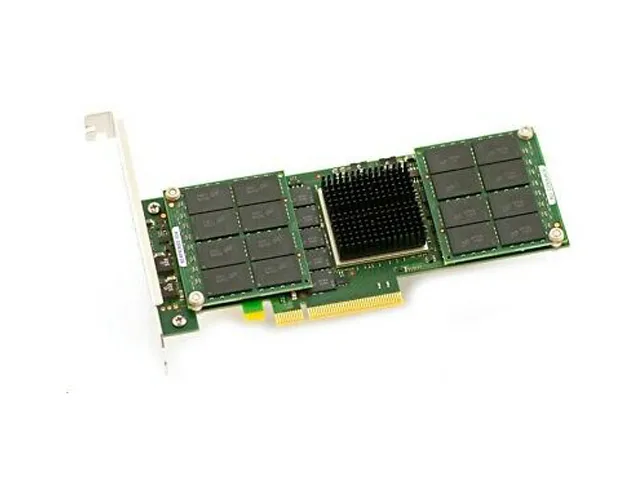
The Micron P320h 350GB (MTFDGAR350SAH-1N1AB) is purpose-built for ultra write-intensive, latency-sensitive workloads such as high-frequency trading, real-time analytics logging, and database journaling, combining 34nm SLC NAND with 25,000 TBW endurance for sustained reliability under extreme duty cycles. Its PCIe Gen2 x8 interface delivers up to 3200/1900 MB/s sequential throughput and 785,000/175,000 IOPS, giving it a clear advantage over mainstream enterprise SSDs in deterministic low-latency performance and heavy mixed-write consistency.
With an endurance rating of 25,000 TBW, the MTFDGAR350SAH-1N1AB is built to handle very heavy write activity over its service life, making it well suited for demanding enterprise workloads as well as long-term OS, application, and data logging duties. In typical deployment scenarios, this level of endurance means the drive can operate for many years with substantial daily writes, giving procurement teams strong confidence in lifecycle stability and low replacement risk. For enterprise reliability, built-in power loss protection (PLP) helps preserve in-flight data and protects metadata integrity if power is interrupted unexpectedly, reducing the risk of corruption and unplanned recovery events. Its UBER of 1.0E-16 and 2 million hour MTBF indicate a highly dependable design for business-critical environments where data integrity, predictable operation, and sustained uptime are essential.
1. The PCIe Gen2 x8 interface provides a wide host bandwidth path that helps eliminate storage bottlenecks in virtualization clusters, database servers, and other throughput-sensitive enterprise platforms.
2. The 3200 MB/s sequential read performance accelerates large-block data access, reducing wait times for analytics jobs, backup recovery, and bulk content streaming.
3. The 785,000 K IOPS random read capability enables extremely fast access to small scattered data, making it well suited for OLTP databases, metadata-heavy applications, and dense multi-VM environments.
4. Built on 34nm SLC NAND and rated for [dwpd] DWPD, the drive is designed for write-intensive enterprise workloads where consistent endurance and long-term reliability are mission-critical.
5. With a typical latency of [latency] µs, the SSD delivers highly responsive storage behavior that improves application QoS and helps maintain predictable service levels under demanding workloads.
Lower capacity reference: 175GB Higher capacity reference: 700GB In this SSD family, the 350GB model sits in the sweet spot for mainstream enterprise deployment. Compared with the 175GB version, it gives noticeably better capacity headroom for OS, logs, metadata, and application growth, reducing early refresh pressure. Compared with the 700GB option, it preserves nearly the same enterprise-class sequential and random performance profile while delivering a more efficient balance of acquisition cost, usable capacity, and endurance planning. It is especially well suited for small-to-midsize virtualization clusters, such as hosting boot and application volumes for about 40 to 60 mixed-workload virtual machines.
Q: Is MTFDGAR350SAH-1N1AB suitable for a write-heavy database server?
A: Yes. With 34nm SLC NAND, 25,000 TBW endurance, PCIe Gen2 x8 interface, and enterprise-grade reliability features, MTFDGAR350SAH-1N1AB is well suited for write-heavy database and transaction-intensive server workloads.
Q: How many full drive writes per day can it actually endure over its warranty period?
A: Based on 350GB capacity and 25,000 TBW, this SSD supports about 39 full drive writes per day over a typical 5-year period, making it highly capable for intensive write workloads.
Q: Does it include power loss protection (PLP) and why is that critical?
A: Yes, it includes power loss protection. PLP helps preserve in-flight data and metadata during sudden outages, reducing corruption risk and improving data integrity for enterprise, database, and caching applications.
Q: What RAID level is recommended for this SSD?
A: For enterprise deployment, RAID 10 is generally recommended. It offers strong performance, fault tolerance, and low rebuild risk, which is especially valuable for write-intensive databases and latency-sensitive applications.