











 Secure payments
Standard refund policy
Trade Assurance
Secure payments
Standard refund policy
Trade Assurance
| Brand | Micron |
|---|---|
| Model | RealSSD P320h |
| Capacity | 700GB |
| Usage Class | Enterprise |
| Host Interface | PCIe Gen2 x8 |
|---|---|
| Total Interface Bandwidth | 32 Gb/s |
| Form Factor | HHHL |
|---|
| NAND Flash | SLC |
|---|---|
| Drive Writes Per Day | |
| Total Bytes Written | 50000 TBW |
| Sequential Read | 3200 MB/s |
|---|---|
| Sequential Write | 1900 MB/s |
| Random Read IOPS | 785000 |
| Random Write IOPS | 205000 |
| Average Latency | 42 μs |
| Mean Time Between Failures | 2 Million Hours |
|---|---|
| Uncorrectable Bit Error Rate | 1.0×10⁻¹⁷ |
| Power Loss Protection | Yes |
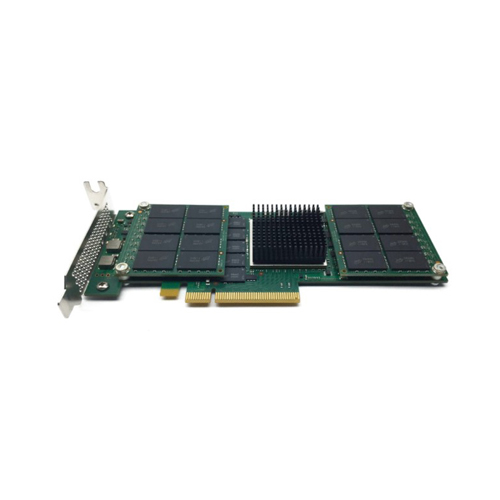
The Micron RealSSD P320h 700GB (MTFDGAR700SAH-1N1AB) is purpose-built for ultra-write-intensive OLTP databases, high-frequency logging, and metadata acceleration tiers, combining SLC endurance with 50,000 TBW and up to 785K/205K random read/write IOPS to sustain low-latency performance under constant mixed I/O pressure. Compared with typical enterprise MLC SSDs in the same generation, its PCIe Gen2 x8 architecture and 3200/1900 MB/s throughput deliver materially higher write consistency and far stronger lifetime durability, making it a better fit where sustained write load and predictable QoS matter more than raw capacity per dollar.
With an endurance rating of 50,000 TBW, the MTFDGAR700SAH-1N1AB is designed to sustain an extremely large amount of data written over its service life, making it well suited for write-intensive enterprise workloads. In typical deployment scenarios, this level of endurance means the drive can comfortably serve as a long-term system or application drive for many years, with substantial margin for daily operating system, logging, and business data activity. For enterprise reliability, the drive includes power-loss protection (PLP), which helps preserve in-flight data and protect metadata integrity if power is interrupted unexpectedly. Its UBER rating of 1.0E-16 indicates a very low probability of unrecoverable bit errors during reads, supporting dependable data integrity, while the 2 million hour MTBF further reflects a design optimized for stable continuous operation.
1. The PCIe Gen2 x8 interface provides broad enterprise server compatibility while supplying enough parallel bandwidth to keep shared storage and virtualization workloads moving efficiently.
2. Sequential read throughput of 3200 MB/s speeds up large-file ingestion, backup recovery, and dataset loading for analytics and content delivery platforms.
3. Random read performance of 785,000 K IOPS enables highly concurrent OLTP, VDI, and metadata-heavy applications to serve more requests with less queue buildup.
4. SLC NAND paired with a [dwpd] DWPD endurance profile makes the drive well suited for write-intensive caching, journaling, and always-on transactional environments that demand predictable lifespan.
5. A typical latency of 42 µs helps latency-sensitive services such as real-time databases and financial transaction systems deliver faster response per operation.
Lower capacity reference: 350GB Higher capacity reference: 1.4TB The 700GB MTFDGAR700SAH-1N1AB sits at the sweet spot of this enterprise SSD family. Compared with the 350GB option, it provides much better headroom for OS images, logs, metadata, and application growth, reducing the risk of early capacity pressure. Compared with the 1.4TB model, it delivers a more balanced acquisition cost while keeping broadly similar enterprise-class sequential throughput and random IOPS. In practice, this capacity is well suited for a mid-sized virtualization cluster, such as hosting boot and application volumes for about 60 to 80 business workloads.
Q: Is MTFDGAR700SAH-1N1AB suitable for a write-heavy database server?
A: Yes. With SLC NAND, 50,000 TBW endurance, 42 µs typical latency, and PCIe Gen2 x8 connectivity, MTFDGAR700SAH-1N1AB is well suited for demanding write-heavy database workloads.
Q: How many full drive writes per day can it actually endure over its warranty period?
A: Based on 700GB capacity and 50,000 TBW, it supports about 71,429 full drive writes total. Assuming a 5-year warranty, that equals roughly 39 DWPD in actual endurance.
Q: Does it include power loss protection (PLP) and why is that critical?
A: Yes, it includes power loss protection. PLP helps preserve in-flight data and metadata during sudden outages, reducing corruption risk and improving data integrity in enterprise storage environments.
Q: What RAID level is recommended for this SSD?
A: For enterprise and database use, RAID 10 is generally recommended. It combines strong performance with redundancy, making it a better fit than RAID 0 or RAID 5 for critical workloads.