











 Secure payments
Standard refund policy
Trade Assurance
Secure payments
Standard refund policy
Trade Assurance
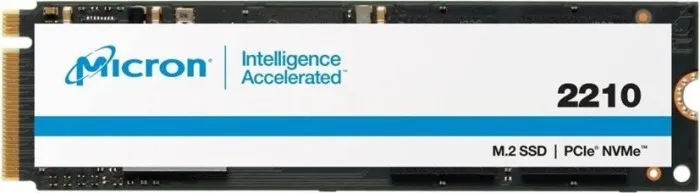
| Brand | Micron |
|---|---|
| Model | 2210 |
| Capacity | 512GB |
| Usage Class | Client |
| Host Interface | PCIe Gen3 x4 NVMe |
|---|---|
| Total Interface Bandwidth | 31.5 Gb/s |
| Form Factor | M.2 2280 |
|---|
| NAND Flash | 3D QLC |
|---|---|
| Drive Writes Per Day | |
| Total Bytes Written | 180 TBW |
| Sequential Read | 2200 MB/s |
|---|---|
| Sequential Write | 1075 MB/s |
| Random Read IOPS | 150000 |
| Random Write IOPS | 260000 |
| Average Latency | μs |
| Mean Time Between Failures | 2 Million Hours |
|---|---|
| Uncorrectable Bit Error Rate | 1.0×10⁻¹⁷ |
| Power Loss Protection | No |
The Micron 2210 512GB (MTFDHBA512QFD-1AX1AABYY) is best suited for read-centric client and edge workloads such as OS boot, application launch, VDI images, and local content caching, where its PCIe Gen3 x4 NVMe interface delivers up to 2200/1075 MB/s and 150K/260K IOPS in a highly space- and power-efficient form factor. Compared with typical SATA SSDs and lower-end DRAMless NVMe drives in the same capacity class, its 3D QLC design provides a stronger balance of throughput, queue-depth responsiveness, and cost efficiency, while the 180 TBW rating is well matched to mainstream deployment cycles.
With an endurance rating of 180 TBW, the MTFDHBA512QFD-1AX1AABYY is well suited for typical read-heavy and mixed business workloads such as OS boot, office applications, device management, and general data access. In practical terms, for a 512GB drive this corresponds to about [dwpd] drive writes per day over the warranty period, which is generally more than sufficient for long-term use as a system or boot drive under normal enterprise client deployment conditions. From a reliability perspective, the drive is specified at 2 million hours MTBF and an UBER of 1.0E-15, meaning the expected unrecoverable bit error rate is very low and aligned with dependable operation in professional environments. This model does not include power-loss protection (PLP), so it is best positioned for applications where sudden power interruption is controlled at the system level, while still providing solid day-to-day reliability for non-write-cache-critical use cases.
1. The PCIe Gen3 x4 NVMe interface provides a low-latency, high-bandwidth path to the CPU, helping virtualized servers and scale-out storage nodes respond faster under mixed enterprise workloads.
2. Its sequential read performance accelerates large-block data access, reducing wait time for analytics scans, backup restores, and content streaming at scale.
3. Strong random read capability enables fast access to small, scattered data sets, which is especially valuable for database queries, metadata-heavy applications, and VDI boot storms.
4. With a [dwpd] DWPD endurance rating, the drive is positioned for predictable lifecycle management in read-centric enterprise environments where consistent service life matters more than heavy daily overwrites.
5. Built on 3D QLC NAND, it offers higher flash density and better cost efficiency per terabyte, making it well suited for capacity-optimized deployments such as content repositories, warm data tiers, and large-scale read-heavy storage.
Lower capacity reference: 256GB Higher capacity reference: 1TB Capacity positioning analysis: In this product family, the 512GB model sits at the sweet spot between the 256GB entry option and the 1TB step-up version. Compared with 256GB, it gives much better headroom for OS images, logs, metadata, and moderate application growth, reducing early capacity pressure. Compared with 1TB, it usually delivers the most practical balance of acquisition cost, usable endurance, and enterprise-class performance consistency, while keeping sequential throughput and random IOPS broadly in line with the series. It is well suited for a mid-sized virtualization cluster hosting about 40 to 60 general-purpose virtual machine boot volumes.
Q: Is MTFDHBA512QFD-1AX1AABYY suitable for a write-heavy database server?
A: Not ideally. This 512GB PCIe Gen3 x4 NVMe SSD uses 3D QLC NAND, offers 180 TBW, and has no PLP, so it is better suited to read-focused or light mixed workloads.
Q: How many full drive writes per day can it actually endure over its warranty period?
A: Based on 180 TBW and 512GB capacity, the drive supports about 352 full-drive writes total. Assuming a 5-year warranty, that equals roughly 0.19 DWPD, which is relatively modest endurance.
Q: Does it include power loss protection (PLP) and why is that critical?
A: No, it does not include power loss protection. PLP is critical in server environments because it helps protect in-flight data and metadata during sudden outages, reducing corruption and recovery risks.
Q: What RAID level is recommended for this SSD?
A: For business or server use, RAID 1 or RAID 10 is generally recommended. These levels improve redundancy and read performance, while RAID 10 is better for balanced performance and fault tolerance.