











 Secure payments
Standard refund policy
Trade Assurance
Secure payments
Standard refund policy
Trade Assurance
| Brand | Micron |
|---|---|
| Model | 2100AI |
| Capacity | 64GB |
| Usage Class | Industrial |
| Host Interface | PCIe Gen3 NVMe |
|---|---|
| Total Interface Bandwidth | 8 Gb/s |
| Form Factor | M.2 2230 |
|---|
| NAND Flash | 3D TLC |
|---|---|
| Drive Writes Per Day | 0.43 |
| Total Bytes Written | 30 TBW |
| Sequential Read | 550 MB/s |
|---|---|
| Sequential Write | 250 MB/s |
| Random Read IOPS | 45000 |
| Random Write IOPS | 30000 |
| Average Latency | 85 μs |
| Mean Time Between Failures | 3 Million Hours |
|---|---|
| Uncorrectable Bit Error Rate | 1.0×10⁻¹⁷ |
| Power Loss Protection | Yes |
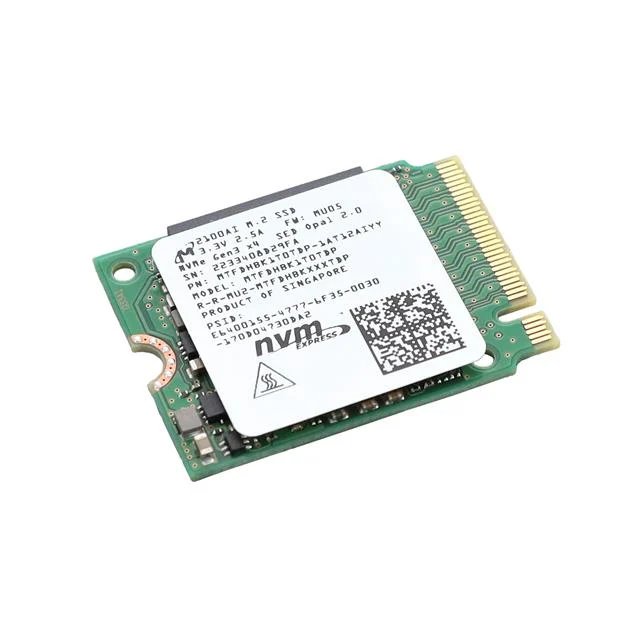
The Micron 2100AI 64GB (MTFDHBK064TDP-1AT12AIYY) is best suited for read-centric embedded boot, hypervisor bootbank, and industrial edge gateway workloads where a small-footprint NVMe drive must deliver predictable low-latency access with 45K/30K random IOPS and 30 TBW endurance. Compared with SATA-class drives and many eMMC-based designs in the same capacity band, it provides a clear interface and responsiveness advantage through PCIe Gen3 NVMe while using 3D TLC NAND to balance reliability, service life, and BOM efficiency for fixed-function systems.
With an endurance rating of 30 TBW, the MTFDHBK064TDP-1AT12AIYY is well suited for typical read-heavy embedded and system-drive workloads, where daily write volumes are relatively low. In practical terms, for use cases such as an OS boot drive, application storage, configuration data, and routine logging, this level of endurance supports many years of stable operation without endurance concern under normal usage. For enterprise reliability, built-in Power Loss Protection (PLP) helps preserve in-flight data and protects metadata integrity if power is interrupted unexpectedly, reducing the risk of corruption or an unclean shutdown. Its UBER rating of 1.0E-16 reflects a very low unrecoverable bit error rate, giving purchasers added confidence in long-term data integrity, while the 3 million hour MTBF further supports dependable continuous operation.
1. The PCIe Gen3 NVMe interface eliminates SATA-era protocol overhead, giving enterprise servers faster queue handling and better parallel access for virtualized and multi-tenant workloads.
2. With 550 MB/s sequential read throughput, the drive can accelerate boot-image delivery, media retrieval, and large-file access in read-focused infrastructure.
3. Its 45,000 random-read IOPS capability helps databases, metadata services, and VDI sessions stay responsive under scattered, high-concurrency access patterns.
4. A 0.43 DWPD endurance rating makes it best suited for read-centric enterprise use cases such as content distribution, OS boot volumes, and analytics replicas with moderate daily writes.
5. Using 3D TLC NAND and delivering a typical latency of 85 µs, it offers a practical balance of flash density, cost efficiency, and consistent responsiveness for mainstream data center deployments.
[lower_capacity]: 32GB [higher_capacity]: 128GB Capacity Positioning Analysis: Within this enterprise SSD family, the 64GB model represents a practical sweet spot. Compared with the 32GB version, it offers much better space headroom for OS images, logs, metadata, and overprovisioning, reducing the risk of early capacity pressure in always-on environments. Compared with the 128GB version, it keeps acquisition cost lower while delivering broadly similar sequential and random performance for typical enterprise workloads. This makes 64GB especially suitable for compact boot tiers, hypervisor nodes, network appliances, or small clustered infrastructure with predictable storage footprints.
Q: Is MTFDHBK064TDP-1AT12AIYY suitable for a write-heavy database server?
A: This model is generally not recommended for write-heavy database servers. With 0.43 DWPD, 30 TBW, and 3D TLC NAND, it is better suited for read-centric, boot, or light mixed-workload environments.
Q: How many full drive writes per day can it actually endure over its warranty period?
A: It is rated for 0.43 drive writes per day, meaning it can sustain about 43% of its total 64GB capacity in writes per day over the defined warranty period.
Q: Does it include power loss protection (PLP) and why is that critical?
A: Yes, it includes power loss protection. PLP is critical because it helps preserve in-flight data and metadata during sudden outages, reducing corruption risk and improving storage reliability.
Q: What RAID level is recommended for this SSD?
A: The recommended RAID level depends on the application. RAID 1 is commonly preferred for OS or boot reliability, while RAID 10 is better for balanced performance and redundancy in enterprise use.