

 Secure payments
Standard refund policy
Trade Assurance
Secure payments
Standard refund policy
Trade Assurance
| Brand | Micron |
|---|---|
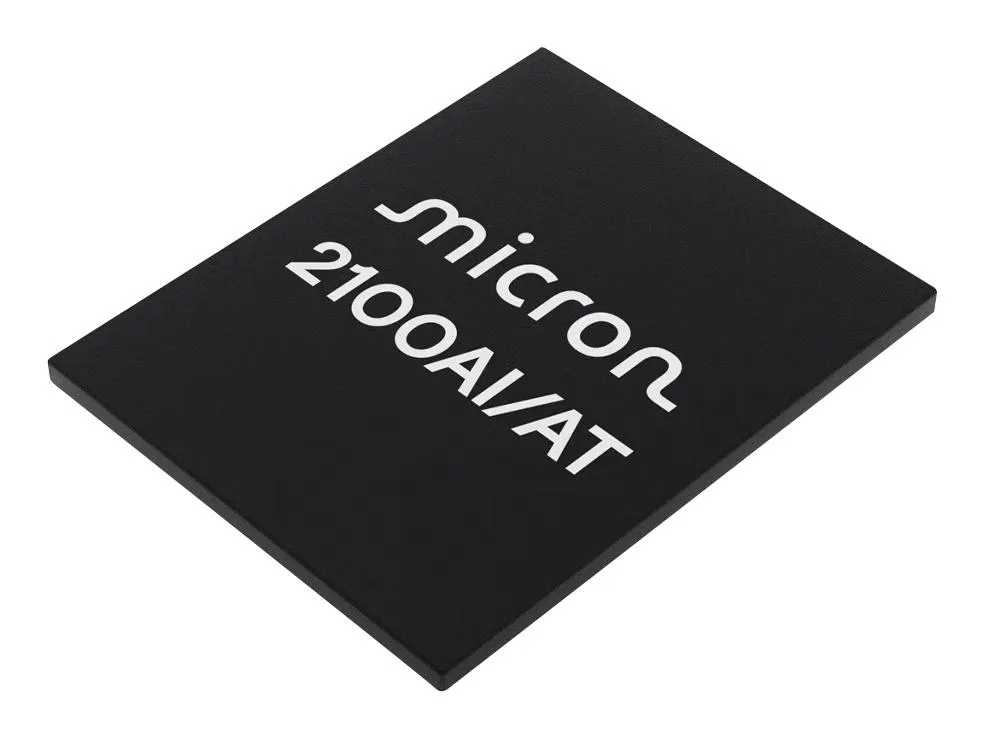
| Model | 2100AI |
| Capacity | 64GB |
| Usage Class | Industrial |
| Host Interface | PCIe Gen3 NVMe |
|---|---|
| Total Interface Bandwidth | 8 Gb/s |
| Form Factor | BGA 1620 |
|---|
| NAND Flash | 3D TLC |
|---|---|
| Drive Writes Per Day | |
| Total Bytes Written | 15 TBW |
| Sequential Read | 1100 MB/s |
|---|---|
| Sequential Write | 200 MB/s |
| Random Read IOPS | 90000 |
| Random Write IOPS | 5000 |
| Average Latency | 85 μs |
| Mean Time Between Failures | 3 Million Hours |
|---|---|
| Uncorrectable Bit Error Rate | 1.0×10⁻¹⁷ |
| Power Loss Protection | Yes |
The Micron 2100AI 64GB (MTFDHBL064TDP-1AT12AIYY) is best suited for compact industrial edge systems, AI gateways, and network appliances that need a small-footprint NVMe boot or read-cache drive with fast startup and responsive metadata access. Compared with typical SATA-class SSDs in the same capacity tier, its PCIe Gen3 NVMe interface and up to 90,000/5,000 random read/write IOPS deliver markedly lower latency for read-heavy workloads, while 3D TLC NAND and 15TB TBW provide the endurance profile needed for controlled embedded deployments.
With an endurance rating of 15 TBW, the MTFDHBL064TDP-1AT12AIYY is well suited for light to moderate write workloads such as OS boot, application hosting, configuration storage, and other read-centric embedded or industrial uses. In practical terms, 15 TBW corresponds to roughly 4 GB of host writes per day over 10 years, giving procurement confidence that it can serve reliably as a system drive in typical low-write deployments. For enterprise-oriented data integrity, built-in power-loss protection helps preserve in-flight data and metadata during unexpected power interruptions, reducing the risk of corruption and improving recovery confidence. Its UBER specification of 1.0E-16, together with a 3-million-hour MTBF, indicates a high standard of read reliability and overall device robustness for long-term dependable operation.
1. The PCIe Gen3 NVMe interface, paired with 1100 MB/s sequential read performance, accelerates OS boot, VM image loading, and large-file access in latency-sensitive enterprise platforms.
2. With 90,000 K IOPS random read capability, the drive sustains fast response under highly fragmented workloads such as OLTP databases, virtual desktop infrastructure, and metadata-heavy applications.
3. An endurance rating of [dwpd] DWPD enables the SSD to handle repeated full-drive writes in write-intensive environments, supporting predictable lifecycle planning and lower replacement risk in enterprise deployments.
4. Built on 3D TLC NAND, the drive balances capacity, cost efficiency, and reliability, making it well suited for mainstream data center workloads that need scalable flash performance without premium media cost.
5. A typical latency of 85 µs helps reduce storage wait time for transactional and real-time services, improving application responsiveness and Quality of Service consistency under mixed workloads.
For the same series as MTFDHBL064TDP-1AT12AIYY 64GB, the nearest lower capacity is 32GB and the nearest higher capacity is 128GB. In this enterprise SSD family, sequential read/write performance and random IOPS are generally very close across these three capacities. The 64GB model sits at the sweet spot of the lineup. Compared with 32GB, it gives much better headroom for OS images, logs, swap, and application growth, reducing early capacity pressure. Compared with 128GB, it preserves nearly the same enterprise-class performance profile while keeping acquisition cost and stranded capacity under tighter control. It is well suited for small boot-tier clusters, such as hosting system drives for about 20 to 30 lightweight servers or edge nodes.
Q: Is MTFDHBL064TDP-1AT12AIYY suitable for a write-heavy database server?
A: Not ideally. With 3D TLC NAND and 15 TBW on a 64GB drive, this model is better suited for boot, read-focused, or light mixed workloads than sustained write-heavy database applications.
Q: How many full drive writes per day can it actually endure over its warranty period?
A: Based on 15 TBW and assuming a 5-year warranty, the drive supports about 0.13 DWPD, equal to roughly 8GB of writes per day or one full rewrite every eight days.
Q: Does it include power loss protection (PLP) and why is that critical?
A: Yes, it includes power loss protection. PLP helps preserve in-flight data and metadata during sudden power failure, which is critical for preventing corruption and maintaining storage integrity in enterprise systems.
Q: What RAID level is recommended for this SSD?
A: RAID 1 or RAID 10 is generally recommended, depending on capacity and performance needs. For write-sensitive environments, avoid RAID 5 unless the workload is light and parity overhead is acceptable.