











 Secure payments
Standard refund policy
Trade Assurance
Secure payments
Standard refund policy
Trade Assurance
| Brand | Micron |
|---|---|
| Model | 2500 |
| Capacity | 2TB |
| Usage Class | Client |
| Host Interface | PCIe Gen4 NVMe |
|---|---|
| Total Interface Bandwidth | 16 Gb/s |
| Form Factor | M.2 2280 |
|---|
| NAND Flash | 232-layer 3D QLC |
|---|---|
| Drive Writes Per Day | |
| Total Bytes Written | 600 TBW |
| Sequential Read | 7100 MB/s |
|---|---|
| Sequential Write | 6000 MB/s |
| Random Read IOPS | 1000000 |
| Random Write IOPS | 1000000 |
| Average Latency | 50 μs |
| Mean Time Between Failures | 2 Million Hours |
|---|---|
| Uncorrectable Bit Error Rate | 1.0×10⁻¹⁷ |
| Power Loss Protection | No |
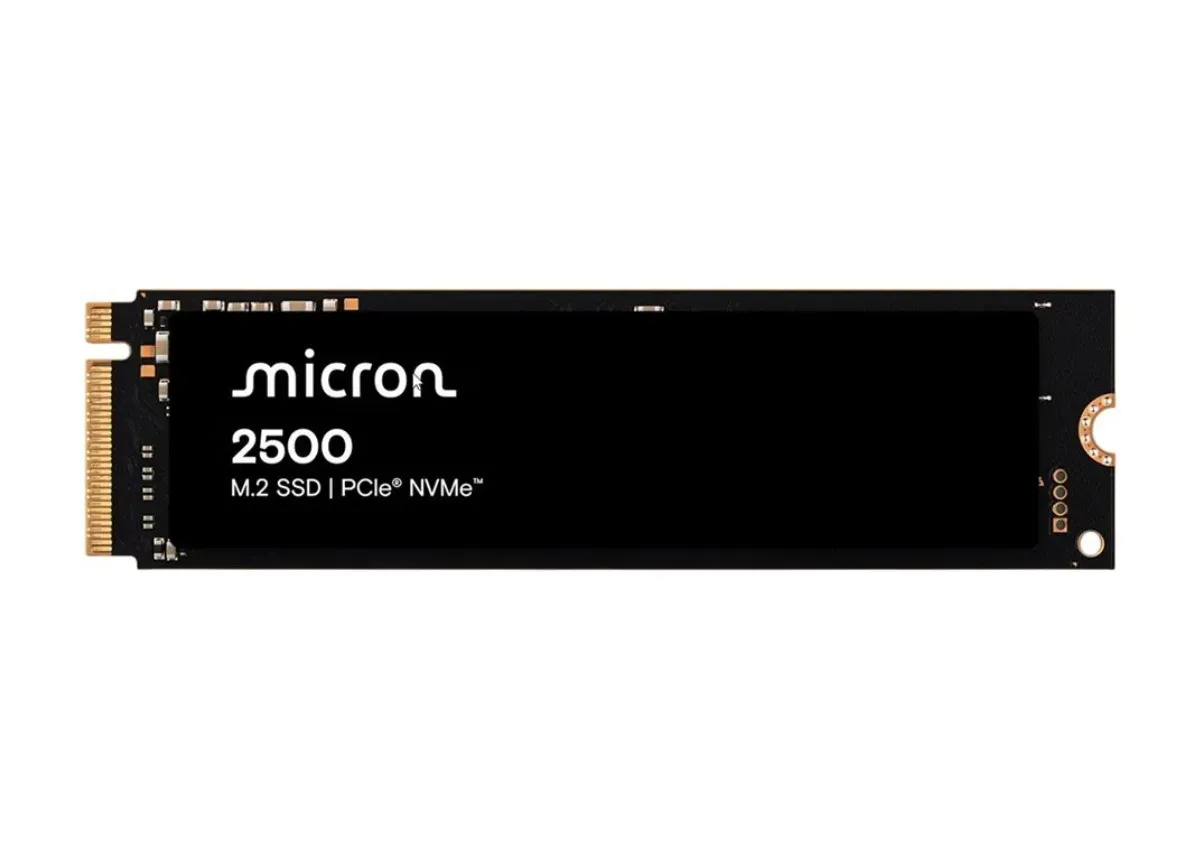
The Micron 2500 2TB (MTFDKBA2T0QGN-1BN15ABYY) is best suited for read-intensive client and edge workloads such as game libraries, content caching, AI dataset staging, and VM image distribution, where its 232-layer 3D QLC delivers strong capacity efficiency without sacrificing PCIe Gen4-class responsiveness. With up to 7100/6000 MB/s sequential performance and 1,000,000/1,000,000 IOPS, it offers a compelling same-tier advantage for capacity-optimized deployments that need near-flagship speed at a lower cost per TB than typical TLC-based alternatives.
With a rated endurance of 600 TBW, the MTFDKBA2T0QGN-1BN15ABYY can comfortably handle typical OS, application, and everyday business data writes over a long service life. In practical terms, for common client or light workstation usage, this level of endurance is generally sufficient for many years of stable operation, making it a dependable choice as a system or boot drive. From a reliability standpoint, the drive is specified at 2 million hours MTBF and an UBER of 1.0E-15, meaning it is designed for consistent operation and a very low rate of unrecoverable read errors under normal conditions. It does not include power-loss protection, so while it is well suited to standard systems with normal shutdown control or upstream power protection, workloads requiring in-flight write protection during sudden power failure should use appropriate system-level safeguards.
1. The PCIe Gen4 NVMe interface gives this drive the bandwidth headroom needed to keep virtualized clusters, analytics nodes, and AI data pipelines fed without creating a storage bottleneck.
2. Its class-leading sequential read performance accelerates large-block workloads such as model loading, backup restoration, and high-speed content streaming in enterprise servers.
3. With exceptionally strong random read capability, the drive is well suited for latency-sensitive databases, large-scale VDI, and metadata-heavy cloud applications that depend on fast small-block access.
4. Built on advanced 232-layer 3D QLC NAND, it enables higher capacity density and better rack-level storage efficiency for read-centric enterprise deployments and warm data tiers.
5. The ultra-low typical latency helps shorten application response times and improves QoS consistency for transactional workloads running at scale in modern data centers.
Within this product family, the nearest lower-capacity reference is 960GB, while the next higher tier is 3.84TB. The 2TB model sits at the sweet spot: compared with 960GB, it gives much more headroom for OS images, logs, containers, and workload growth, reducing early capacity pressure. Compared with 3.84TB, it preserves similar enterprise-class read/write and random IOPS behavior while delivering a better balance of acquisition cost, usable flash, and performance efficiency. It is especially well suited for mid-scale virtualization clusters, such as shared boot and application storage for about 40–60 general-purpose virtual machines.
Q: Is MTFDKBA2T0QGN-1BN15ABYY suitable for a write-heavy database server?
A: Not ideal for write-heavy database workloads. Its 232-layer 3D QLC NAND, 600 TBW endurance, and lack of PLP make it better suited for read-centric, mixed-use, or general-purpose environments.
Q: How many full drive writes per day can it actually endure over its warranty period?
A: Based on 600 TBW and 2TB capacity, it supports about 300 full drive writes total. Assuming a 5-year warranty, that equals roughly 0.16 drive writes per day.
Q: Does it include power loss protection (PLP) and why is that critical?
A: No, it does not include power loss protection. PLP is critical because it helps preserve in-flight data and mapping tables during sudden outages, reducing corruption and unexpected downtime risk.
Q: What RAID level is recommended for this SSD?
A: RAID 1 or RAID 10 is generally recommended for better redundancy and read performance. For capacity-focused deployments, RAID 5 may work, but write penalty and rebuild risk should be considered.