











 Secure payments
Standard refund policy
Trade Assurance
Secure payments
Standard refund policy
Trade Assurance
| Brand | Micron |
|---|---|
| Model | 2600 |
| Capacity | 2000GB |
| Usage Class | Client |
| Host Interface | PCIe Gen4 NVMe |
|---|---|
| Total Interface Bandwidth | 16 Gb/s |
| Form Factor | M.2 2280 |
|---|
| NAND Flash | QLC |
|---|---|
| Drive Writes Per Day | 0.2 |
| Total Bytes Written | 700 TBW |
| Sequential Read | 7200 MB/s |
|---|---|
| Sequential Write | 6500 MB/s |
| Random Read IOPS | 1000000 |
| Random Write IOPS | 1100000 |
| Average Latency | μs |
| Mean Time Between Failures | 2 Million Hours |
|---|---|
| Uncorrectable Bit Error Rate | 1.0×10⁻¹⁷ |
| Power Loss Protection | No |
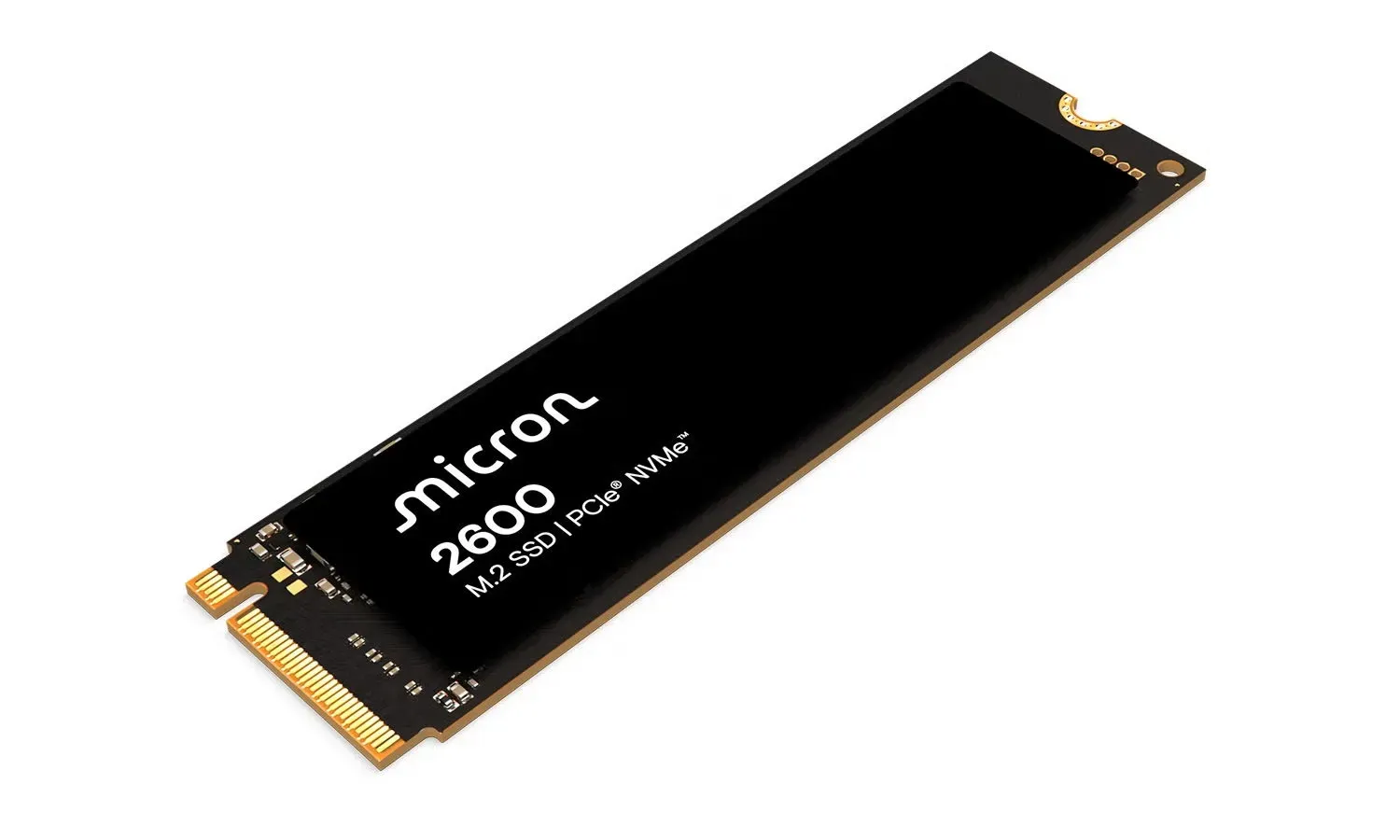
The MTFDKBA2T0QHK-1BQ1AABYYT 2600 2TB pairs PCIe Gen4 throughput of up to 7200/6500 MB/s with 1.0M/1.1M random IOPS, giving read-centric infrastructure a rare combination of QLC density and near-mainstream TLC-class responsiveness. It is best suited for content delivery caches, virtual desktop image repositories, and scale-out cloud storage tiers where its 0.2 DWPD and 700 TBW profile align with predominantly read-heavy duty cycles while maximizing capacity efficiency per slot.
With an endurance rating of 700 TBW and 0.2 DWPD, this 2TB SSD is designed for read-centric and mixed-use environments where daily write volumes are moderate rather than heavy. In practical terms, a typical OS, boot, or general application drive would usually stay well within this limit, making it a solid choice for long-term deployment and easily supporting around 192 GB of host writes per day over a 10-year period. On reliability, the 1.0E-15 UBER specification means the drive is built to maintain a very low uncorrectable bit error rate, which is an important indicator of data integrity in business systems, while the 2-million-hour MTBF further supports dependable continuous operation. This model does not include power-loss protection, so it is best suited to systems with stable power or upstream safeguards such as UPS and application-level journaling, where it can still provide reliable service with the right platform design.
1. The PCIe Gen4 NVMe interface gives this drive the bandwidth and low-overhead command path needed to keep virtualized clusters, AI data pipelines, and high-density storage nodes fed without bus-level bottlenecks.
2. Its top-tier sequential read performance accelerates large-block workloads such as database snapshots, media streaming, backup restores, and model or dataset loading, helping shorten job start times across enterprise platforms.
3. The very high random read capability is ideal for latency-sensitive applications like OLTP databases, metadata-heavy file systems, and large VDI fleets where massive numbers of small requests must be served concurrently.
4. The light write-endurance profile makes it best suited for read-dominant deployments, delivering enterprise NVMe capacity economics for content repositories, warm data tiers, and scale-out analytics environments with limited daily overwrite pressure.
5. Built on QLC NAND with microsecond-class response behavior, the drive is optimized for cost-efficient, high-capacity storage that still maintains responsive access for cloud services, search indexes, and read-focused enterprise workloads.
In this series, the nearest reference capacities are 960GB on the lower side and 3840GB on the higher side, with broadly similar enterprise-class sequential throughput and random IOPS to the 2000GB model. The 2000GB drive sits at the sweet spot of the lineup: it offers meaningfully more headroom than 960GB for OS images, logs, metadata, and workload growth, while avoiding the higher acquisition cost of 3840GB. It is the best-balanced choice for mid-scale virtualization or database clusters, such as hosting system and application storage for roughly 40 to 60 business-critical virtual machines.
Q: Is MTFDKBA2T0QHK-1BQ1AABYYT suitable for a write-heavy database server?
A: This model is generally not recommended for write-heavy database servers. With QLC NAND and 0.2 DWPD endurance, it is better suited for read-intensive, mixed-use, or capacity-focused workloads.
Q: How many full drive writes per day can it actually endure over its warranty period?
A: It is rated for 0.2 DWPD, meaning about 0.4TB of writes per day on a 2TB drive during the warranty period. The total endurance specification is 700TBW.
Q: Does it include power loss protection (PLP) and why is that critical?
A: No, this SSD does not include power loss protection. PLP is critical in enterprise environments because it helps prevent in-flight data loss and reduces metadata corruption during unexpected power failures.
Q: What RAID level is recommended for this SSD?
A: For most deployments, RAID 1 or RAID 10 is recommended to improve redundancy and performance. RAID 5/6 may be used cautiously, but parity writes can increase wear on lower-endurance QLC SSDs.