

 Secure payments
Standard refund policy
Trade Assurance
Secure payments
Standard refund policy
Trade Assurance
| Brand | Micron |
|---|---|
| Model | 2600 |
| Capacity | 512GB |
| Usage Class | Client |
| Host Interface | PCIe Gen4 NVMe |
|---|---|
| Total Interface Bandwidth | 16 Gb/s |
| Form Factor | M.2 2280 |
|---|
| NAND Flash | 3D QLC |
|---|---|
| Drive Writes Per Day | 0.22 |
| Total Bytes Written | 200 TBW |
| Sequential Read | 5000 MB/s |
|---|---|
| Sequential Write | 3000 MB/s |
| Random Read IOPS | 370000 |
| Random Write IOPS | 69000 |
| Average Latency | 50 μs |
| Mean Time Between Failures | 2 Million Hours |
|---|---|
| Uncorrectable Bit Error Rate | 1.0×10⁻¹⁷ |
| Power Loss Protection | No |
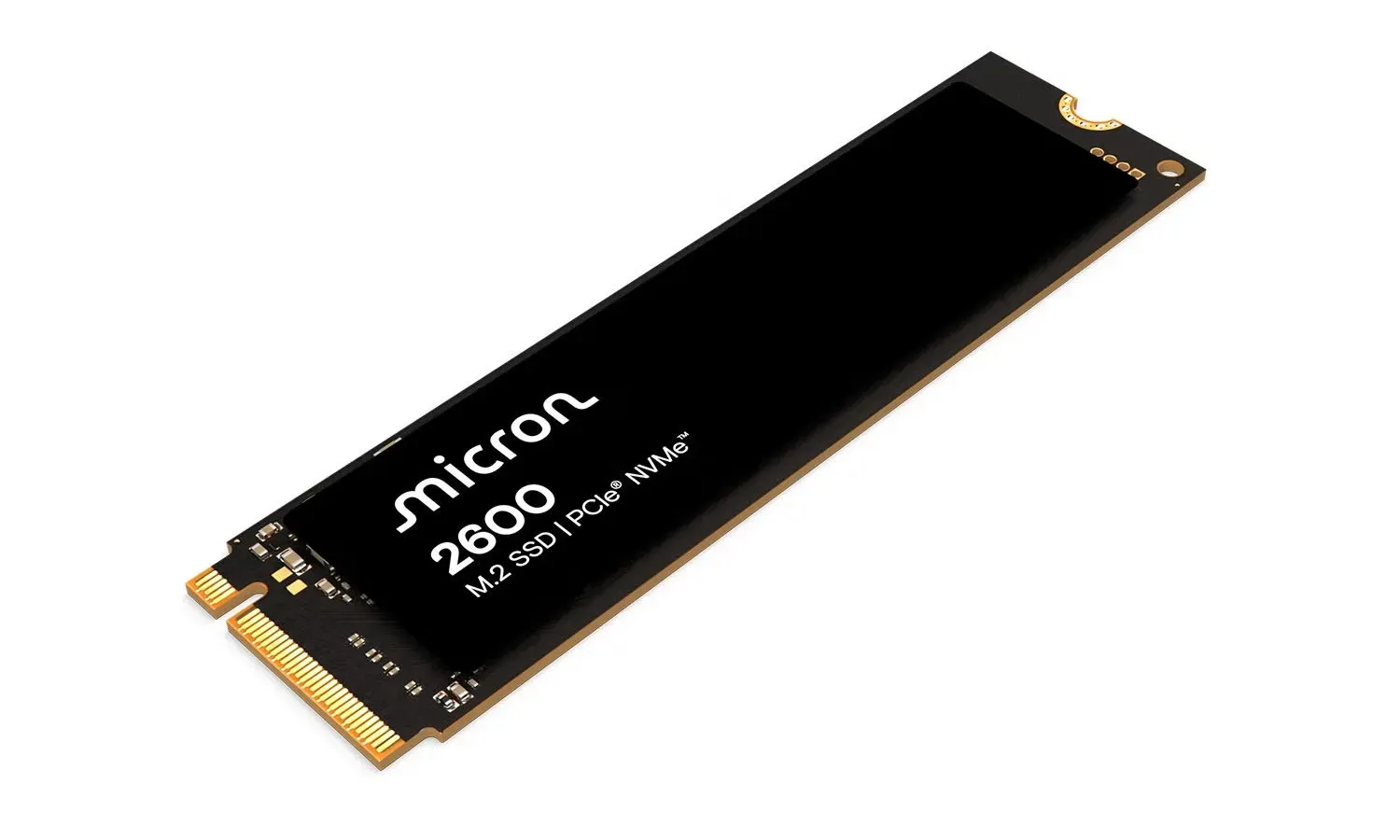
The Micron 2600 512GB (MTFDKBA512QHK-1BQ15ABYYR) is best suited for read-intensive client and edge workloads such as OS boot drives, application distribution caches, and large content libraries, where its PCIe Gen4 NVMe interface delivers up to 5000 MB/s read throughput and 370,000 random-read IOPS with lower-cost 3D QLC media. Compared with typical SATA SSDs and entry Gen3 drives in the same capacity class, it provides substantially higher bandwidth and responsiveness while still sustaining practical write endurance at 200 TBW / 0.22 DWPD for mainstream deployment cycles.
With an endurance rating of 200 TBW, this 512GB SSD can sustain about 55 GB of host writes per day for 10 years, or about 110 GB per day for 5 years, which is well suited for typical OS, application, and general office workloads. In practical terms, for use as a boot or system drive with normal business usage patterns, this endurance level provides a comfortable margin and should not be a concern in day-to-day deployment. The specified UBER of 1.0E-15 means the drive is designed for a very low rate of uncorrectable read errors, supporting dependable data reads in standard enterprise and commercial environments, while the 2 million hour MTBF further reflects strong overall hardware reliability. This model does not include power-loss protection, so it is best suited to systems with stable power or UPS backup where sudden outages are controlled, making it a solid choice for read-intensive and mixed general-purpose workloads rather than write-critical caching or transaction-heavy applications.
1. The PCIe Gen4 NVMe interface provides a modern low-overhead data path that keeps virtualized databases, analytics nodes, and edge servers fed with storage bandwidth instead of waiting on legacy protocol bottlenecks.
2. With sequential read performance of 5000 MB/s, this drive accelerates large-block workloads such as VM image loading, backup restore, and media or dataset streaming in enterprise environments.
3. Delivering 370,000 random-read IOPS with a typical latency of 50 µs, it is well suited for read-intensive applications like content delivery, metadata lookup, and fast-responding cloud services where queue-depth efficiency matters.
4. The 0.22 DWPD endurance profile aligns with mixed-to-read-centric deployment models, helping enterprises maximize capacity economics for scale-out storage tiers that do not require heavy daily overwrite cycles.
5. Built on 3D QLC NAND, the SSD prioritizes high-density flash efficiency, making it a strong fit for cost-optimized enterprise platforms that need substantial capacity for warm data, object storage, and large read-mostly datasets.
Lower capacity reference: 256GB Higher capacity reference: 1TB In this product family, the 512GB model sits at the capacity sweet spot. Compared with the 256GB version, it offers much better headroom for OS images, application stacks, logs, and moderate data growth, reducing early replacement pressure. Compared with the 1TB option, it keeps acquisition cost and fleet-wide budget under tighter control while delivering essentially the same enterprise-class sequential and random performance profile. This makes 512GB especially suitable for mid-scale virtualization clusters, such as boot and workload storage for roughly 40 to 60 general-purpose virtual machines.
Q: Is MTFDKBA512QHK-1BQ15ABYYR suitable for a write-heavy database server?
A: No. With 3D QLC NAND, 0.22 DWPD, and 200 TBW, this model is better suited for read-centric or mixed workloads rather than write-heavy database server environments.
Q: How many full drive writes per day can it actually endure over its warranty period?
A: It is rated for 0.22 DWPD, meaning about 0.22 full drive writes per day. For a 512GB SSD, that equals roughly 113GB of writes daily over warranty.
Q: Does it include power loss protection (PLP) and why is that critical?
A: No, it does not include PLP. This matters because PLP helps protect in-flight data and metadata during sudden power loss, which is especially important for enterprise and transactional workloads.
Q: What RAID level is recommended for this SSD?
A: For general deployment, RAID 1 or RAID 10 is recommended to improve redundancy and performance. For capacity-focused use, RAID 5 may be considered, but write overhead should be evaluated.