











 Secure payments
Standard refund policy
Trade Assurance
Secure payments
Standard refund policy
Trade Assurance
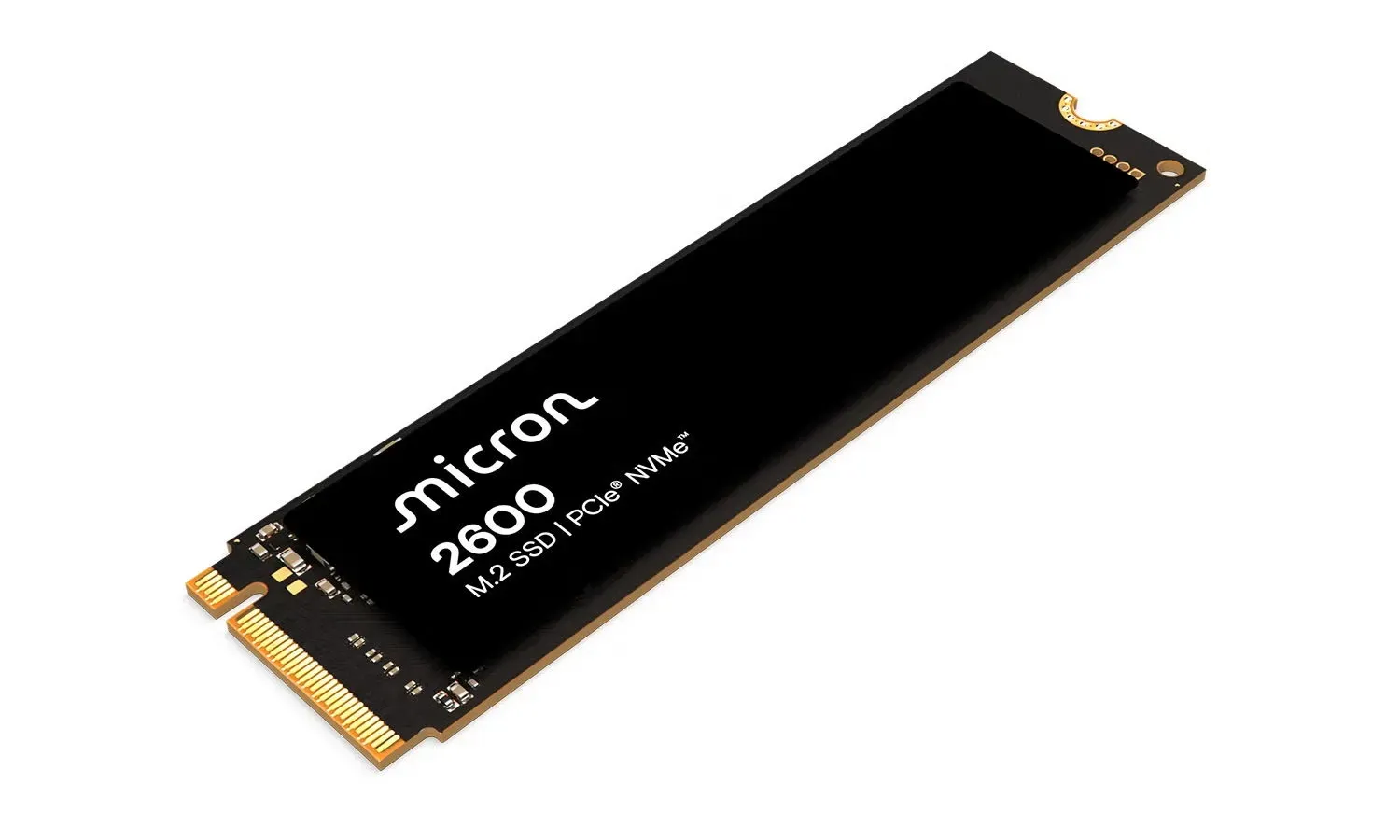
| Brand | Micron |
|---|---|
| Model | 2600 |
| Capacity | 512GB |
| Usage Class | Client |
| Host Interface | PCIe Gen4 NVMe |
|---|---|
| Total Interface Bandwidth | 16 Gb/s |
| Form Factor | M.2 2280 |
|---|
| NAND Flash | QLC |
|---|---|
| Drive Writes Per Day | 0.2 |
| Total Bytes Written | 175 TBW |
| Sequential Read | 7000 MB/s |
|---|---|
| Sequential Write | 4200 MB/s |
| Random Read IOPS | 570000 |
| Random Write IOPS | 750000 |
| Average Latency | μs |
| Mean Time Between Failures | 2 Million Hours |
|---|---|
| Uncorrectable Bit Error Rate | 1.0×10⁻¹⁷ |
| Power Loss Protection | No |
The Micron 2600 512GB (MTFDKBA512QHK-1BQ15ABYYT) is best suited for read-centric client and edge workloads such as OS boot drives, application launch acceleration, local content caching, and VDI endpoints, where its PCIe Gen4 performance of up to 7000/4200 MB/s and 570K/750K IOPS delivers noticeably faster responsiveness than typical value-tier QLC SSDs. With 175 TBW endurance at 0.2 DWPD, it offers a well-balanced combination of capacity efficiency, high random write capability, and Gen4 bandwidth that makes it a strong choice when maximizing user experience per watt and per gigabyte matters more than mixed-write enterprise endurance.
With an endurance rating of 175 TBW and 0.2 DWPD, this 512GB SSD is well suited for read-intensive and light-write workloads such as OS boot, office applications, thin clients, POS systems, and embedded/edge devices. In practical terms, a typical system-drive workload of around 40–50 GB of writes per day would keep the drive comfortably within its rated endurance for about 10 years, providing ample margin for normal operating use. For reliability, the drive is rated at 2 million hours MTBF and an UBER of 1.0E-15, meaning the probability of an unrecoverable bit error is extremely low and aligned with dependable business-class data integrity expectations. This model does not include power-loss protection, so while it is a strong fit for stable-power environments, applications requiring protection for in-flight writes during sudden outages should pair it with a UPS or select a PLP-enabled model.
1. The PCIe Gen4 NVMe interface provides the bandwidth headroom needed for modern virtualization, analytics, and scale-out storage platforms, reducing data-access bottlenecks across dense enterprise workloads.
2. With sequential read performance of 7000 MB/s, this SSD accelerates large-block operations such as database snapshot loading, media streaming, and backup recovery to shorten service wait times.
3. Delivering 570,000 K IOPS in random reads, it is well suited for metadata-heavy applications like OLTP databases and high-concurrency VM environments where fast small-block access drives user experience.
4. Rated at 0.2 DWPD and built on QLC NAND, the drive is optimized for read-centric enterprise deployments that prioritize high capacity and cost efficiency over intensive daily overwrite cycles.
5. A typical latency of [latency] µs helps sustain responsive application behavior under pressure, supporting faster transaction handling and more predictable QoS in shared infrastructure.
For the MTFDKBA512QHK-1BQ15ABYYT 512GB enterprise SSD, the nearest same-series reference capacities are typically 256GB on the lower side and 1TB on the higher side, with broadly similar sequential throughput and random IOPS under normal enterprise positioning. Within the family, 512GB is the sweet-spot capacity. Compared with 256GB, it gives much better headroom for OS images, logs, patch growth, and overprovisioning margin. Compared with 1TB, it usually delivers the best balance of acquisition cost, usable capacity, and consistent enterprise performance. It is well suited for mid-scale virtualization clusters, such as hosting boot and application volumes for about 40 to 60 business service instances.
Q: Is MTFDKBA512QHK-1BQ15ABYYT suitable for a write-heavy database server?
A: No. This 512GB PCIe Gen4 NVMe SSD uses QLC NAND and is rated at 0.2 DWPD, so it is better suited for read-centric or mixed workloads, not write-heavy database servers.
Q: How many full drive writes per day can it actually endure over its warranty period?
A: It is rated for 0.2 DWPD, meaning about 0.2 full drive writes per day over the warranty period. For a 512GB model, that equals roughly 102GB of writes daily.
Q: Does it include power loss protection (PLP) and why is that critical?
A: No, it does not include power loss protection. PLP is critical in enterprise environments because it helps protect in-flight data and metadata during sudden power failure, reducing corruption risk.
Q: What RAID level is recommended for this SSD?
A: For this SSD, RAID 1 or RAID 10 is typically recommended when data protection and availability matter. These levels help improve redundancy, especially since the drive does not include PLP.