











 Secure payments
Standard refund policy
Trade Assurance
Secure payments
Standard refund policy
Trade Assurance
| Brand | Micron |
|---|---|
| Model | 2450 |
| Capacity | 512GB |
| Usage Class | Client |
| Host Interface | PCIe Gen4 x4 |
|---|---|
| Total Interface Bandwidth | 16 Gb/s |
| Form Factor | M.2 2280 |
|---|
| NAND Flash | 3D TLC |
|---|---|
| Drive Writes Per Day | |
| Total Bytes Written | 180 TBW |
| Sequential Read | 3600 MB/s |
|---|---|
| Sequential Write | 3000 MB/s |
| Random Read IOPS | 380000 |
| Random Write IOPS | 500000 |
| Average Latency | μs |
| Mean Time Between Failures | 2 Million Hours |
|---|---|
| Uncorrectable Bit Error Rate | 1.0×10⁻¹⁷ |
| Power Loss Protection | No |
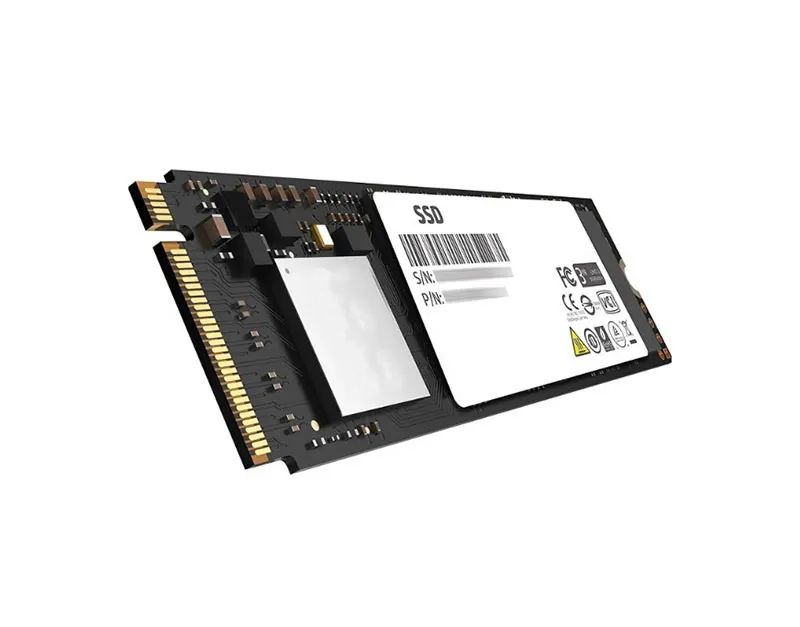
The Micron 2450 512GB (MTFDKBA512TFK-1BC15ABYY) is a strong fit for thin-and-light client systems, developer notebooks, and virtual desktop images that need PCIe Gen4 responsiveness, delivering up to 3600/3000 MB/s sequential performance and 380K/500K IOPS from efficient 3D TLC NAND. Its distinctive value in this class is the balance of Gen4 x4 throughput with 180 TBW endurance at 512GB, making it especially well suited for OS, application, and mixed read/write productivity workloads where consistent low-latency performance matters more than peak capacity.
With an endurance rating of 180 TBW, this 512GB SSD can sustain about 49GB of host writes per day for 10 years, which is more than sufficient for typical OS, boot, office, and general-purpose edge or embedded workloads. In practical terms, for use as a system drive rather than a heavy write-cache or data-logging drive, this endurance level provides comfortable long-term write headroom. This model does not include power-loss protection (PLP), so it is best suited to applications where unexpected power interruption during active writes is uncommon or where the system already has stable backup power and file-system safeguards. Its UBER of 1.0E-15 indicates a very low rate of unrecoverable read errors, supporting dependable data integrity in normal operation, while the 2 million hour MTBF further reflects a strong baseline reliability profile.
1. The PCIe Gen4 x4 interface provides the bandwidth headroom needed to keep virtualized databases, analytics pipelines, and GPU-fed application servers from being constrained by storage traffic.
2. Its strong sequential read performance speeds up large-block data movement, reducing wait time for backup recovery, media streaming, and high-capacity dataset loading in enterprise environments.
3. The high random read capability enables faster response under mixed and metadata-heavy workloads, making it well suited for OLTP databases, VDI boot storms, and read-intensive cloud services.
4. With a durability rating of [dwpd] DWPD, the drive is built to sustain consistent daily write pressure, helping enterprises deploy it confidently in always-on transactional and logging workloads.
5. Built on 3D TLC NAND and paired with a typical latency of [latency] µs, it balances capacity efficiency with predictable responsiveness for scale-out infrastructure and latency-sensitive business applications.
Lower-capacity reference: 480GB Higher-capacity reference: 960GB In this enterprise SSD family, the 512GB model sits at a practical sweet spot. Compared with the 480GB option, it gives more headroom for OS images, logs, metadata, and short-term workload growth without materially changing the familiar enterprise-grade sequential throughput or random IOPS profile. Compared with the 960GB model, it usually offers a better balance between acquisition cost, usable capacity, and performance consistency. It is especially well suited for mid-scale virtualization or container platforms, such as serving as boot and application storage for about 40 to 60 business application instances.
Q: Is MTFDKBA512TFK-1BC15ABYY suitable for a write-heavy database server?
A: Not ideally. With 3D TLC NAND, 180 TBW endurance, and no power loss protection, this 512GB PCIe Gen4 SSD is better suited to read-intensive or mixed workloads than heavy-write database environments.
Q: How many full drive writes per day can it actually endure over its warranty period?
A: Based on 180 TBW total endurance, the drive supports about 0.19 DWPD over a 5-year warranty, which equals roughly 98GB of host writes per day, not one full drive write daily.
Q: Does it include power loss protection (PLP) and why is that critical?
A: No, this model does not include PLP. That matters because PLP helps protect in-flight data and mapping tables during unexpected power loss, reducing corruption risk in enterprise and database applications.
Q: What RAID level is recommended for this SSD?
A: For database or business-critical use, RAID 10 is generally recommended for the best balance of performance, redundancy, and rebuild safety. RAID 1 is also acceptable for smaller deployments requiring simple mirroring.