











 Secure payments
Standard refund policy
Trade Assurance
Secure payments
Standard refund policy
Trade Assurance
| Brand | Micron |
|---|---|
| Model | 2450 |
| Capacity | 512GB |
| Usage Class | Client |
| Host Interface | PCIe Gen4 x4 |
|---|---|
| Total Interface Bandwidth | 16 Gb/s |
| Form Factor | M.2 2280 |
|---|
| NAND Flash | 3D TLC |
|---|---|
| Drive Writes Per Day | |
| Total Bytes Written | 180 TBW |
| Sequential Read | 3600 MB/s |
|---|---|
| Sequential Write | 3000 MB/s |
| Random Read IOPS | 380000 |
| Random Write IOPS | 500000 |
| Average Latency | μs |
| Mean Time Between Failures | 2 Million Hours |
|---|---|
| Uncorrectable Bit Error Rate | 1.0×10⁻¹⁷ |
| Power Loss Protection | No |
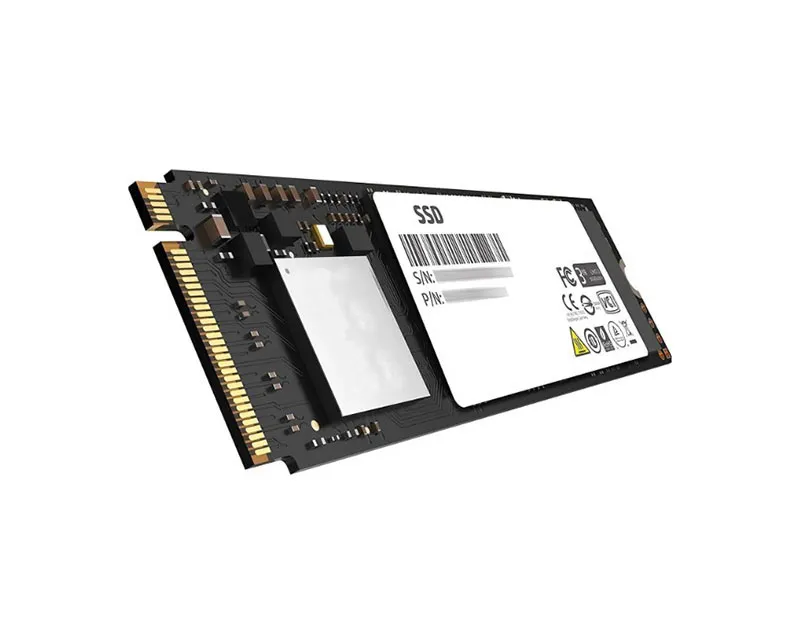
The Micron 2450 512GB (MTFDKBA512TFK) is best suited for OS boot, application launch, and read-intensive edge or client compute workloads where PCIe Gen4 x4 bandwidth, 3D TLC reliability, and a 180TB endurance rating must be balanced within a compact capacity point. With up to 3600/3000 MB/s sequential performance and 380K/500K IOPS random throughput, it delivers a strong step up over typical Gen3-class drives in responsiveness and queue-depth efficiency for modern notebooks, thin clients, and embedded systems.
With an endurance rating of 180 TBW, this SSD can sustain about 49 GB of host writes per day for 10 years, which is comfortably sufficient for typical OS, boot, office, and general-purpose edge or embedded workloads. In practical procurement terms, it is a solid fit as a system drive where write volumes are moderate and predictable, rather than a heavy write-intensive logging or database device. Its specified UBER of 1.0E-15 indicates a very low probability of uncorrectable bit errors, supporting dependable data integrity in normal operation, while the 2 million hour MTBF further reflects a mature and stable hardware platform. This model does not include power-loss protection (PLP), so it is best deployed in systems with controlled shutdown behavior, UPS backing, or applications that do not rely on in-flight write preservation during sudden power interruption.
1. The PCIe Gen4 x4 interface, paired with strong sequential read bandwidth, accelerates VM boot storms, large database scans, and analytics pipelines by reducing time spent waiting on storage.
2. With up to 380,000 random-read IOPS, this drive sustains responsive performance for metadata-heavy workloads such as OLTP databases, virtualized infrastructure, and high-concurrency cloud services.
3. A [dwpd] DWPD endurance rating makes it suitable for write-intensive enterprise environments where predictable lifespan and lower replacement risk are critical to uptime planning.
4. Built on 3D TLC NAND, it balances enterprise-grade capacity, performance consistency, and cost efficiency, making it a practical fit for mainstream server and storage deployments.
5. A typical latency of [latency] µs helps minimize application response time, which is especially valuable for latency-sensitive workloads like real-time transaction processing and interactive services.
In the same product family, the nearest lower-capacity option is 256GB, and the next higher-capacity option is 1TB. As is typical for enterprise SSD lineups, sequential read/write throughput and random IOPS remain broadly similar across these three capacities, with differences driven more by workload conditions than by nominal capacity. The 512GB model sits at the sweet spot of the series. Compared with 256GB, it gives much better headroom for OS images, logs, hot data, and application growth without frequent capacity pressure. Compared with 1TB, it delivers a more attractive cost-to-performance balance while preserving essentially the same enterprise-class responsiveness. It is especially well suited for mid-scale virtualization clusters, such as shared boot and utility storage for about 40 to 60 virtual machines.
Q: Is MTFDKBA512TFK suitable for a write-heavy database server?
A: Not ideally. With 3D TLC NAND, 180 TBW endurance, and no power loss protection, this 512GB PCIe Gen4 x4 SSD is better for read-intensive or mixed workloads than write-heavy databases.
Q: How many full drive writes per day can it actually endure over its warranty period?
A: Based on 180 TBW and assuming a 5-year warranty, the drive supports about 0.19 DWPD, equal to roughly one full drive write every five days on average.
Q: Does it include power loss protection (PLP) and why is that critical?
A: No, it does not include PLP. This matters because PLP helps protect in-flight data and mapping tables during sudden outages, reducing corruption risk in enterprise or transactional environments.
Q: What RAID level is recommended for this SSD?
A: For most business deployments, RAID 1 or RAID 10 is recommended to improve redundancy and availability. RAID 10 is preferable for better performance, but a UPS is strongly advised.