











 Secure payments
Standard refund policy
Trade Assurance
Secure payments
Standard refund policy
Trade Assurance
| Brand | Micron |
|---|---|
| Model | 7450 MAX |
| Capacity | 800GB |
| Usage Class | Enterprise |
| Host Interface | PCIe Gen4 NVMe |
|---|---|
| Total Interface Bandwidth | 16 Gb/s |
| Form Factor | M.2 2280 |
|---|
| NAND Flash | 3D TLC |
|---|---|
| Drive Writes Per Day | 3 |
| Total Bytes Written | 4380 TBW |
| Sequential Read | 5500 MB/s |
|---|---|
| Sequential Write | 1500 MB/s |
| Random Read IOPS | 530000 |
| Random Write IOPS | 170000 |
| Average Latency | 80 μs |
| Mean Time Between Failures | 2 Million Hours |
|---|---|
| Uncorrectable Bit Error Rate | 1.0×10⁻¹⁷ |
| Power Loss Protection | Yes |
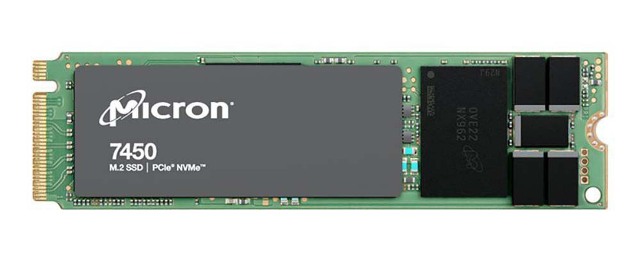
The Micron 7450 MAX 800GB is purpose-built for write-intensive, latency-sensitive workloads such as database journaling, metadata acceleration, log ingestion, and mixed OLTP at the edge, combining 3 DWPD endurance with 4,380 TBW in a compact PCIe Gen4 NVMe platform. Compared with mainstream read-optimized SSDs in the same class, it delivers a stronger balance of sustained durability and predictable QoS, while still reaching up to 5,500 MB/s read and 530K/170K random read/write IOPS for consistently responsive performance.
With an endurance rating of 4,380 TBW and 3 DWPD, the MTFDKBA800TFS-1BC1ZABYYR is designed for sustained enterprise write activity and can comfortably support typical server or system-drive workloads over many years of operation. In practical terms, for OS, application, boot, and general mixed enterprise workloads, this level of endurance provides ample margin for long-term deployment and helps minimize concerns about write wear during the product’s service life. Its enterprise reliability profile is further strengthened by power-loss protection, which helps preserve in-flight data and metadata during unexpected power interruptions, reducing the risk of corruption and unclean shutdown effects. An UBER of 1.0E-17 and an MTBF of 2 million hours indicate a very low probability of unrecoverable read errors and strong overall hardware reliability, which are important for procurement teams evaluating data integrity and operational stability.
1. The PCIe Gen4 NVMe interface removes storage as a bottleneck in modern servers, enabling faster data pipelines and higher VM or container density in latency-sensitive enterprise platforms.
2. Its strong sequential read performance accelerates large-block workloads such as database backup, media streaming, and analytics scans, helping shorten job completion windows in production environments.
3. The high random read capability supports transaction-heavy applications like OLTP databases, virtual desktop infrastructure, and metadata-intensive cloud services with consistently responsive access under concurrency.
4. With an endurance profile built for sustained daily drive writes, it is well suited for write-active enterprise deployments that require predictable lifespan, lower replacement risk, and stable service levels over time.
5. The 3D TLC NAND design, paired with very low typical latency, balances capacity, cost efficiency, and responsiveness for enterprise workloads that need both scalable flash economics and fast time-to-data.
Lower-capacity reference: 400GB Higher-capacity reference: 1.6TB In this product family, the 800GB model sits at a practical sweet spot. Compared with the 400GB option, it gives meaningfully more headroom for OS images, application binaries, logs, and short-term data growth, reducing the risk of early capacity pressure. Compared with the 1.6TB version, it typically preserves similar enterprise-class sequential throughput and random IOPS while offering a more balanced acquisition cost per drive. This makes 800GB especially well suited for mid-scale virtualization clusters, such as shared boot and application storage for roughly 40 to 60 general-purpose virtual machines.
Q: Is MTFDKBA800TFS-1BC1ZABYYR suitable for a write-heavy database server?
A: Yes. With 3 DWPD endurance, 4380 TBW, 3D TLC NAND, PCIe Gen4 NVMe, and 80 µs typical latency, it is well suited for write-intensive database and transactional server workloads.
Q: How many full drive writes per day can it actually endure over its warranty period?
A: This model is rated for 3 drive writes per day. For an 800GB SSD, that equals about 2.4TB of writes daily across the specified warranty period under normal enterprise conditions.
Q: Does it include power loss protection (PLP) and why is that critical?
A: Yes, it includes power loss protection. PLP helps preserve in-flight data and metadata during unexpected outages, reducing corruption risk and improving reliability for databases, RAID arrays, and enterprise servers.
Q: What RAID level is recommended for this SSD?
A: RAID 1, 10, or 5/6 can be used depending on priorities. For database workloads, RAID 10 is typically recommended because it offers strong performance, redundancy, and faster rebuild behavior.