











 Secure payments
Standard refund policy
Trade Assurance
Secure payments
Standard refund policy
Trade Assurance
| Brand | Micron |
|---|---|
| Model | 2500 |
| Capacity | 1TB |
| Usage Class | Client |
| Host Interface | PCIe Gen4 NVMe |
|---|---|
| Total Interface Bandwidth | 16 Gb/s |
| Form Factor | M.2 2230 |
|---|
| NAND Flash | 232-layer 3D QLC |
|---|---|
| Drive Writes Per Day | |
| Total Bytes Written | 300 TBW |
| Sequential Read | 7100 MB/s |
|---|---|
| Sequential Write | 5800 MB/s |
| Random Read IOPS | 900000 |
| Random Write IOPS | 1000000 |
| Average Latency | 50 μs |
| Mean Time Between Failures | 2 Million Hours |
|---|---|
| Uncorrectable Bit Error Rate | 1.0×10⁻¹⁷ |
| Power Loss Protection | No |
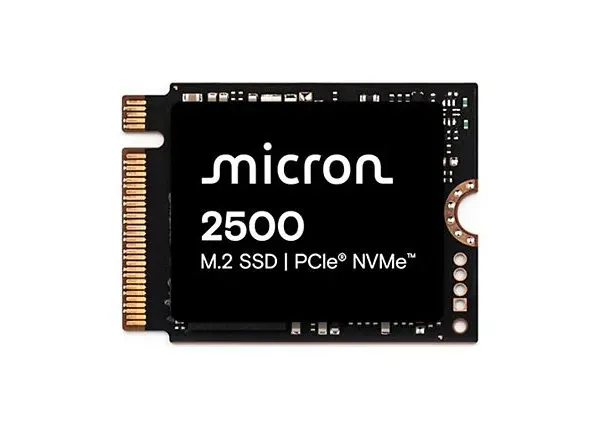
The Micron 2500 1TB (MTFDKBK1T0QGN-1BN1AABYYT) is best suited for read-intensive client and edge workloads such as game libraries, media creation scratch space, and content distribution cache tiers, where its 232-layer 3D QLC delivers 7,100/5,800 MB/s and up to 900K/1,000K IOPS on a PCIe Gen4 NVMe interface. Compared with typical value-tier Gen4 SSDs, it stands out by pairing higher-end sequential and random performance with 300 TBW endurance, making it a strong choice when maximizing capacity-per-dollar without giving up responsiveness.
With an endurance rating of 300 TBW, this 1TB SSD can sustain about 82 GB of host writes per day for 10 years, which is well above the write volume of most OS, boot, and general business application workloads. In practical terms, for typical client or light business use, it is well suited as a long-life system drive and should provide worry-free service over its intended deployment cycle. For reliability, the drive is rated at 2 million hours MTBF and an UBER of 1.0E-15, meaning the probability of an uncorrectable bit error is extremely low and consistent with dependable data integrity in normal operation. This model does not include power-loss protection, so while it is a strong choice for read-centric and standard endpoint workloads, applications requiring in-flight write protection during sudden power failure should use systems with backup power or select a PLP-equipped SSD.
1. The PCIe Gen4 NVMe interface provides the bandwidth and parallelism needed to keep virtualized databases, analytics nodes, and scale-out cloud platforms fed without creating a storage bottleneck.
2. With sequential reads up to 7100 MB/s, this drive accelerates large-block workloads such as backup restores, media streaming, and AI dataset loading, reducing wait time for data-heavy operations.
3. Delivering 900,000 K IOPS in random reads, it is well suited for latency-sensitive enterprise applications like OLTP, metadata services, and high-concurrency VM environments where fast small-block access drives overall responsiveness.
4. Built on 232-layer 3D QLC NAND, it offers high-capacity flash economics for read-centric enterprise deployments, helping lower cost per terabyte in content repositories, object storage, and warm-data tiers.
5. A typical latency of 50 µs helps shorten application response paths, which is especially valuable for real-time indexing, cache-tier acceleration, and user-facing services that depend on consistent low-latency reads.
For MPN MTFDKBK1T0QGN-1BN1AABYYT, the closest lower-capacity reference in the same enterprise SSD family is 960GB, and the next higher tier is 1.92TB. The 1TB class sits at the sweet spot of the lineup: compared with 960GB, it gives more headroom for OS growth, logs, metadata, and workload bursts; compared with 1.92TB, it preserves nearly the same enterprise-grade read/write and random IOPS profile while keeping acquisition cost and $/IOPS efficiency more balanced. It is well suited for a mid-size virtualization cluster supporting about 40–60 mixed application VMs.
Q: Is MTFDKBK1T0QGN-1BN1AABYYT suitable for a write-heavy database server?
A: This model is generally not recommended for write-heavy database servers. Its 232-layer 3D QLC NAND, 300 TBW endurance, and lack of PLP make it better suited to read-focused or light mixed workloads.
Q: How many full drive writes per day can it actually endure over its warranty period?
A: Based on 300 TBW and 1TB capacity, it supports about 300 full drive writes total. Assuming a 5-year warranty, that equals roughly 0.16 DWPD, or one full drive write every six days.
Q: Does it include power loss protection (PLP) and why is that critical?
A: No, this SSD does not include power loss protection. PLP is critical in server environments because it helps protect in-flight data and metadata during unexpected power failures, reducing corruption risk.
Q: What RAID level is recommended for this SSD?
A: For this SSD, RAID 1 or RAID 10 is typically recommended, especially for business use. These levels improve redundancy and read performance while avoiding the heavier parity-write overhead of RAID 5 or RAID 6.