











 Secure payments
Standard refund policy
Trade Assurance
Secure payments
Standard refund policy
Trade Assurance
| Brand | Micron |
|---|---|
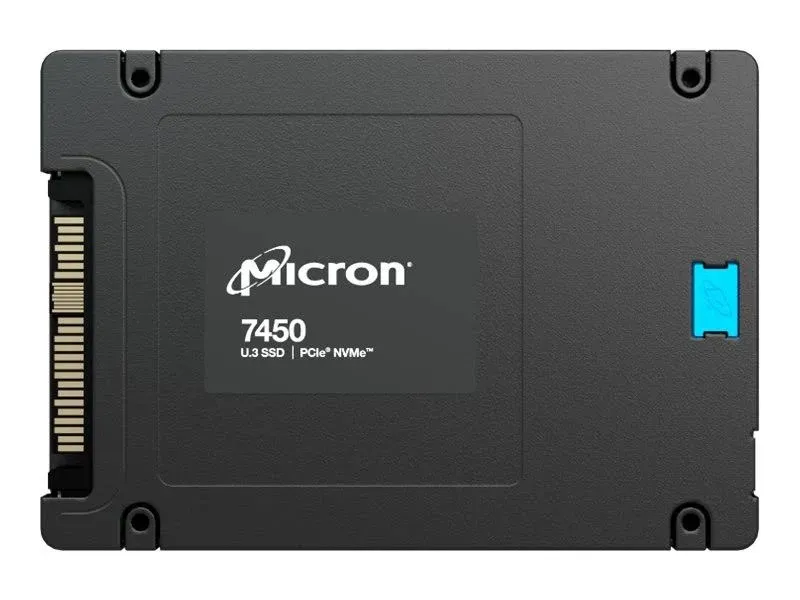
| Model | 7450 PRO |
| Capacity | 960GB |
| Usage Class | Enterprise |
| Host Interface | NVMe |
|---|---|
| Total Interface Bandwidth | 64 Gb/s |
| Form Factor | E1.S |
|---|
| NAND Flash | 176-layer 3D TLC |
|---|---|
| Drive Writes Per Day | 1 |
| Total Bytes Written | 1752 TBW |
| Sequential Read | 5000 MB/s |
|---|---|
| Sequential Write | 1100 MB/s |
| Random Read IOPS | 430000 |
| Random Write IOPS | 45000 |
| Average Latency | 80 μs |
| Mean Time Between Failures | 2 Million Hours |
|---|---|
| Uncorrectable Bit Error Rate | 1.0×10⁻¹⁷ |
| Power Loss Protection | Yes |
Compared with the previous-generation MTFDKCB960TFS-1BC15ABYY, the Micron 7450 PRO 960GB (MTFDKCB960TFR-1BC1ZABYY) advances to 176-layer 3D TLC and delivers a balanced NVMe profile of 5000 MB/s read, 1100 MB/s write, and 430K/45K IOPS, making it a stronger fit for mixed enterprise boot, read-centric virtualization, and metadata-intensive server workloads. Its 1 DWPD endurance and 1752 TBW give engineers a dependable upgrade path over the prior MPN, with a more modern NAND platform that improves deployment longevity and platform efficiency versus older generation drives in the same capacity class.
With an endurance rating of 1,752 TBW and 1 DWPD, the MTFDKCB960TFR-1BC1ZABYY is designed to support writing the full 960GB capacity once per day for five years, which is a strong fit for sustained enterprise use. Under typical OS, boot, or read-centric application workloads that often generate far less daily write volume, this level of endurance means the drive can comfortably serve as a system disk for 10 years or more without endurance being a practical concern. Its built-in power loss protection (PLP) helps preserve in-flight data and metadata during unexpected power interruptions, reducing the risk of corruption and improving operational resilience. The ultra-low UBER of 1.0E-17 means the probability of an unrecoverable bit error is extremely low, giving procurement teams added confidence in data integrity for business-critical environments.
1. The NVMe interface removes legacy storage bottlenecks, enabling far faster host communication for virtualized infrastructure, database acceleration, and latency-sensitive enterprise applications.
2. Its high sequential read throughput speeds up large-block data movement, reducing wait time for analytics scans, backup restores, and content delivery workloads.
3. Strong random read performance helps the drive sustain heavy small-block access patterns, improving responsiveness in OLTP databases, metadata services, and dense VM environments.
4. Built on 176-layer 3D TLC NAND and rated for one full drive write per day, it delivers a practical balance of flash density, cost efficiency, and write endurance for mainstream enterprise deployments.
5. With typical latency in the tens of microseconds, the drive supports faster transaction turnaround and more predictable QoS for real-time and mixed-workload servers.
For MPN MTFDKCB960TFR-1BC1ZABYY (960GB), the nearest lower-capacity reference in the same enterprise SSD family is typically 480GB, while the next higher-capacity option is commonly 1.92TB. The 960GB model sits at the sweet spot of the lineup: compared with 480GB, it offers much better headroom for OS images, logs, metadata, and application growth; compared with 1.92TB, it delivers a stronger balance of acquisition cost, usable capacity, and broadly similar enterprise-class read/write and random IOPS behavior. It is well suited for mid-scale virtualization clusters, such as hosting boot and utility volumes for about 40 to 60 virtual machines.
Q: Is MTFDKCB960TFR-1BC1ZABYY suitable for a write-heavy database server?
A: Yes, it is suitable for write-intensive database workloads. With 1 DWPD, 1752 TBW endurance, NVMe performance, 176-layer 3D TLC NAND, and PLP, it supports reliable enterprise write-heavy operation.
Q: How many full drive writes per day can it actually endure over its warranty period?
A: This model is rated for 1 DWPD, meaning it can sustain one full 960GB drive write per day throughout its warranty period, aligning with its specified 1752 TB total endurance.
Q: Does it include power loss protection (PLP) and why is that critical?
A: Yes, it includes power loss protection. PLP helps preserve in-flight data and metadata during unexpected outages, reducing corruption risk and improving reliability in servers, databases, and transactional workloads.
Q: What RAID level is recommended for this SSD?
A: RAID 1, RAID 10, or RAID 5/6 may be selected depending on performance, redundancy, and capacity goals. For database servers, RAID 10 is commonly recommended for balanced speed and fault tolerance.