

 Secure payments
Standard refund policy
Trade Assurance
Secure payments
Standard refund policy
Trade Assurance
| Brand | Micron |
|---|---|
| Model | 9400 PRO |
| Capacity | 15.36TB |
| Usage Class | Read-Intensive |
| Host Interface | PCIe Gen4 NVMe |
|---|---|
| Total Interface Bandwidth | 16 Gb/s |
| Form Factor | U.3 15mm |
|---|
| NAND Flash | 176-layer 3D TLC |
|---|---|
| Drive Writes Per Day | 1 |
| Total Bytes Written | 28032 TBW |
| Sequential Read | 7000 MB/s |
|---|---|
| Sequential Write | 7000 MB/s |
| Random Read IOPS | 1600000 |
| Random Write IOPS | 300000 |
| Average Latency | 77 μs |
| Mean Time Between Failures | 2 Million Hours |
|---|---|
| Uncorrectable Bit Error Rate | 1.0×10⁻¹⁷ |
| Power Loss Protection | Yes |
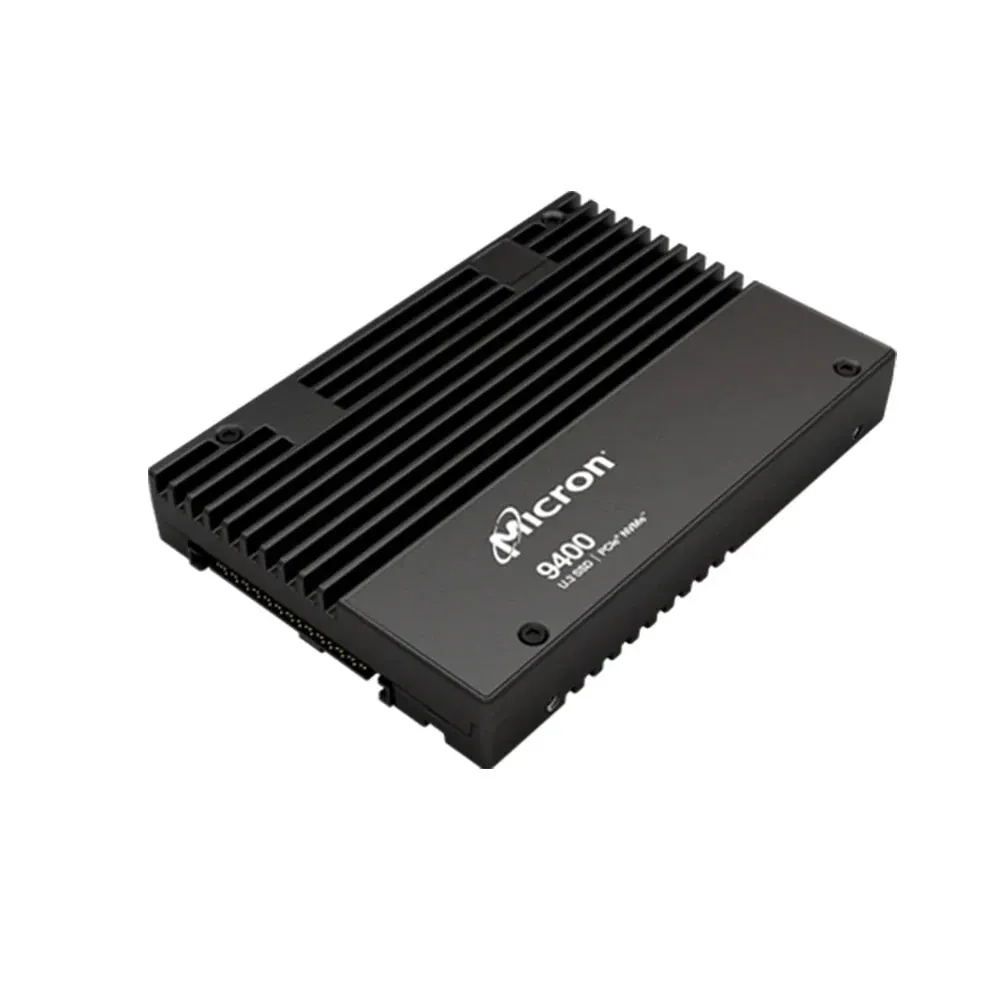
The Micron 9400 PRO 15.36TB is purpose-built for read-intensive, capacity-dense deployments such as CDN edge caches, object storage metadata tiers, and large virtualized read pools, where its 176-layer 3D TLC, 7,000/7,000 MB/s throughput, and 1.6M random-read IOPS keep latency low at scale. Compared with typical 1 DWPD PCIe Gen4 SSDs in the same class, this MPN stands out by combining full 15.36TB capacity with 28,032 TBW enterprise endurance, enabling higher rack-level density and fewer drive slots without sacrificing sustained performance.
With an endurance rating of 28,032 TBW and 1 DWPD, this SSD is designed to sustain very heavy write activity across its service life, making it far more robust than typical client-grade drives. In practical terms, under normal enterprise system-boot, application, logging, or mixed read/write workloads, it can reliably serve as a system or data drive for many years without endurance becoming a concern. For enterprise reliability, the drive includes power-loss protection, which helps preserve in-flight data and metadata integrity if power is interrupted unexpectedly, reducing the risk of corruption and unplanned recovery events. Its UBER of 1.0E-17 and MTBF of 2 million hours indicate an enterprise-class reliability profile, supporting very low unrecoverable read error rates and dependable long-term operation in business-critical environments.
1. The PCIe Gen4 NVMe architecture gives this drive the bandwidth and protocol efficiency needed to keep GPU servers, virtualized clusters, and high-concurrency databases fed without storage becoming the bottleneck.
2. Its top-end sequential read performance accelerates large-block workloads such as analytics scans, backup restore, media streaming, and AI model loading, cutting wait time for data-heavy enterprise applications.
3. The extremely strong random read capability makes it well suited for latency-sensitive workloads like OLTP databases, VDI boot storms, metadata services, and high-traffic web platforms that must handle massive parallel access.
4. With an endurance rating of one full drive write per day, it fits mixed-use enterprise deployments that need predictable lifespan under sustained daily updates without paying for unnecessary write-heavy overprovisioning.
5. Built on advanced 176-layer 3D TLC NAND and paired with very low typical latency, the drive balances high density, consistent responsiveness, and cost-efficient reliability for mainstream data center production environments.
Lower capacity reference: 7.68TB Higher capacity reference: 30.72TB In this product family, 15.36TB is the sweet-spot capacity point. Compared with the 7.68TB model, it provides much better headroom for data growth, denser consolidation, and longer refresh cycles without materially changing the familiar enterprise read/write and random IOPS profile. Compared with the 30.72TB version, it delivers a more balanced acquisition cost, power footprint, and usable performance per dollar, avoiding overprovisioning for mainstream deployments. It is especially well suited for mid-scale virtualization clusters, such as shared storage for roughly 150-250 mixed business application virtual machines.
Q: Is MTFDKCC15T3TGH-1BC1ZABYY suitable for a write-heavy database server?
A: Yes. With 1 DWPD, 28,032 TBW, PCIe Gen4 NVMe performance, and 176-layer 3D TLC NAND, it is suitable for mixed-use and moderately write-heavy database workloads requiring enterprise reliability.
Q: How many full drive writes per day can it actually endure over its warranty period?
A: It is rated for 1 full drive write per day over a 5-year warranty period. For a 15.36TB SSD, that equals 15.36TB of writes daily, totaling 28,032TBW.
Q: Does it include power loss protection (PLP) and why is that critical?
A: Yes, it includes power loss protection. PLP helps preserve in-flight data and metadata during unexpected power failure, which is critical for preventing corruption and maintaining database integrity.
Q: What RAID level is recommended for this SSD?
A: For database and virtualization workloads, RAID 10 is generally recommended. It provides strong read and write performance, redundancy, and faster rebuilds than parity-based RAID levels such as RAID 5.