











 Secure payments
Standard refund policy
Trade Assurance
Secure payments
Standard refund policy
Trade Assurance
| Brand | Micron |
|---|---|
| Model | 7500 PRO |
| Capacity | 15.36TB |
| Usage Class | Enterprise |
| Host Interface | PCIe Gen4 x4 NVMe |
|---|---|
| Total Interface Bandwidth | 16 Gb/s |
| Form Factor | U.3 15mm |
|---|
| NAND Flash | 232-layer 3D TLC |
|---|---|
| Drive Writes Per Day | 1 |
| Total Bytes Written | 28032 TBW |
| Sequential Read | 7000 MB/s |
|---|---|
| Sequential Write | 5900 MB/s |
| Random Read IOPS | 1100000 |
| Random Write IOPS | 250000 |
| Average Latency | 70 μs |
| Mean Time Between Failures | 2 Million Hours |
|---|---|
| Uncorrectable Bit Error Rate | 1.0×10⁻¹⁷ |
| Power Loss Protection | Yes |
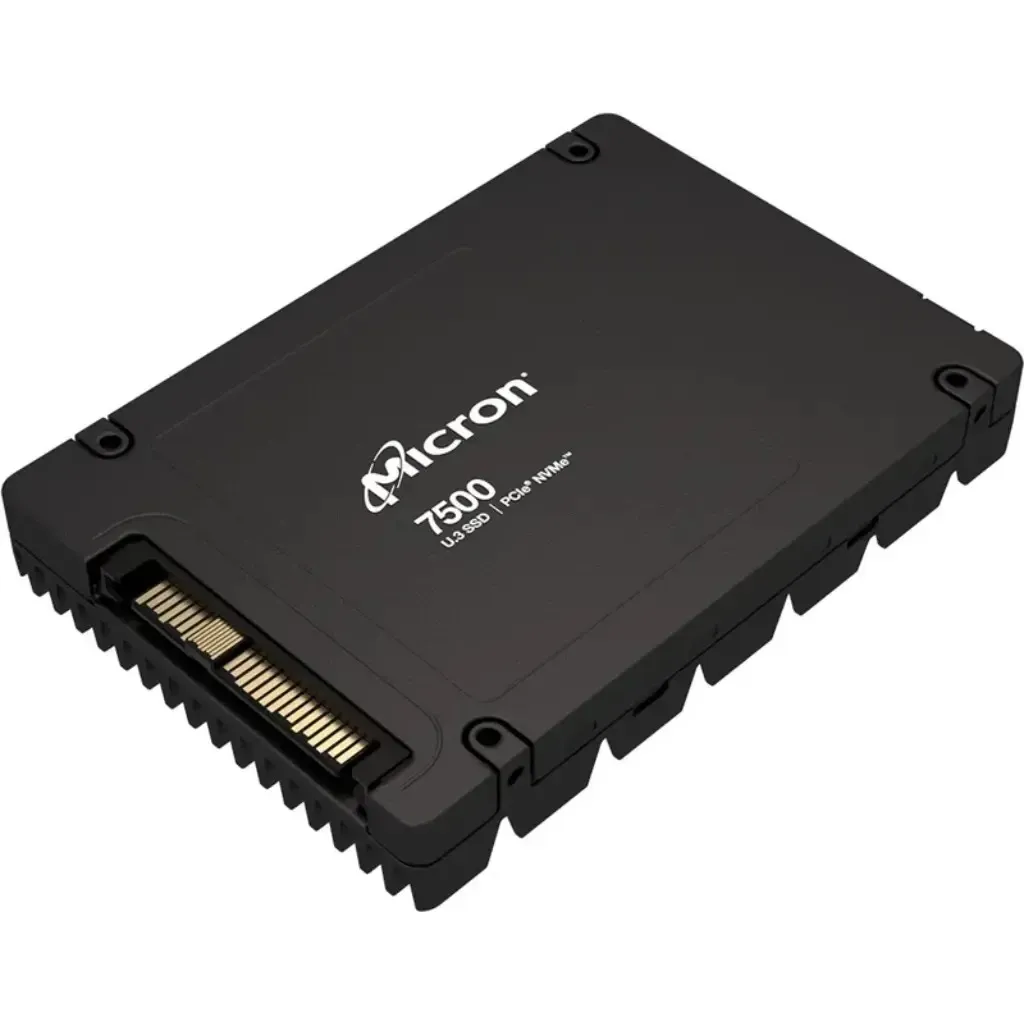
The Micron 7500 PRO 15.36TB (MTFDKCC15T3TGP-1BK1JABYY) is best suited for high-density read-centric enterprise workloads such as scale-out object storage, large virtualized data stores, and analytics clusters that need maximum capacity per U. With 232-layer 3D TLC NAND, PCIe Gen4 x4 performance up to 7000/5900 MB/s, 1.1M/250K IOPS, and 28,032 TBW endurance, it delivers a stronger balance of usable capacity, sustained responsiveness, and write life than typical same-class Gen4 TLC SSDs at this capacity point.
With an endurance rating of 28,032 TBW and 1 DWPD, the MTFDKCC15T3TGP-1BK1JABYY is built to sustain heavy, sustained write activity over its service life. In typical enterprise or system-disk workloads, this level of endurance means the drive can comfortably support many years of daily operation without endurance becoming a practical concern. For enterprise reliability, built-in power loss protection (PLP) helps preserve data in flight and protects against corruption if power is unexpectedly interrupted. Its ultra-low UBER of 1.0E-18 indicates an exceptionally low probability of uncorrectable bit errors during reads, supporting high data integrity for business-critical environments.
1. The PCIe Gen4 x4 NVMe architecture, paired with top-tier sequential read speed, accelerates data staging and large-block transfers, reducing job start times for analytics, AI, and backup-heavy environments.
2. Its random read capability is built for latency-sensitive enterprise workloads, sustaining fast access to massive small-file and metadata sets in virtualized databases and cloud platforms.
3. A 1 DWPD endurance rating gives IT teams the confidence to run steady daily write activity throughout the drive’s service life without overprovisioning for durability.
4. The 232-layer 3D TLC NAND balances performance, density, and cost efficiency, making it well suited for mainstream enterprise deployments that need predictable QoS at scale.
5. With typical latency as low as 70 microseconds, the drive helps minimize storage response delays, improving transaction consistency and application responsiveness under mixed workloads.
Lower capacity reference: 7.68TB Higher capacity reference: 30.72TB In this family, the 15.36TB model sits at the sweet spot of capacity planning. Compared with the 7.68TB version, it provides much better headroom for dataset growth, VM density, and longer refresh cycles without changing the expected enterprise read/write and random IOPS profile. Compared with the 30.72TB option, it usually delivers the best balance between usable capacity, acquisition cost, and risk concentration per drive. It is especially well suited for mid-scale virtualization clusters, such as shared storage tiers supporting about 150 to 250 general-purpose virtual desktops or mixed application VMs.
Q: Is MTFDKCC15T3TGP-1BK1JABYY suitable for a write-heavy database server?
A: It can support mainstream database workloads, but with 1 DWPD it is better classified for mixed-use environments. For consistently write-intensive databases, a higher-endurance SSD would be the safer choice.
Q: How many full drive writes per day can it actually endure over its warranty period?
A: This model is rated at 1 DWPD, meaning one full 15.36TB drive write per day. That aligns with its 28,032TB TBW rating across a standard 5-year warranty period.
Q: Does it include power loss protection (PLP) and why is that critical?
A: Yes, it includes power loss protection. PLP helps preserve in-flight data and metadata during unexpected power failures, which is critical for data integrity, consistency, and enterprise storage reliability.
Q: What RAID level is recommended for this SSD?
A: For most enterprise and database deployments, RAID 10 is the preferred option because it balances strong performance, low latency, and redundancy better than parity-based RAID for write-sensitive workloads.