











 Secure payments
Standard refund policy
Trade Assurance
Secure payments
Standard refund policy
Trade Assurance
| Brand | Micron |
|---|---|
| Model | 7500 PRO |
| Capacity | 1920GB |
| Usage Class | Enterprise |
| Host Interface | PCIe Gen4 NVMe |
|---|---|
| Total Interface Bandwidth | 16 Gb/s |
| Form Factor | U.3 |
|---|
| NAND Flash | 3D TLC |
|---|---|
| Drive Writes Per Day | 1 |
| Total Bytes Written | 3504 TBW |
| Sequential Read | 7000 MB/s |
|---|---|
| Sequential Write | 2800 MB/s |
| Random Read IOPS | 700000 |
| Random Write IOPS | 110000 |
| Average Latency | 15 μs |
| Mean Time Between Failures | 2 Million Hours |
|---|---|
| Uncorrectable Bit Error Rate | 1.0×10⁻¹⁷ |
| Power Loss Protection | Yes |
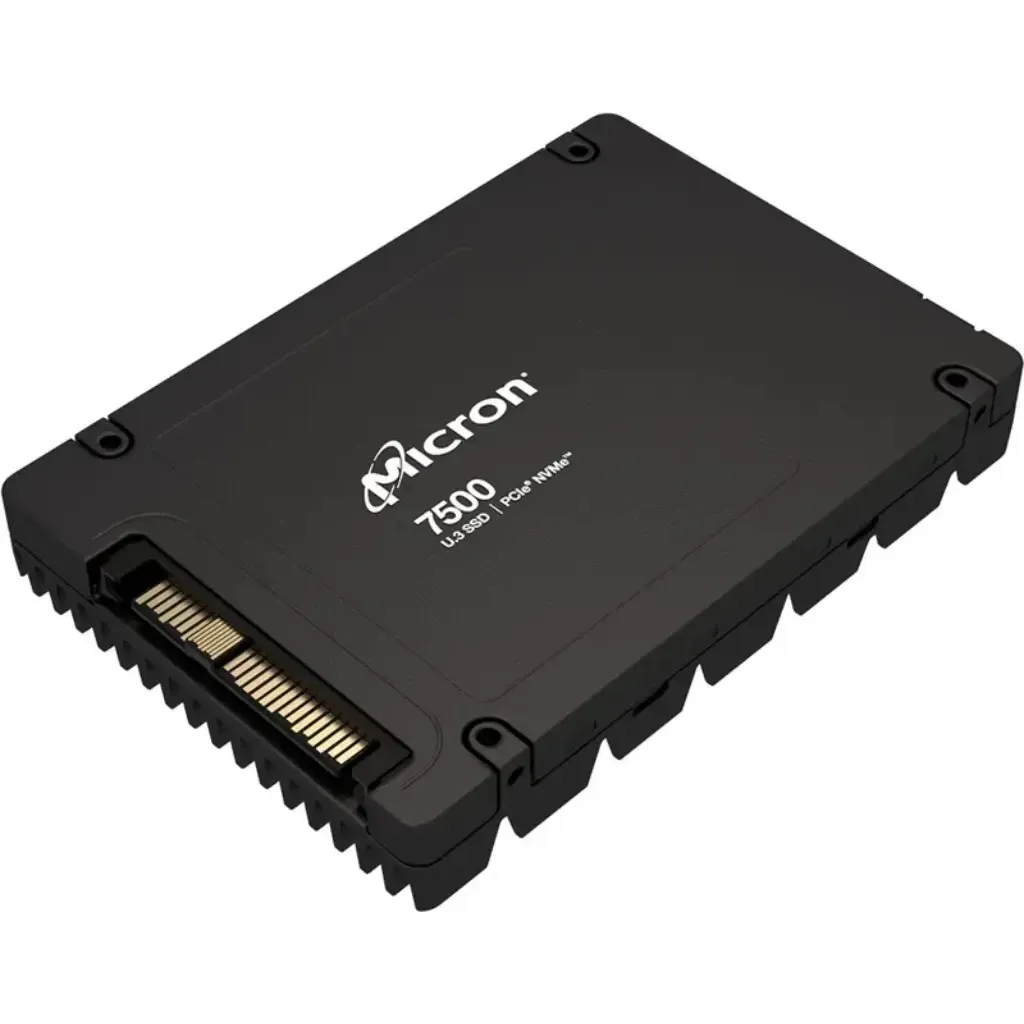
The Micron 7500 PRO MTFDKCC1T9TGP-1BK1JABYYR is best suited for read-centric cloud and edge workloads such as CDN cache, virtual desktop boot storms, and scale-out analytics tiers, where its 7,000 MB/s sequential read and 700,000 IOPS random read help reduce queueing and response-time variance at 1.92TB. Compared with same-class Gen4 drives focused mainly on capacity, it combines 1 DWPD and 3504 TBW on 3D TLC NAND to provide a stronger endurance margin for steady daily updates without stepping up to a higher-cost mixed-use SSD.
With an endurance rating of 3,504 TBW and 1 DWPD, this 1.92TB SSD is designed to sustain writing its full capacity once per day throughout its warranted service life, which is more than sufficient for typical enterprise boot, OS, virtualization, and read-intensive application workloads. In practical terms, under common system-drive usage patterns with moderate daily writes, this level of endurance provides a very comfortable margin and supports long-term, worry-free deployment. For enterprise reliability, the drive includes Power Loss Protection (PLP), which helps preserve in-flight data and protect metadata integrity during unexpected power interruptions, reducing the risk of corruption and unplanned recovery events. Its ultra-low UBER of 1.0E-18 means the probability of uncorrectable bit errors is exceptionally small, supporting high data integrity expectations in business-critical environments.
1. The PCIe Gen4 NVMe interface gives this drive the bandwidth needed to keep virtualization clusters, high-speed databases, and modern application stacks fed without becoming a storage bottleneck.
2. Its strong sequential read performance accelerates large-block workloads such as analytics scans, backup restoration, media streaming, and AI dataset loading, helping servers move more data in less time.
3. Its high random read capability is well suited for latency-sensitive enterprise applications like OLTP databases, VDI, and metadata-heavy cloud services where fast access to small files directly improves user responsiveness.
4. Built with 3D TLC NAND and rated for one full drive write per day, it offers a practical balance of endurance, capacity efficiency, and cost for mainstream enterprise workloads with steady daily write activity.
5. The very low typical latency helps reduce tail-response times in transactional systems, allowing applications to deliver more predictable performance under sustained multi-tenant load.
Lower-capacity reference: 960GB Higher-capacity reference: 3840GB The 1920GB model sits at the sweet spot of this SSD family. Compared with the 960GB version, it gives noticeably more headroom for OS images, application growth, logs, and spare overprovisioning, reducing early capacity pressure in mixed enterprise workloads. Compared with the 3840GB version, it delivers a better balance of acquisition cost, usable capacity, and performance consistency, since sequential throughput and random IOPS are broadly similar across nearby capacities. It is especially well suited for mid-scale virtualization, such as hosting boot and application volumes for around 40 to 60 business VMs.
Q: Is MTFDKCC1T9TGP-1BK1JABYYR suitable for a write-heavy database server?
A: This SSD can support database workloads, but with 1 DWPD it is better suited for mixed-use rather than extremely write-heavy servers. For sustained intensive writes, a higher-endurance enterprise model is recommended.
Q: How many full drive writes per day can it actually endure over its warranty period?
A: The rated endurance is 1 DWPD, meaning the 1920GB drive can handle one full drive write per day throughout its warranty period, consistent with its 3504 TBW specification.
Q: Does it include power loss protection (PLP) and why is that critical?
A: Yes, it includes power loss protection. PLP helps preserve in-flight data and metadata during unexpected outages, which is critical for maintaining data integrity and reducing corruption risk in enterprise systems.
Q: What RAID level is recommended for this SSD?
A: RAID 1, 10, or 5 can be selected depending on performance and redundancy goals. For databases and enterprise workloads, RAID 10 is commonly recommended for balanced speed, resilience, and rebuild efficiency.