











 Secure payments
Standard refund policy
Trade Assurance
Secure payments
Standard refund policy
Trade Assurance
| Brand | Micron |
|---|---|
| Model | 6500 ION |
| Capacity | 30.72TB |
| Usage Class | Enterprise |
| Host Interface | PCIe Gen4 x4 NVMe |
|---|---|
| Total Interface Bandwidth | 16 Gb/s |
| Form Factor | U.3 15mm |
|---|
| NAND Flash | 232-layer 3D TLC |
|---|---|
| Drive Writes Per Day | 1 |
| Total Bytes Written | 56000 TBW |
| Sequential Read | 6800 MB/s |
|---|---|
| Sequential Write | 5000 MB/s |
| Random Read IOPS | 1000000 |
| Random Write IOPS | 200000 |
| Average Latency | 70 μs |
| Mean Time Between Failures | 2.5 Million Hours |
|---|---|
| Uncorrectable Bit Error Rate | 1.0×10⁻¹⁷ |
| Power Loss Protection | Yes |
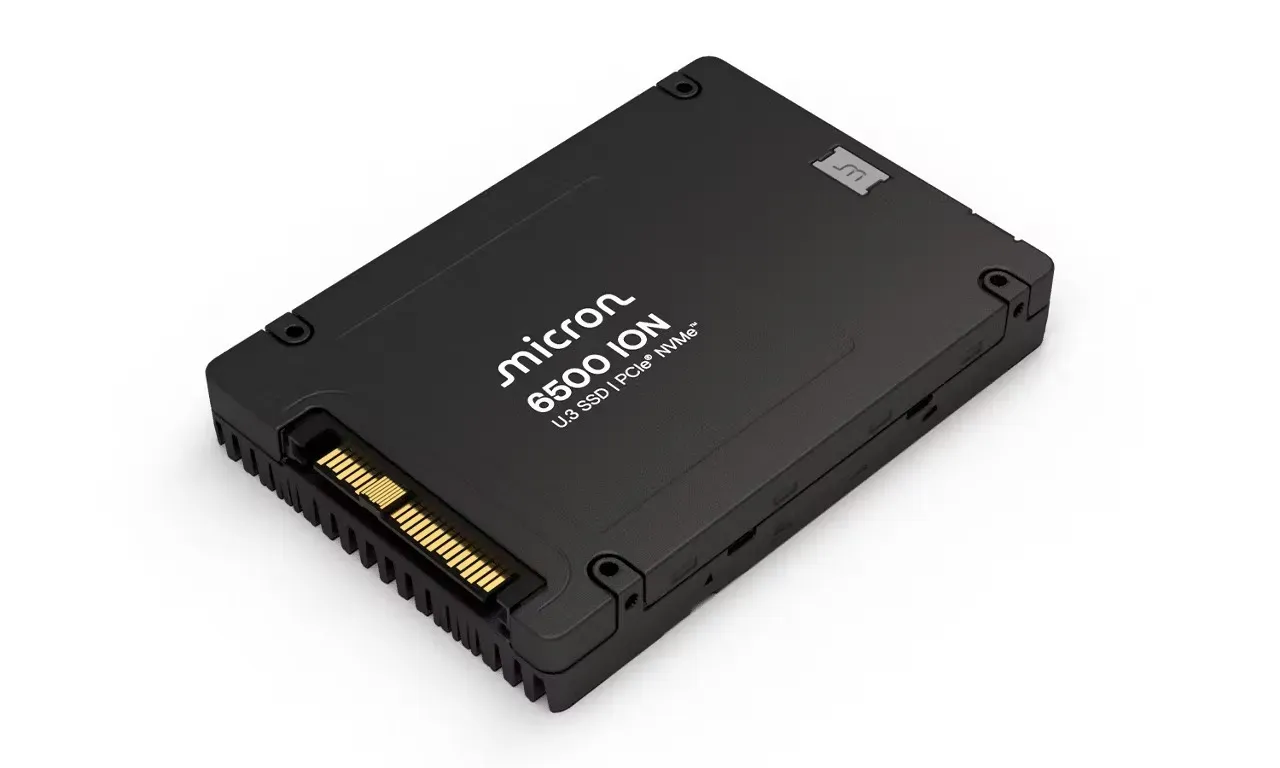
Micron’s 6500 ION MTFDKCC30T7TGR-1BK4JABYY is engineered for capacity-dense, read-intensive cloud infrastructure such as CDN edge caches, object storage, and large-scale data lakes, combining 30.72TB of 232-layer 3D TLC with PCIe Gen4 x4 performance up to 6800/5000 MB/s and 1M/200K IOPS. Compared with typical same-class 1 DWPD enterprise SSDs, its standout value is delivering ultra-high usable capacity and a 56,000 TBW endurance profile in a single drive, helping architects increase rack-level storage density while maintaining predictable NVMe performance for mixed read and light-write workloads.
With an endurance rating of 56,000 TBW and 1 DWPD, this SSD is designed to sustain a full drive write per day across its warranted service life, making it well suited for demanding enterprise and mixed-use workloads. In typical real-world deployment, where write intensity is often below the maximum rating, it can serve reliably for many years as a system, boot, or application drive with substantial endurance headroom. Enterprise reliability is further strengthened by power-loss protection (PLP), which helps preserve in-flight data and maintain metadata integrity if external power is unexpectedly interrupted. Its UBER of 1.0E-17 indicates an extremely low probability of unrecoverable bit errors, and when combined with a 2.5 million-hour MTBF, it supports the high data integrity and operational stability expected in business-critical environments.
1. The PCIe Gen4 x4 NVMe architecture, paired with class-leading sequential bandwidth, accelerates large dataset streaming and sharply reduces VM boot, backup restore, and analytics load times in modern data centers.
2. Its million-class random read capability sustains extremely high transaction concurrency, helping databases, virtual desktop farms, and metadata-heavy workloads stay responsive under peak demand.
3. A 1 DWPD endurance profile makes it well suited for mixed-use enterprise deployments that need predictable lifespan under steady daily overwrite activity without overpaying for write-optimized media.
4. Built on 232-layer 3D TLC NAND, the drive balances density, power efficiency, and cost, giving enterprises scalable flash capacity with dependable performance consistency.
5. With typical latency in the tens of microseconds, it minimizes storage wait states so latency-sensitive applications such as real-time analytics and high-frequency transaction processing can respond faster.
Lower capacity reference: 25.60TB Higher capacity reference: 61.44TB At 30.72TB, this SSD sits in a practical sweet spot within the series. Compared with the 25.60TB model, it gives noticeably more headroom for data growth, longer refresh cycles, and better space efficiency per drive without changing the expected enterprise-class performance profile. Compared with the 61.44TB option, it delivers a more balanced acquisition cost, easier fleet standardization, and lower risk of overprovisioning capacity that may remain unused. It is especially well suited for mid-scale virtualization clusters, such as shared storage pools for roughly 150 to 250 mixed-workload virtual desktops or application instances.
Q: Is MTFDKCC30T7TGR-1BK4JABYY suitable for a write-heavy database server?
A: It can support mixed and moderately write-intensive database workloads, but with 1 DWPD it is not ideal for extremely write-heavy servers. For sustained heavy writes, a higher-endurance SSD is recommended.
Q: How many full drive writes per day can it actually endure over its warranty period?
A: This model is rated for 1 DWPD, meaning one full 30.72TB drive write per day. That aligns with its 56,000TBW endurance rating, typically across a standard 5-year warranty period.
Q: Does it include power loss protection (PLP) and why is that critical?
A: Yes, it includes power loss protection. PLP helps preserve in-flight data and metadata during unexpected outages, which is critical for maintaining data integrity and reducing corruption risk in enterprise systems.
Q: What RAID level is recommended for this SSD?
A: The recommended RAID level depends on workload needs. RAID 10 is preferred for high database performance and resilience, while RAID 5 or 6 may suit capacity-focused environments with acceptable write overhead.