











 Secure payments
Standard refund policy
Trade Assurance
Secure payments
Standard refund policy
Trade Assurance
| Brand | Micron |
|---|---|
| Model | 7450 MAX |
| Capacity | 3.2TB |
| Usage Class | Mixed Use |
| Host Interface | PCIe Gen4 NVMe |
|---|---|
| Total Interface Bandwidth | 16 Gb/s |
| Form Factor | U.3 15mm |
|---|
| NAND Flash | 176-layer 3D TLC |
|---|---|
| Drive Writes Per Day | 3 |
| Total Bytes Written | 17500 TBW |
| Sequential Read | 6800 MB/s |
|---|---|
| Sequential Write | 5300 MB/s |
| Random Read IOPS | 1000000 |
| Random Write IOPS | 370000 |
| Average Latency | 80 μs |
| Mean Time Between Failures | 2 Million Hours |
|---|---|
| Uncorrectable Bit Error Rate | 1.0×10⁻¹⁷ |
| Power Loss Protection | Yes |
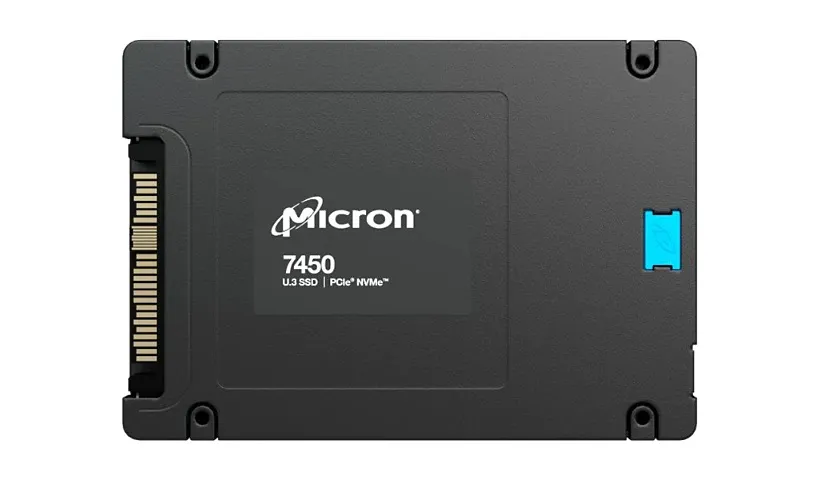
The Micron 7450 MAX 3.2TB (MPN: MTFDKCC3T2TFS-1BC1ZABYY) is purpose-built for write-intensive OLTP databases, high-churn virtualization clusters, and metadata-heavy software-defined storage, combining 3 DWPD endurance, 17,500 TBW, and 176-layer 3D TLC with PCIe Gen4 performance up to 6800/5300 MB/s. Compared with typical mainstream Gen4 TLC SSDs in the same class, it stands out by pairing 1,000,000 random-read IOPS with substantially higher sustained write endurance, making it a stronger choice where predictable latency and long service life under mixed random workloads matter more than raw capacity alone.
With an endurance rating of 17,500 TBW and 3 DWPD, the MTFDKCC3T2TFS-1BC1ZABYY is built to sustain very heavy daily write workloads throughout its service life. In typical enterprise use, this level of endurance means it can operate as a highly dependable system or application drive for many years, including long-term deployment scenarios where consistent write activity is expected. For enterprise reliability, the drive includes power-loss protection (PLP), which helps preserve in-flight data and protect metadata integrity if power is interrupted unexpectedly. Its UBER of 1.0E-17 indicates an extremely low uncorrectable bit error rate, supporting strong data integrity for business-critical environments, while the 2 million-hour MTBF further reflects a design focused on stable, continuous operation.
1. The PCIe Gen4 NVMe architecture, paired with top-tier sequential read bandwidth, accelerates large dataset streaming, VM boot storms, and analytics jobs by sharply reducing storage bottlenecks.
2. With 1,000,000K random read IOPS, this SSD sustains extremely high transaction concurrency, making it ideal for OLTP databases, virtualized environments, and metadata-heavy cloud workloads.
3. A 3 DWPD endurance rating enables consistent heavy write usage over the drive’s service life, giving enterprises the confidence to run write-intensive logging, caching, and mixed-workload applications without premature wear concerns.
4. Built on 176-layer 3D TLC NAND, the drive balances performance, density, and reliability, delivering enterprise-class flash efficiency suitable for scale-out data center deployments.
5. A typical latency of 80 µs helps keep application response times predictable under load, which is critical for latency-sensitive services such as real-time analytics, high-frequency transaction processing, and performance-tier storage.
Lower capacity reference: 1.6TB Higher capacity reference: 6.4TB At 3.2TB, this SSD sits in the sweet spot of the series. Compared with the 1.6TB model, it gives much better headroom for data growth, overprovisioning flexibility, and mixed workload consolidation without changing the familiar enterprise-class sequential throughput or random IOPS profile. Compared with the 6.4TB option, it avoids the higher acquisition cost while still delivering ample usable capacity and balanced performance efficiency. In practice, 3.2TB is well suited for mid-scale virtualization clusters, such as hosting boot and application volumes for around 60 to 80 general-purpose virtual machines.
Q: Is MTFDKCC3T2TFS-1BC1ZABYY suitable for a write-heavy database server?
A: Yes. With 3 DWPD, 17,500 TBW, 176-layer 3D TLC NAND, and low 80 µs typical latency, this 3.2TB PCIe Gen4 NVMe SSD is well suited for write-intensive database workloads.
Q: How many full drive writes per day can it actually endure over its warranty period?
A: It is rated for 3 full drive writes per day. For a 3.2TB drive, that equals about 9.6TB of writes daily, consistent with its 17,500 TBW endurance specification.
Q: Does it include power loss protection (PLP) and why is that critical?
A: Yes, it includes power loss protection. PLP helps preserve in-flight data and metadata during unexpected outages, reducing corruption risk and improving reliability for transactional and enterprise storage environments.
Q: What RAID level is recommended for this SSD?
A: RAID recommendation depends on workload. RAID 1 or RAID 10 is commonly preferred for databases because it balances redundancy and performance, while RAID 5/6 may suit capacity-focused environments.