











 Secure payments
Standard refund policy
Trade Assurance
Secure payments
Standard refund policy
Trade Assurance
| Brand | Micron |
|---|---|
| Model | 7450 MAX |
| Capacity | 6400GB |
| Usage Class | Enterprise |
| Host Interface | PCIe Gen4 NVMe |
|---|---|
| Total Interface Bandwidth | 16 Gb/s |
| Form Factor | U.3 15mm |
|---|
| NAND Flash | 3D TLC |
|---|---|
| Drive Writes Per Day | 3 |
| Total Bytes Written | 35000 TBW |
| Sequential Read | 6800 MB/s |
|---|---|
| Sequential Write | 5300 MB/s |
| Random Read IOPS | 1000000 |
| Random Write IOPS | 370000 |
| Average Latency | 80 μs |
| Mean Time Between Failures | 2 Million Hours |
|---|---|
| Uncorrectable Bit Error Rate | 1.0×10⁻¹⁷ |
| Power Loss Protection | Yes |
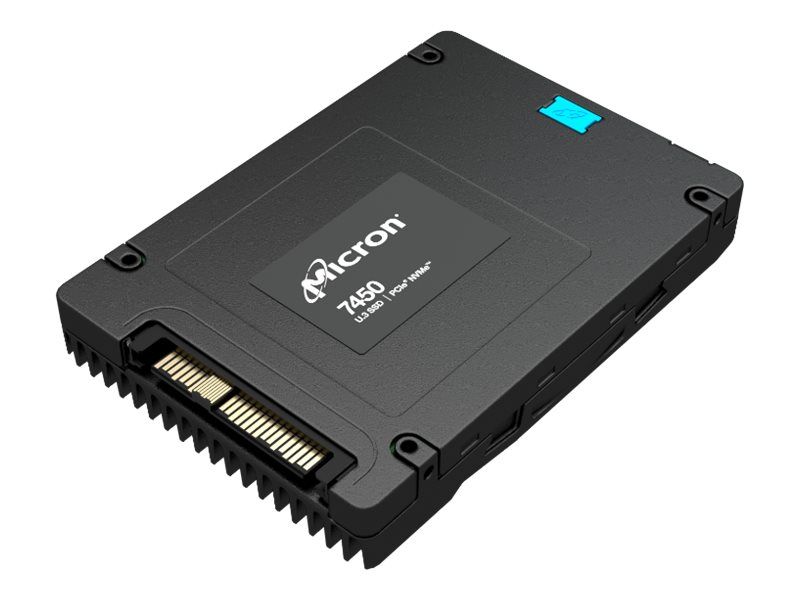
The Micron 7450 MAX 6.4TB (MTFDKCC6T4TFS-1BC15ABYY) is purpose-built for write-intensive OLTP databases, high-frequency logging, and virtualization caches, combining 3 DWPD endurance with 35,000 TBW to sustain heavy mixed workloads without sacrificing capacity efficiency. Its PCIe Gen4 NVMe interface delivers up to 6800/5300 MB/s and 1,000,000/370,000 IOPS, making it a stronger choice than typical read-optimized enterprise SSDs when low-latency consistency and durable write performance are the priority.
With a rated endurance of 35,000 TBW and 3 DWPD, this SSD is designed to handle very heavy write activity over its service life, making it well suited for write-intensive enterprise applications as well as mixed-use infrastructure. In typical lighter-duty roles such as an operating system, boot, or general server system drive, this level of endurance translates into many years of worry-free operation and is far beyond normal daily write demands. Its enterprise reliability is strengthened by power-loss protection (PLP), which helps preserve in-flight data and metadata during an unexpected power interruption, reducing the risk of corruption and improving system resilience. An UBER of 1.0E-17, together with a 2 million hour MTBF rating, reflects a very low uncorrectable bit error rate and strong long-term dependability expected in data center environments.
1. The PCIe Gen4 NVMe architecture, paired with top-tier sequential read bandwidth, keeps large databases, VM images, and analytics datasets moving fast enough to reduce boot, restore, and data-staging bottlenecks in busy data centers.
2. Its million-class random read capability enables ultra-responsive access to small blocks of data, making it ideal for high-concurrency workloads such as OLTP databases, metadata services, and large-scale virtualization.
3. A 3 DWPD endurance rating gives enterprises the confidence to run sustained write-heavy applications like logging, caching, and transactional systems every day over the drive’s service life.
4. Built on 3D TLC NAND, the drive balances flash density, performance consistency, and cost efficiency, making it well suited for mainstream enterprise deployments that need both scale and predictable QoS.
5. Typical latency at the tens-of-microseconds level helps accelerate real-time decision paths, improving tail-response behavior for latency-sensitive applications such as financial trading, search, and inference serving.
Lower capacity reference: 3.2TB Higher capacity reference: 7.68TB Capacity positioning analysis: The 6.4TB model sits in the sweet spot of this enterprise SSD family. Compared with the 3.2TB option, it gives meaningfully more headroom for VM growth, container images, hot data, and snapshot buffers, reducing early capacity pressure and refresh frequency. Compared with the 7.68TB option, it usually delivers a better balance of usable space, acquisition cost, and performance consistency, while avoiding overbuying capacity that may remain idle. It is well suited for a mid-sized virtualization cluster, such as shared primary storage for around 60 to 80 mixed-production virtual machines.
Q: Is MTFDKCC6T4TFS-1BC15ABYY suitable for a write-heavy database server?
A: Yes. With 3 DWPD, 35,000 TBW endurance, 3D TLC NAND, and low 80 µs typical latency, this SSD is well suited for write-intensive database, logging, and transactional server workloads.
Q: How many full drive writes per day can it actually endure over its warranty period?
A: It is rated for 3 full drive writes per day. For a 6.4 TB drive, that equals about 19.2 TB of writes daily across the stated warranty period.
Q: Does it include power loss protection (PLP) and why is that critical?
A: Yes, it includes power loss protection. PLP helps preserve in-flight data and metadata during unexpected outages, which is critical for maintaining consistency, integrity, and reducing corruption risk in enterprise systems.
Q: What RAID level is recommended for this SSD?
A: RAID 10 is commonly recommended for performance-sensitive enterprise workloads, especially databases. It provides strong read/write performance and redundancy, while RAID 1 or RAID 5 may suit different capacity priorities.