











 Secure payments
Standard refund policy
Trade Assurance
Secure payments
Standard refund policy
Trade Assurance
| Brand | Micron |
|---|---|
| Model | 4100AT Series |
| Capacity | 128GB |
| Usage Class | Automotive / Industrial Grade |
| Host Interface | PCIe Gen 4.0 x4, NVMe |
|---|---|
| Total Interface Bandwidth | 16 Gb/s |
| Form Factor | BGA (291-ball LFBGA) |
|---|
| NAND Flash | Micron 3D TLC NAND |
|---|---|
| Drive Writes Per Day | |
| Total Bytes Written | TBW |
| Sequential Read | 1200 MB/s |
|---|---|
| Sequential Write | 500 MB/s |
| Random Read IOPS | 80000 |
| Random Write IOPS | 55000 |
| Average Latency | μs |
| Mean Time Between Failures | 2.0 Million Hours |
|---|---|
| Uncorrectable Bit Error Rate | 1.0×10⁻¹⁷ |
| Power Loss Protection | Yes |
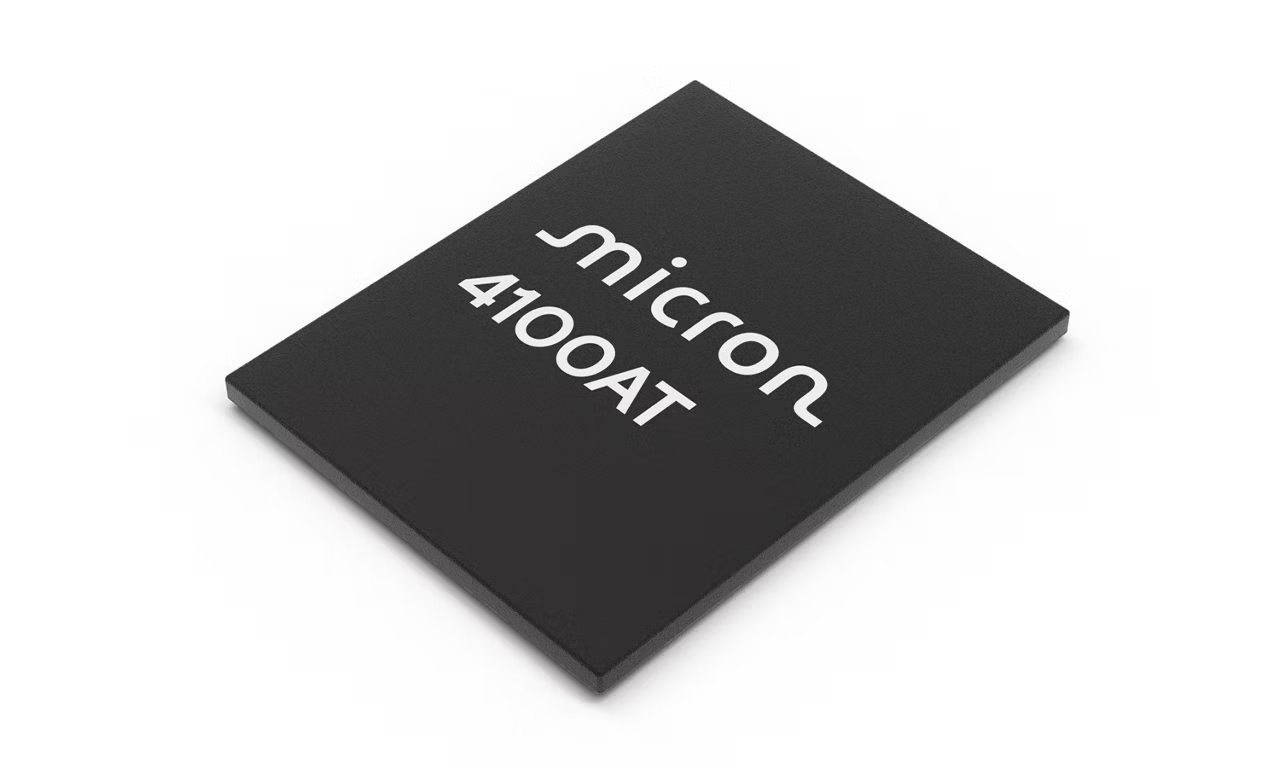
Compared with the earlier MTFDKEL128THE, the MTFDKEL128THE-1BM15ATYY in the 4100AT Series advances to a PCIe Gen4 x4 NVMe design with Micron 3D TLC NAND, delivering up to 1,200/500 MB/s and 80,000/55,000 IOPS for faster boot, logging, and application response in embedded and industrial platforms. Its 128GB capacity point is especially well suited for read-intensive edge systems that need lower latency and a more modern host interface than the previous generation, while maintaining a compact, deployment-friendly endurance profile.
With an endurance rating of [tbw] TBW and [dwpd] DWPD, the MTFDKEL128THE-1BM15ATYY is designed to handle typical OS, boot, logging, and routine application workloads with substantial write headroom over its service life. In practical terms, for common system-drive usage patterns, this level of endurance supports stable long-term deployment and can comfortably cover many years of normal operation without endurance becoming a concern. For enterprise reliability, built-in power-loss protection (PLP) helps preserve in-flight data and maintain metadata integrity if power is interrupted unexpectedly, reducing the risk of corruption during sudden shutdowns. Its UBER of 1.0E-16 indicates a very low unrecoverable bit error rate for high data integrity, while the 2-million-hour MTBF further reflects a design intended for dependable, always-on environments.
1. With a PCIe Gen4 x4 NVMe design and sustained read bandwidth of 1200 MB/s, this drive helps enterprise servers pull large datasets, VM images, and application binaries faster to reduce boot and load bottlenecks.
2. Its random read capability of 80,000 K IOPS supports highly parallel access patterns, making it well suited for metadata-heavy databases, virtualization clusters, and read-intensive cloud services.
3. Rated for [dwpd] DWPD, the SSD is built to withstand continuous full-drive rewrites in demanding enterprise environments, improving service life predictability under heavy daily write pressure.
4. Micron 3D TLC NAND balances enterprise-class capacity, endurance, and cost efficiency, enabling denser storage deployments without sacrificing reliability for mainstream data center workloads.
5. With a typical latency of [latency] µs, the drive enables faster response times for transactional applications, helping reduce tail latency in business-critical workloads.
Lower-capacity reference: 64GB Higher-capacity reference: 256GB Capacity positioning analysis: In this SSD family, the 128GB model sits in the practical sweet spot. Compared with the 64GB version, it gives noticeably more headroom for OS images, logs, patches, and overprovisioning, reducing early capacity pressure in always-on enterprise environments. Compared with the 256GB option, it preserves nearly the same enterprise-class sequential and random performance profile while delivering a more efficient cost-per-node for large rollouts. This makes 128GB especially suitable for dense boot-drive pools, such as supporting about 40 to 60 lightweight virtualization hosts or appliance nodes.
Q: Is MTFDKEL128THE-1BM15ATYY suitable for a write-heavy database server?
A: It can support database workloads, but suitability for write-heavy use depends mainly on its rated DWPD and TBW. Please verify those endurance figures against your application’s daily write volume.
Q: How many full drive writes per day can it actually endure over its warranty period?
A: The exact full-drive writes per day is defined by the published DWPD rating. For this 128GB model, the actual endurance over warranty should be calculated directly from the specified DWPD and TBW values.
Q: Does it include power loss protection (PLP) and why is that critical?
A: Yes, it includes power loss protection. PLP helps preserve in-flight data and metadata during unexpected outages, which is especially important for enterprise systems requiring strong data integrity and consistency.
Q: What RAID level is recommended for this SSD?
A: RAID recommendation depends on your priority. RAID 1 is common for OS or critical data redundancy, while RAID 10 is typically preferred for performance-sensitive enterprise workloads and better fault tolerance.