











 Secure payments
Standard refund policy
Trade Assurance
Secure payments
Standard refund policy
Trade Assurance
| Brand | Micron |
|---|---|
| Model | 7600 MAX |
| Capacity | 25600GB |
| Usage Class | Enterprise |
| Host Interface | PCIe Gen5 NVMe |
|---|---|
| Total Interface Bandwidth | 32 Gb/s |
| Form Factor | U.2 |
|---|
| NAND Flash | 3D TLC |
|---|---|
| Drive Writes Per Day | 3 |
| Total Bytes Written | 140160 TBW |
| Sequential Read | 12000 MB/s |
|---|---|
| Sequential Write | 7000 MB/s |
| Random Read IOPS | 2100000 |
| Random Write IOPS | 675000 |
| Average Latency | 75 μs |
| Mean Time Between Failures | 2.5 Million Hours |
|---|---|
| Uncorrectable Bit Error Rate | 1.0×10⁻¹⁷ |
| Power Loss Protection | Yes |
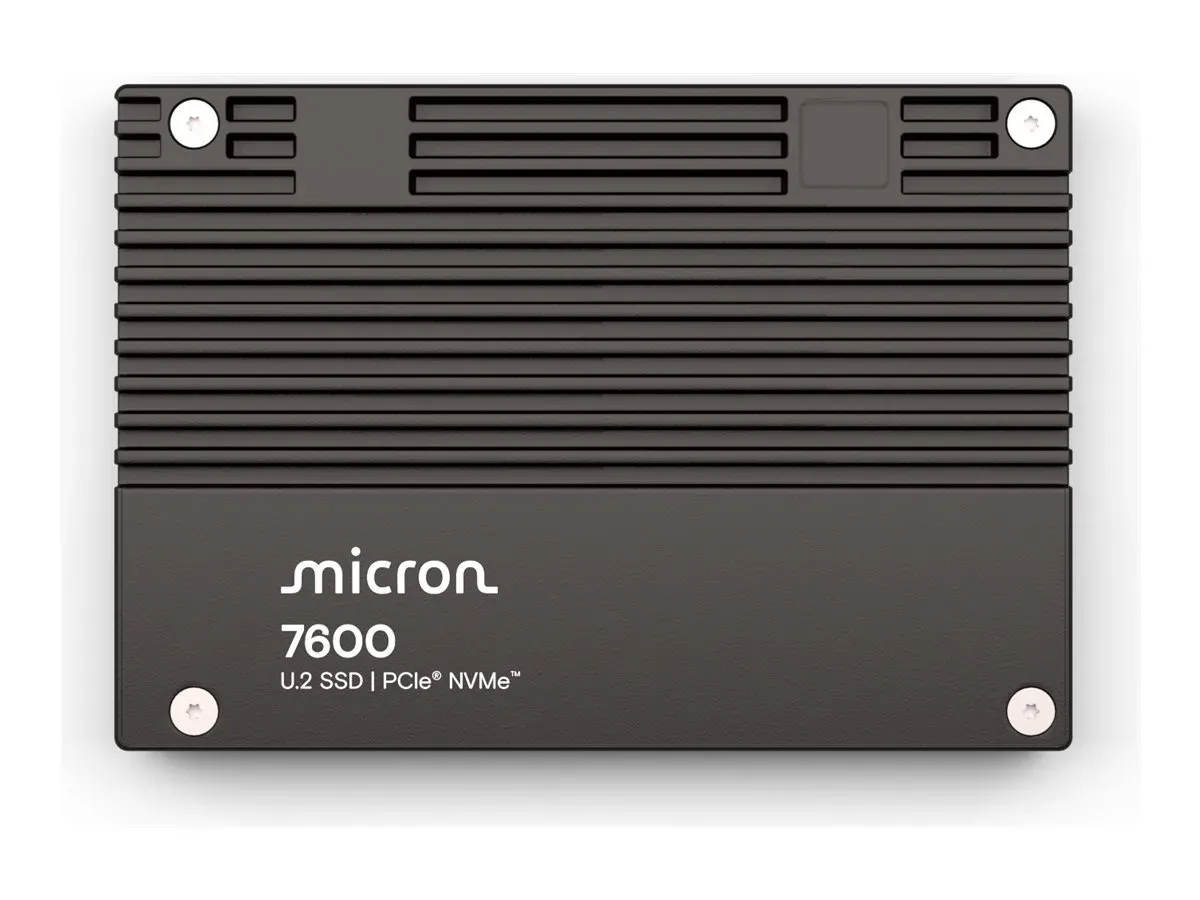
The Micron 7600 MAX 25.6TB (MPN: MTFDLAL25T6THS-1BP1JABYY) is engineered for capacity-dense AI data lakes, scale-out object storage, and read-intensive cloud platforms that need Gen5 bandwidth, pairing 12,000/7,000 MB/s sequential performance with up to 2.1M/675K IOPS in a single 3D TLC drive. With 3 DWPD endurance and an exceptional 140,160 TBW at 25.6TB, it delivers a standout balance of very high capacity, enterprise-class write durability, and reduced drive count per server compared with typical same-tier Gen5 TLC SSDs.
With an endurance rating of 140,160 TBW and 3 DWPD, this SSD is built to sustain very heavy write activity over its service life, making it well suited for write-intensive enterprise applications as well as long-term use as a highly reliable system or data drive. In practical terms, typical OS, virtualization, logging, and mixed business workloads will consume only a small fraction of this write budget, giving procurement teams strong confidence in long-term deployment stability. This drive also includes power-loss protection, which helps preserve in-flight data and metadata during unexpected power interruptions, reducing the risk of corruption and improving operational resilience. Its enterprise-class UBER of 1.0E-17 indicates an extremely low uncorrectable bit error rate, supporting high data integrity for mission-critical storage environments.
1. The PCIe Gen5 NVMe interface unlocks next-generation host bandwidth, helping dense servers remove storage bottlenecks in AI pipelines, real-time analytics, and high-speed virtualization clusters.
2. With sequential read performance of 12000 MB/s, this SSD accelerates large-block workloads such as dataset streaming, backup recovery, and checkpoint loading for faster time to data.
3. Delivering 2,100,000 K IOPS in random reads, it is built for latency-sensitive applications like large-scale databases and cloud platforms where massive concurrent small-block access drives user experience.
4. Rated for 3 DWPD and built on 3D TLC NAND, the drive balances enterprise endurance with flash efficiency, making it well suited for mixed workloads that demand sustained write reliability without sacrificing capacity economics.
5. A typical latency of 75 µs helps reduce transaction wait time and tail-latency exposure, which is critical for consistent SLA performance in mission-critical enterprise services.
Lower-capacity reference: 15360GB Higher-capacity reference: 30720GB Typical same-series performance positioning: 15360GB: sequential read/write and random IOPS are generally in the same enterprise band as 25600GB 25600GB: sequential read/write and random IOPS remain broadly consistent with the series norm 30720GB: sequential read/write and random IOPS are also broadly comparable, with only minor workload-dependent variation At 25600GB, this SSD sits in the sweet spot of the family. Compared with the 15360GB option, it provides much more headroom for growth, helping delay capacity-driven refresh cycles and reducing drive count in dense servers. Compared with the 30720GB model, it preserves nearly the same enterprise-class throughput and IOPS while offering a more efficient balance of acquisition cost, usable capacity, and fleet standardization. It is especially well suited for medium-to-large virtualization clusters, scale-out databases, and hyperconverged nodes that need strong density without overcommitting budget.
Q: Is MTFDLAL25T6THS-1BP1JABYY suitable for a write-heavy database server?
A: Yes. With 3 DWPD endurance, 140160 TBW, PCIe Gen5 NVMe performance, and 3D TLC NAND, this SSD is well suited for write-intensive database, OLTP, and enterprise mixed-workload environments.
Q: How many full drive writes per day can it actually endure over its warranty period?
A: It is rated for 3 full drive writes per day over the warranty period. For a 25.6TB drive, that equals about 76.8TB of writes per day within specification.
Q: Does it include power loss protection (PLP) and why is that critical?
A: Yes, it includes PLP. Power loss protection helps preserve in-flight data and metadata during sudden outages, reducing corruption risk and improving reliability for databases, virtualization, and transactional enterprise workloads.
Q: What RAID level is recommended for this SSD?
A: The best RAID level depends on your priority. RAID 10 is commonly recommended for databases, delivering strong performance and redundancy. RAID 1 or RAID 5/6 may suit capacity-focused or balanced deployments.