

 Secure payments
Standard refund policy
Trade Assurance
Secure payments
Standard refund policy
Trade Assurance
| Brand | Micron |
|---|---|
| Model | 9550 PRO |
| Capacity | 30720GB |
| Usage Class | Enterprise |
| Host Interface | PCIe Gen5 NVMe |
|---|---|
| Total Interface Bandwidth | 32 Gb/s |
| Form Factor | U.2 |
|---|
| NAND Flash | 3D TLC |
|---|---|
| Drive Writes Per Day | 1 |
| Total Bytes Written | 56064 TBW |
| Sequential Read | 14000 MB/s |
|---|---|
| Sequential Write | 10000 MB/s |
| Random Read IOPS | 3300000 |
| Random Write IOPS | 400000 |
| Average Latency | 60 μs |
| Mean Time Between Failures | 2.5 Million Hours |
|---|---|
| Uncorrectable Bit Error Rate | 1.0×10⁻¹⁷ |
| Power Loss Protection | Yes |
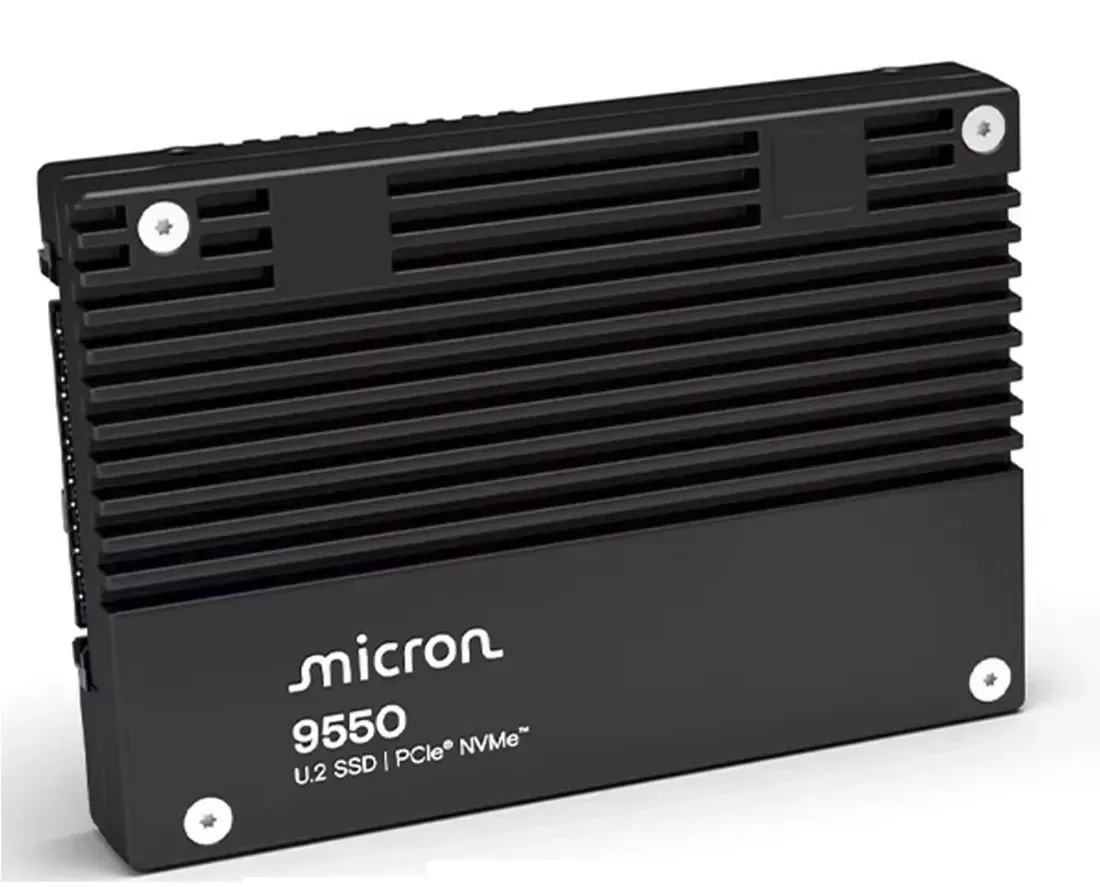
The Micron 9550 PRO MTFDLAL30T7THA-1BK1DABYYT is purpose-built for read-intensive AI data lakes, large-scale analytics, and high-density cloud storage tiers, combining 30.72TB of 3D TLC capacity with PCIe Gen5 performance up to 14,000/10,000 MB/s and 3.3M/400K IOPS. Compared with typical enterprise Gen4 SSDs in the same endurance class, it delivers a clear step-up in throughput and queue-depth responsiveness while maintaining 1 DWPD and 56,064 TBW, making it a strong choice for maximizing rack-level performance per slot.
With an endurance rating of 56,064 TBW and 1 DWPD, this SSD is designed to handle the equivalent of one full drive write every day under enterprise operating conditions, providing substantial write headroom for demanding workloads. In typical real-world use such as OS boot, application hosting, logging, and general server storage, that level of endurance means procurement teams can expect worry-free service over the practical life of the system. Its built-in power-loss protection (PLP) helps preserve in-flight data and metadata during an unexpected power interruption, reducing the risk of corruption and improving data integrity in enterprise environments. An ultra-low UBER of 1.0E-17, together with a 2.5 million-hour MTBF, indicates extremely strong read reliability and a design focused on stable long-term operation in business-critical deployments.
1. The PCIe Gen5 NVMe interface, paired with **14,000 MB/s** sequential read performance, accelerates dataset streaming and sharply reduces application, VM, and AI model load times in throughput-intensive servers.
2. With **3,300,000 K IOPS** random read capability, the drive sustains extremely high transaction concurrency, helping databases, virtualization clusters, and real-time analytics platforms respond faster under mixed enterprise workloads.
3. A **1 DWPD** endurance rating is well suited for read-centric and balanced data center deployments, giving operators predictable lifespan and easier fleet-level replacement planning.
4. Built on **3D TLC** NAND, the SSD delivers an effective balance of capacity density, performance consistency, and cost efficiency for mainstream enterprise storage scaling.
5. The **60 µs** typical latency helps minimize tail-response delays, which is critical for latency-sensitive applications such as high-frequency caching, metadata services, and interactive cloud infrastructure.
Lower capacity reference: 15360GB Higher capacity reference: 61440GB At 30720GB, this SSD sits in the sweet spot of the family. Compared with the 15360GB model, it provides much better headroom for data growth, denser consolidation, and longer refresh cycles without changing the platform footprint. Compared with the 61440GB model, it usually delivers the best balance of acquisition cost, usable capacity, and enterprise-class performance consistency, since sequential throughput and random IOPS remain broadly similar across nearby capacities. It is especially well suited for a mid-sized virtualization cluster, such as hosting boot and application storage for about 180 to 250 business VMs.
Q: Is MTFDLAL30T7THA-1BK1DABYYT suitable for a write-heavy database server?
A: This SSD is better suited for mixed or read-intensive enterprise workloads. With 1 DWPD and 3D TLC NAND, it can handle steady writes, but extremely write-heavy database environments may require higher-endurance models.
Q: How many full drive writes per day can it actually endure over its warranty period?
A: It is rated for 1 DWPD, meaning one full drive write per day over its warranty period. For a 30.72TB drive, that aligns with its specified endurance of 56,064TBW.
Q: Does it include power loss protection (PLP) and why is that critical?
A: Yes, it includes power loss protection. PLP helps preserve in-flight data and protects metadata during sudden outages, which is critical for enterprise systems requiring data integrity and operational reliability.
Q: What RAID level is recommended for this SSD?
A: The recommended RAID level depends on your priority. RAID 1 or RAID 10 is preferred for performance and redundancy, while RAID 5 or RAID 6 may suit capacity-focused environments.