











 Secure payments
Standard refund policy
Trade Assurance
Secure payments
Standard refund policy
Trade Assurance
| Brand | Micron |
|---|---|
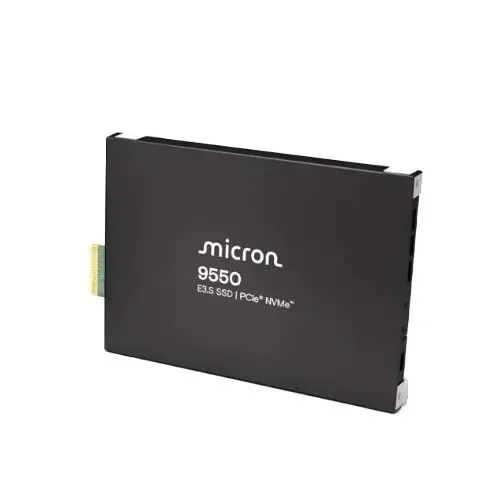
| Model | 9550 MAX |
| Capacity | 12280GB |
| Usage Class | Enterprise |
| Host Interface | PCIe Gen5 NVMe |
|---|---|
| Total Interface Bandwidth | 32 Gb/s |
| Form Factor | E3.S 1T |
|---|
| NAND Flash | 3D TLC |
|---|---|
| Drive Writes Per Day | 3 |
| Total Bytes Written | 67232 TBW |
| Sequential Read | 14000 MB/s |
|---|---|
| Sequential Write | 10000 MB/s |
| Random Read IOPS | 3300000 |
| Random Write IOPS | 1050000 |
| Average Latency | 60 μs |
| Mean Time Between Failures | 2.5 Million Hours |
|---|---|
| Uncorrectable Bit Error Rate | 1.0×10⁻¹⁷ |
| Power Loss Protection | Yes |
The Micron 9550 MAX 12.28TB is purpose-built for AI data staging, large-scale OLTP, and high-density virtualization clusters that need both extreme Gen5 performance and sustained write endurance, delivering up to 14,000/10,000 MB/s and 3.3M/1.05M IOPS with 3 DWPD and 67,232 TBW. Compared with typical capacity-matched PCIe Gen5 TLC drives that prioritize read speed over durability, this model stands out by pairing top-tier random performance with write-heavy enterprise endurance, making it a stronger fit for latency-sensitive mixed workloads.
With an endurance rating of 67,232 TBW and 3 DWPD, this SSD is designed to sustain very heavy write activity throughout its service life, making it well suited for write-intensive enterprise workloads as well as continuously active system or application storage. In typical deployment scenarios, this level of endurance provides a very large margin for long-term daily operation, allowing buyers to use it with confidence for years without endurance becoming a practical concern. For enterprise reliability, built-in power-loss protection (PLP) helps preserve in-flight data and protect metadata integrity during unexpected power interruptions, reducing the risk of corruption and unplanned recovery events. Its UBER of 1.0E-17 indicates an extremely low unrecoverable bit error rate, supporting high data integrity expectations in business-critical environments where read accuracy and storage reliability are essential.
1. The PCIe Gen5 NVMe architecture, paired with class-leading sequential bandwidth, accelerates checkpoint loading, data staging, and large-file streaming for GPU servers and high-performance storage nodes.
2. Its exceptionally strong random-read capability sustains massive parallel query traffic, making it ideal for latency-sensitive databases, virtualized clusters, and AI feature-serving workloads.
3. The enterprise-grade endurance profile supports heavy daily overwrite cycles with predictable reliability, fitting write-intensive logging, caching, and mixed-workload infrastructure.
4. Built on 3D TLC NAND, the drive balances high density, stable performance, and lower cost per usable terabyte for mainstream enterprise deployment at scale.
5. The very low typical latency helps reduce tail-response times, improving application consistency for real-time analytics, transactional systems, and performance-critical cloud services.
Lower capacity reference: 7.68TB Higher capacity reference: 15.36TB At 12.28TB, this model sits in the sweet spot of the family. Compared with the 7.68TB option, it provides meaningfully more headroom for data growth, overprovisioning, and mixed-workload consolidation without changing the platform or the expected enterprise-class latency and throughput profile. Compared with the 15.36TB drive, it usually reaches a more efficient cost point while keeping a very similar real-world performance envelope, which helps control budget at scale. It is especially well suited for mid-sized infrastructure, such as a 12-node virtualization or Kubernetes cluster with steady expansion plans.
Q: Is MTFDLBQ12T8THB-1BK1DABYYR suitable for a write-heavy database server?
A: Yes. With 3 DWPD endurance, 67,232 TBW, 3D TLC NAND, and low 60 µs typical latency, this SSD is well suited for write-intensive database and enterprise transaction workloads.
Q: How many full drive writes per day can it actually endure over its warranty period?
A: It is rated for 3 full drive writes per day (3 DWPD) over the warranty period. For a 12,280GB drive, that equals approximately 36.84TB of writes per day.
Q: Does it include power loss protection (PLP) and why is that critical?
A: Yes, it includes power loss protection. PLP helps preserve in-flight data and metadata during unexpected outages, reducing corruption risk and improving reliability for databases, virtualization, and other critical enterprise workloads.
Q: What RAID level is recommended for this SSD?
A: RAID choice depends on your priority. RAID 10 is commonly recommended for high-performance, write-heavy applications because it balances speed, redundancy, and rebuild safety better than RAID 5 or RAID 6.