











 Secure payments
Standard refund policy
Trade Assurance
Secure payments
Standard refund policy
Trade Assurance
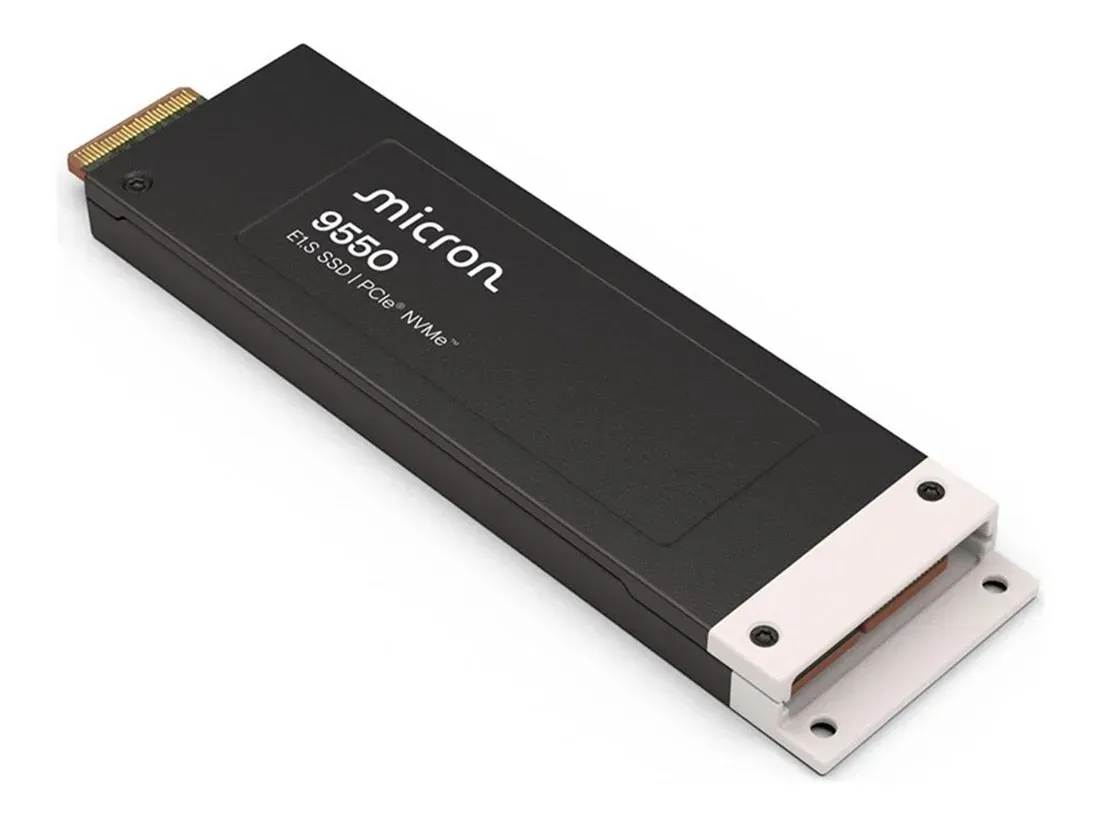
| Brand | Micron |
|---|---|
| Model | 9550 PRO |
| Capacity | 7680GB |
| Usage Class | Enterprise |
| Host Interface | PCIe Gen5 NVMe |
|---|---|
| Total Interface Bandwidth | 32 Gb/s |
| Form Factor | E1.S 9.5mm |
|---|
| NAND Flash | 3D TLC |
|---|---|
| Drive Writes Per Day | 1 |
| Total Bytes Written | 14016 TBW |
| Sequential Read | 14000 MB/s |
|---|---|
| Sequential Write | 10000 MB/s |
| Random Read IOPS | 3300000 |
| Random Write IOPS | 400000 |
| Average Latency | 60 μs |
| Mean Time Between Failures | 2.5 Million Hours |
|---|---|
| Uncorrectable Bit Error Rate | 1.0×10⁻¹⁷ |
| Power Loss Protection | Yes |
The MTFDLBT7T6THA-1BK1JABYY 9550 PRO 7.68TB is purpose-built for AI data pipelines, high-frequency analytics, and large-scale virtualization tiers that need Gen5 bandwidth, delivering up to 14,000/10,000 MB/s and 3.3M random-read IOPS from durable 3D TLC NAND. With 1 DWPD endurance and 14,016 TBW at this capacity point, it offers a strong balance of sustained performance density and write life for read-intensive enterprise deployments where fast dataset access and predictable service levels matter most.
With an endurance rating of 14,016 TBW and 1 DWPD, this SSD is designed to handle sustained daily writes across its full capacity throughout its service life, making it well suited for demanding enterprise workloads. In typical server use, especially as a boot or system drive, this level of endurance provides ample headroom for many years of reliable operation and should not be a practical wear concern. For enterprise reliability, the drive includes power-loss protection (PLP), which helps preserve data in flight and protects against corruption if power is interrupted unexpectedly. Its UBER of 1.0E-17 indicates an extremely low rate of uncorrectable bit errors, supporting high data integrity, while the 2.5 million hour MTBF further reflects a design built for stable, continuous operation.
1. The latest-generation PCIe and NVMe architecture provides ultra-fast host connectivity, helping AI clusters, scale-out databases, and analytics platforms move more data with less pipeline congestion.
2. Its top-tier sequential read performance accelerates model loading, checkpoint restores, and large-file streaming, reducing wait time for data-intensive enterprise workloads.
3. Exceptional random read capability enables dense virtualization, high-QPS online transaction processing, and metadata-heavy applications to sustain massive parallel access with consistent responsiveness.
4. A one-drive-write-per-day endurance profile is well suited for read-centric cloud infrastructure and mixed enterprise workloads, balancing service life, fleet reliability, and storage TCO.
5. Built on 3D TLC NAND and paired with very low typical latency, the drive delivers an efficient blend of capacity, predictable QoS, and fast access times for latency-sensitive production environments.
Lower reference capacity: 3840GB Higher reference capacity: 15360GB At 7680GB, this SSD sits in the sweet spot of the family. Compared with the 3840GB model, it provides much better headroom for dataset growth, VM density, and write buffering, reducing the need for early drive expansion. Compared with the 15360GB option, it keeps acquisition cost, power, and replacement budget under tighter control while delivering essentially the same enterprise-class sequential throughput and random IOPS profile. This makes 7680GB especially well suited for mid-scale virtualization clusters, database nodes, or hyperconverged infrastructure with balanced capacity and performance targets.
Q: Is MTFDLBT7T6THA-1BK1JABYY suitable for a write-heavy database server?
A: It can support mixed-use or moderate write-intensive database workloads, but with 1 DWPD, it is not ideal for extremely write-heavy environments. Higher-endurance models are better for sustained heavy writes.
Q: How many full drive writes per day can it actually endure over its warranty period?
A: This SSD is rated for 1 DWPD, meaning it can handle one full drive write per day across its warranty period, supported by a total endurance rating of 14,016 TBW.
Q: Does it include power loss protection (PLP) and why is that critical?
A: Yes, it includes power loss protection. PLP helps preserve in-flight data and metadata during sudden outages, which is critical for maintaining data integrity and reducing corruption risks in enterprise systems.
Q: What RAID level is recommended for this SSD?
A: RAID 10 is commonly recommended for databases needing strong performance and redundancy. For capacity-focused applications, RAID 5 or RAID 6 may also be considered, depending on workload and rebuild tolerance.