











 Secure payments
Standard refund policy
Trade Assurance
Secure payments
Standard refund policy
Trade Assurance
| Brand | Samsung |
|---|---|
| Model | T7 |
| Capacity | 1TB |
| Usage Class | Client |
| Host Interface | USB |
|---|---|
| Total Interface Bandwidth | 10 Gb/s |
| Form Factor | Portable |
|---|
| NAND Flash | TLC V-NAND |
|---|---|
| Drive Writes Per Day | 0.1 |
| Total Bytes Written | 300 TBW |
| Sequential Read | 1050 MB/s |
|---|---|
| Sequential Write | 1000 MB/s |
| Random Read IOPS | 50000 |
| Random Write IOPS | 50000 |
| Average Latency | 60 μs |
| Mean Time Between Failures | 1.5 Million Hours |
|---|---|
| Uncorrectable Bit Error Rate | 1.0×10⁻¹⁷ |
| Power Loss Protection | No |
| MPN | MU-PA1T0B |
|---|
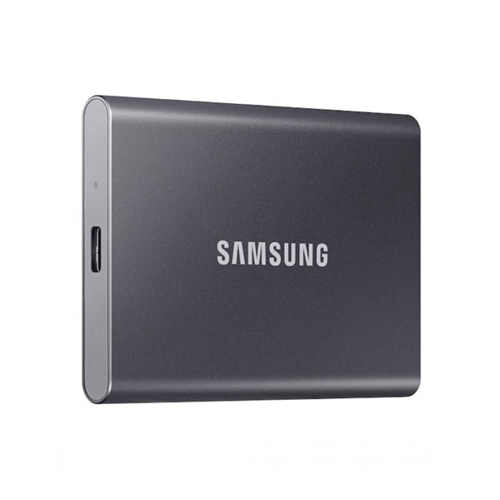
The MU-PC1T0T/AM (T7) delivers a clear generational step over the MU-PA1T0B, nearly doubling sequential performance to 1050/1000 MB/s and improving small-file responsiveness with up to 50,000/50,000 IOPS over the same compact USB portable-SSD class. For engineers who need fast external scratch, backup, or field-transfer storage, its 1TB TLC V-NAND design and 300 TBW endurance provide a stronger balance of throughput, consistency, and durability than the previous generation.
With an endurance rating of 300 TBW, the MU-PC1T0T/AM can sustain writing a total of 300 terabytes over its service life, which is more than sufficient for typical client and light business workloads. In practical terms, if it is used as an OS or office-work system drive and writes around 80 GB per day, it would support roughly 10 years of use before reaching its TBW rating, so everyday deployment can be considered low risk from an endurance standpoint. Its specified UBER of 1.0E-15 means the expected unrecoverable bit error rate is one bit per 10^15 bits read, which is a standard level for modern SSDs and suitable for mainstream commercial applications, especially when combined with normal system-level error handling and backups. This model does not include power-loss protection (PLP), so it is best suited for notebooks, desktops, and other environments where sudden power interruption is infrequent, while applications requiring guaranteed in-flight write protection during unexpected outages should consider a drive with PLP.
1. The USB interface enables true plug-and-play deployment, making this drive ideal for fast data handoff, portable backup workflows, and edge-side content transport without requiring server-class backplanes.
2. Its strong sequential read performance accelerates large file transfers, reducing wait time for media assets, analytics datasets, and system images in high-throughput business workflows.
3. High random read capability helps the drive respond quickly to scattered small-block requests, improving application snappiness for indexing, caching, and metadata-heavy workloads.
4. The low DWPD rating indicates it is best suited for read-focused enterprise use cases such as content distribution, reference data access, and external backup retention rather than sustained write-intensive logging or transactional workloads.
5. TLC V-NAND provides a balanced mix of capacity, performance, and cost efficiency, making it a practical choice for organizations that need dependable flash storage at scale without paying a premium for niche endurance tiers.
Lower capacity reference: 500GB Higher capacity reference: 2TB In this series, the 1TB model sits at the sweet spot between the 500GB and 2TB options. Compared with 500GB, it gives much more headroom for OS images, application stacks, logs, and working datasets, reducing capacity pressure as environments grow. Compared with 2TB, it typically delivers nearly the same sequential and random performance profile while keeping acquisition cost and fleet standardization more efficient. This makes 1TB a balanced choice for mid-scale deployments, such as storage nodes supporting about 40 to 60 mixed-use virtual desktop instances.
Q: Is MU-PC1T0T/AM suitable for a write-heavy database server?
A: No. MU-PC1T0T/AM is not recommended for a write-heavy database server. Its USB interface, 0.1 DWPD endurance, 300 TBW rating, and lack of PLP make it better for light client or portable storage use.
Q: How many full drive writes per day can it actually endure over its warranty period?
A: It is rated for 0.1 DWPD, meaning about 0.1 full drive write per day. For a 1TB model, that is roughly 100GB of writes daily on average, within its endurance design.
Q: Does it include power loss protection (PLP) and why is that critical?
A: No, this model does not include power loss protection. PLP is critical in server and database workloads because it helps prevent in-flight data loss or metadata corruption during sudden power interruption.
Q: What RAID level is recommended for this SSD?
A: For this SSD, RAID 1 is the safer minimum if redundancy is required, while RAID 10 is preferable for better performance and fault tolerance. It is not ideal for mission-critical server RAID deployments.