











 Secure payments
Standard refund policy
Trade Assurance
Secure payments
Standard refund policy
Trade Assurance
| Brand | Samsung |
|---|---|
| Model | T7 Shield |
| Capacity | 2 TB |
| Usage Class | Portable / Consumer |
| Host Interface | USB 3.2 Gen2 |
|---|---|
| Total Interface Bandwidth | 10 Gb/s |
| Form Factor | Portable |
|---|
| NAND Flash | Samsung V-NAND 3-bit TLC |
|---|---|
| Drive Writes Per Day | 0.3 |
| Total Bytes Written | 600 TBW |
| Sequential Read | 1050 MB/s |
|---|---|
| Sequential Write | 1000 MB/s |
| Random Read IOPS | 100000 |
| Random Write IOPS | 100000 |
| Average Latency | 80 μs |
| Mean Time Between Failures | 1.5 Million Hours |
|---|---|
| Uncorrectable Bit Error Rate | 1.0×10⁻¹⁷ |
| Power Loss Protection | No |
| MPN | MU-PC2T0T/AM |
|---|
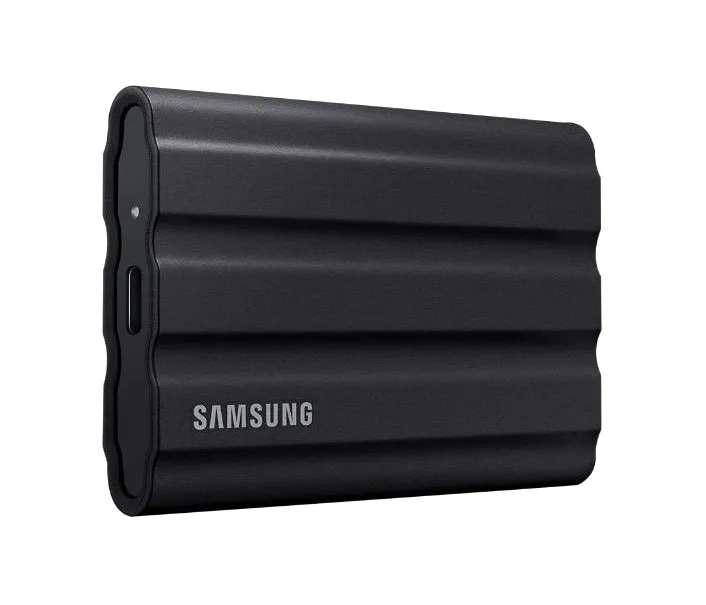
The MU-PE2T0S/AM T7 Shield 2 TB is the stronger field-deployment choice for high-speed external content capture, media shuttle, and mobile backup, combining USB 3.2 Gen2 performance up to 1050/1000 MB/s with Samsung V-NAND 3-bit TLC endurance rated for 600 TBW and 100,000/100,000 IOPS. Compared with the previous MU-PC2T0T/AM, it maintains the same top-tier throughput and endurance profile while upgrading to the T7 Shield platform, making it the more robust and deployment-ready option for professionals who need sustained portable performance in harsher working environments.
With an endurance rating of 600 TBW, the MU-PE2T0S/AM is well suited for typical OS, boot, office, and general business workloads, where daily write volume is usually modest. In practical terms, 600 TBW is equivalent to about 160 GB of writes per day for 10 years, so as a system drive or for read-focused applications, it can be deployed with strong confidence in long-term wear life. For reliability, the specified UBER of 1.0E-15 means the drive is designed for a very low rate of unrecoverable read errors, supporting dependable data reads in normal enterprise operation. This model does not include power-loss protection (PLP), so while it remains a solid choice for non-write-critical use cases, systems that require protection for in-flight data during sudden power interruption should pair it with stable power design such as a UPS or select a PLP-equipped SSD.
1. The USB 3.2 Gen2 interface gives this drive plug-and-play deployment across modern servers, edge systems, and service laptops, making high-speed data mobility far easier without requiring internal expansion slots.
2. Its strong sequential read performance accelerates large-file transfers, OS image distribution, and media or backup retrieval, helping teams cut wait time during bulk data access.
3. The high random read capability is well suited for VM boot storms, metadata-heavy workloads, and analytics queries where fast access to many small files directly improves system responsiveness.
4. With enterprise-focused endurance tuned for read-centric usage, it is a practical fit for content distribution, reference datasets, and external tiered storage where predictable reliability matters more than heavy daily overwrites.
5. Samsung V-NAND 3-bit TLC, paired with low typical latency, delivers a balanced mix of cost efficiency, capacity density, and snappy application response for business workloads that need dependable flash performance at scale.
Reference capacities in the same MU-PE series for the 2 TB model MU-PE2T0S/AM are: Lower capacity: 1 TB Typical model: MU-PE1T0S/AM Sequential read/write: up to 1,050 / 1,000 MB/s Random read/write: up to 98K / 88K IOPS Higher capacity: 4 TB Typical model: MU-PE4T0S/AM Sequential read/write: up to 1,050 / 1,000 MB/s Random read/write: up to 98K / 88K IOPS Capacity positioning analysis: In this series, 2 TB is the sweet-spot capacity. Compared with the 1 TB version, it gives much better headroom for dataset growth, snapshots, staging files, and longer retention without forcing early storage expansion. Compared with the 4 TB model, it delivers essentially the same day-to-day performance while keeping acquisition cost and unused capacity risk under tighter control. That makes 2 TB the best-balanced choice for edge servers, branch-office storage nodes, or a compact virtualization host supporting roughly 20 to 30 light-to-medium workload instances.
Q: Is MU-PE2T0S/AM suitable for a write-heavy database server?
A: No. With 0.3 DWPD, 600 TBW, TLC NAND, USB 3.2 Gen2 interface, and no PLP, MU-PE2T0S/AM is better suited for portable storage or light-to-moderate workloads, not write-heavy database servers.
Q: How many full drive writes per day can it actually endure over its warranty period?
A: Its endurance rating is 0.3 DWPD, meaning about 0.3 full drive writes per day. For a 2 TB drive, that is roughly 600 GB of writes daily, aligning with 600 TBW total endurance.
Q: Does it include power loss protection (PLP) and why is that critical?
A: No, it does not include power loss protection. PLP is critical in transactional or enterprise environments because it helps prevent in-flight data loss and metadata corruption during unexpected power interruptions.
Q: What RAID level is recommended for this SSD?
A: For critical data, RAID 1 or RAID 10 is generally recommended for redundancy and stable performance. However, because this is a USB SSD without PLP, it is not ideal for production RAID deployments.