











 Secure payments
Standard refund policy
Trade Assurance
Secure payments
Standard refund policy
Trade Assurance
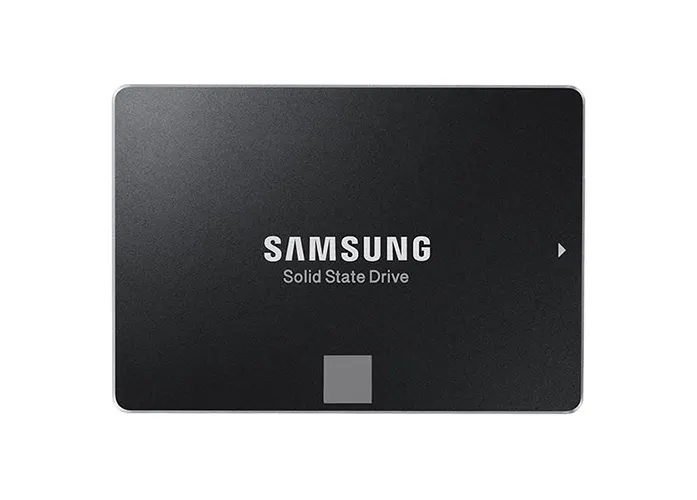
| Brand | Samsung |
|---|---|
| Model | 850 EVO |
| Capacity | 1 TB |
| Usage Class | Client / Consumer |
| Host Interface | SATA 6Gb/s |
|---|---|
| Total Interface Bandwidth | 6 Gb/s |
| Form Factor | 2.5 |
|---|
| NAND Flash | Samsung V-NAND 3bit TLC |
|---|---|
| Drive Writes Per Day | 0.3 |
| Total Bytes Written | 150 TBW |
| Sequential Read | 540 MB/s |
|---|---|
| Sequential Write | 520 MB/s |
| Random Read IOPS | 98000 |
| Random Write IOPS | 90000 |
| Average Latency | 50 μs |
| Mean Time Between Failures | 1.5 Million Hours |
|---|---|
| Uncorrectable Bit Error Rate | 1.0×10⁻¹⁷ |
| Power Loss Protection | No |
| MPN | MZ-7TE1T0BW |
|---|
Compared with the previous-generation MZ-7TE1T0BW, the MZ-75E1T0BW upgrades to Samsung V-NAND 3-bit TLC and increases rated endurance to 150 TBW, delivering a clear generational gain in write durability while sustaining top-tier SATA 6Gb/s performance at 540/520 MB/s. For 1 TB client and workstation deployments, its 98,000/90,000 IOPS random performance and 0.3 DWPD profile make it a stronger long-life choice than typical SATA TLC drives for OS, application, and mixed daily productivity workloads.
With an endurance rating of 150 TBW, the MZ-75E1T0BW can sustain about 41 GB of writes per day for 10 years, which is more than enough for typical OS, office, web, and general business workloads. In practical terms, when used as a boot or system drive rather than a heavy write-intensive database disk, this level of endurance supports long, trouble-free service within normal client and light commercial usage. For reliability, the specified UBER of 1.0E-15 means the drive is designed for a very low unrecoverable bit error rate, helping maintain data integrity during normal read operations. This model does not include power-loss protection (PLP), so while it is well suited for standard desktop and system use, applications with frequent sudden power interruption or write-in-flight protection requirements should use a platform with stable power backup or a drive with onboard PLP.
1. The SATA 6Gb/s interface, paired with full-bus sequential read performance, provides a cost-efficient drop-in upgrade for enterprise servers and storage arrays that need faster backup, boot, and bulk data access without changing existing SATA infrastructure.
2. With up to 98,000 random read IOPS, this SSD can accelerate metadata-heavy workloads such as virtualization, web hosting, and database lookups by serving far more small-block requests per second than mechanical storage.
3. A 0.3 DWPD endurance profile makes it well suited for read-centric enterprise deployments like content delivery, boot volumes, and analytics repositories where capacity and steady service life matter more than intensive daily rewrites.
4. Samsung V-NAND 3bit TLC enables higher storage density and better power efficiency, helping businesses lower cost per terabyte while maintaining the consistency required for always-on datacenter operation.
5. The typical 50 µs latency supports highly responsive application behavior, reducing storage wait time in transactional workloads and improving user experience in multi-VM and latency-sensitive server environments.
Lower capacity: 500 GB Higher capacity: 2 TB In this series, the 1 TB model sits at the sweet spot for mainstream enterprise deployment. Compared with the 500 GB version, it offers much better headroom for OS images, application growth, logs, and overprovisioning, reducing the risk of early capacity pressure. Compared with the 2 TB option, it preserves nearly the same enterprise-class read/write behavior while delivering a more attractive cost-per-node and simpler budget scaling. It is especially well suited for medium-sized virtualization clusters, such as hosting boot and application volumes for around 40 to 60 business service instances.
Q: Is MZ-75E1T0BW suitable for a write-heavy database server?
A: Generally, no. With Samsung V-NAND 3bit TLC and 0.3 DWPD, MZ-75E1T0BW is better suited for read-intensive or mixed workloads rather than sustained write-heavy database server applications.
Q: How many full drive writes per day can it actually endure over its warranty period?
A: This model is rated for 0.3 DWPD, meaning about 0.3 full drive writes per day. For a 1 TB SSD, that equals roughly 300 GB of writes daily.
Q: Does it include power loss protection (PLP) and why is that critical?
A: No, it does not include PLP. Power loss protection is critical in enterprise environments because it helps prevent in-flight data loss and reduces corruption risks during unexpected power outages.
Q: What RAID level is recommended for this SSD?
A: RAID 1 or RAID 10 is typically recommended, depending on capacity and performance needs. These levels improve redundancy and availability, which is especially important since this SSD has no PLP.