











 Secure payments
Standard refund policy
Trade Assurance
Secure payments
Standard refund policy
Trade Assurance
| Brand | Samsung |
|---|---|
| Model | 860 PRO |
| Capacity | 256GB |
| Usage Class | Client |
| Host Interface | SATA |
|---|---|
| Total Interface Bandwidth | 6 Gb/s |
| Form Factor | 2.5 |
|---|
| NAND Flash | MLC V-NAND |
|---|---|
| Drive Writes Per Day | 0.65 |
| Total Bytes Written | 300 TBW |
| Sequential Read | 560 MB/s |
|---|---|
| Sequential Write | 530 MB/s |
| Random Read IOPS | 100000 |
| Random Write IOPS | 90000 |
| Average Latency | 50 μs |
| Mean Time Between Failures | 1.5 Million Hours |
|---|---|
| Uncorrectable Bit Error Rate | 1.0×10⁻¹⁷ |
| Power Loss Protection | No |
| MPN | MZ-75P256 |
|---|
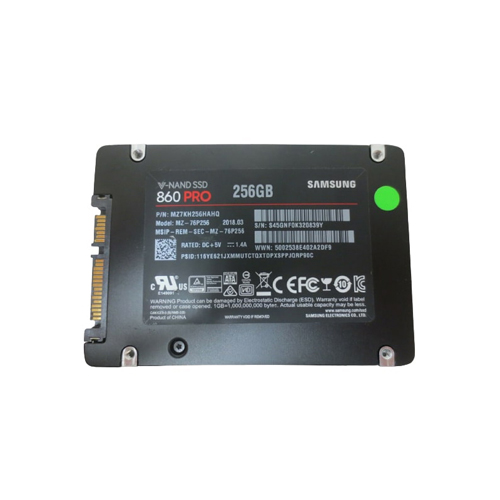
The Samsung 860 PRO 256GB (MZ-76P256) is the stronger choice for write-intensive SATA deployments that still require premium client SSD endurance, combining MLC V-NAND with 300 TBW / 0.65 DWPD, 560/530 MB/s sequential performance, and up to 100,000/90,000 IOPS. Compared with the previous-generation MZ-75P256, it doubles endurance from 150 TBW to 300 TBW while also improving sequential throughput from 550/520 MB/s to 560/530 MB/s, making it a more durable and better-balanced option for workstation boot, caching, and high-duty-cycle mixed workloads.
A 300 TBW endurance rating means the drive can handle about 82 GB of host writes per day for 10 years, or around 164 GB per day over 5 years, which is comfortably above the needs of a typical OS, office, and general business workload. With a 0.65 DWPD rating, the MZ-76P256 is a solid choice for use as a system or boot drive and can be deployed with confidence in read-heavy or moderate-write environments. Its 1.0E-15 UBER specification means the expected uncorrectable bit error rate is no worse than one bit per 10^15 bits read, helping ensure stable data integrity during normal operation, while the 1.5 million-hour MTBF reflects strong overall hardware reliability. This model does not include power-loss protection, so it is best suited to systems with stable power or UPS coverage rather than write-critical caching applications, but for standard business PCs and non-mission-critical deployments it remains a dependable option.
1. The SATA interface, paired with 560 MB/s sequential read performance, makes this drive an easy fit for existing enterprise platforms while speeding up OS boot, backup, and large-file access tasks.
2. The 100,000 random-read IOPS capability helps databases, VDI pools, and virtualized application stacks respond faster under highly concurrent access patterns.
3. A 0.65 DWPD endurance rating is well suited for read-centric enterprise workloads that need predictable service life without paying for unnecessary write-heavy overprovisioning.
4. MLC V-NAND provides a stronger balance of endurance, consistency, and data retention than consumer-grade flash, making it a safer choice for always-on business environments.
5. With a typical latency of 50 µs, the drive reduces storage wait time enough to improve transaction responsiveness and keep CPU resources better utilized in latency-sensitive systems.
Reference capacities in the same Samsung 860 PRO series for MPN MZ-76P256: Lower capacity: None in-series; 256GB is the base capacity point of the 860 PRO lineup Higher capacity: 512GB (MZ-76P512) Capacity positioning analysis: In the 860 PRO family, the 256GB model sits at the practical sweet spot for entry enterprise-style deployments. Compared with a hypothetical smaller drive, it offers more breathing room for OS images, logs, swap, metadata, and overprovisioning, reducing early capacity pressure. Compared with the 512GB version, it preserves nearly the same sequential and random performance profile while keeping acquisition cost tighter and improving budget efficiency per node. It is best suited for small virtualization clusters, branch-office servers, or roughly 20 to 30 lightweight virtual desktop system drives.
Q: Is MZ-76P256 suitable for a write-heavy database server?
A: MZ-76P256 is not the best choice for a write-heavy database server. Its 0.65 DWPD, SATA interface, and lack of PLP make it better suited for mixed-read or moderate-write workloads.
Q: How many full drive writes per day can it actually endure over its warranty period?
A: Based on 300 TBW and 256GB capacity, the drive supports about 1,170 full-drive writes total. Over a typical 5-year warranty, that equals roughly 0.64 drive writes per day.
Q: Does it include power loss protection (PLP) and why is that critical?
A: No, this model does not include power loss protection. PLP is critical because it helps preserve in-flight data and mapping tables during sudden outages, reducing corruption and consistency risks.
Q: What RAID level is recommended for this SSD?
A: For business or database use, RAID 10 is generally recommended. It provides strong redundancy and better write performance than parity RAID, which is important for SATA SSDs without PLP.