











 Secure payments
Standard refund policy
Trade Assurance
Secure payments
Standard refund policy
Trade Assurance
| Brand | Samsung |
|---|---|
| Model | 860 PRO |
| Capacity | 2 TB |
| Usage Class | Client / Consumer |
| Host Interface | SATA 6.0 Gbps |
|---|---|
| Total Interface Bandwidth | 6 Gb/s |
| Form Factor | 2.5" |
|---|
| NAND Flash | Samsung V-NAND 2bit MLC |
|---|---|
| Drive Writes Per Day | 0.66 |
| Total Bytes Written | 2400 TBW |
| Sequential Read | 560 MB/s |
|---|---|
| Sequential Write | 530 MB/s |
| Random Read IOPS | 100000 |
| Random Write IOPS | 90000 |
| Average Latency | 120 μs |
| Mean Time Between Failures | 1.5 Million Hours |
|---|---|
| Uncorrectable Bit Error Rate | 1.0×10⁻¹⁷ |
| Power Loss Protection | No |
| MPN | MZ-WLL3T2B |
|---|
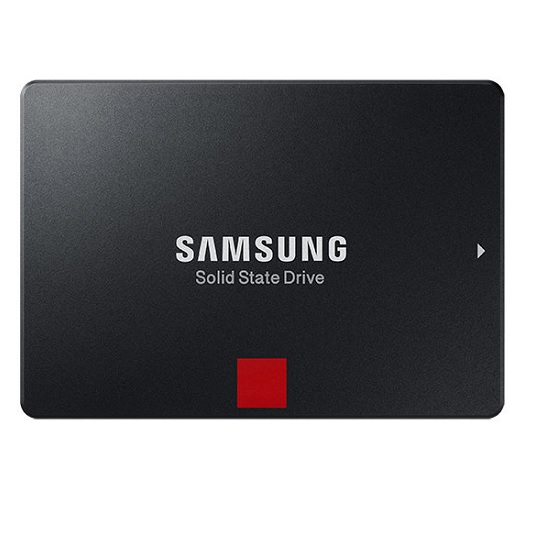
The Samsung 860 PRO 2TB (MZ-76P2T0) is the stronger choice for write-intensive SATA deployments such as database logs, virtualization boot clusters, and edge caching, because its Samsung V-NAND 2-bit MLC, 2400 TBW endurance, and 100,000/90,000 IOPS deliver near-interface-limit performance with enterprise-class write durability. Compared with the previous MZ-WLL3T2B generation, MZ-76P2T0 provides a clear generational step up in endurance headroom and sustained random I/O consistency, making it a more dependable long-life platform where SATA compatibility must be retained.
With an endurance rating of 2400 TBW, this 2TB SSD can sustain a very large amount of data written over its service life, far beyond the needs of a typical OS, application, or boot drive. In practical terms, under common enterprise system-disk workloads, it provides ample margin for long-term use and can comfortably support many years of operation, including 10+ years in lighter daily-write scenarios. An UBER of 1.0E-15 means the drive is designed for a very low uncorrectable bit error rate, which helps ensure strong data integrity and dependable read performance in business use. This model does not include power-loss protection (PLP), so while it remains reliable for general system and application workloads, environments that require guaranteed protection for in-flight writes during sudden power failure should pair it with a stable power path such as a UPS or choose a PLP-equipped model.
1. The SATA 6.0 Gbps interface, paired with near-saturation sequential read performance, makes this drive a practical drop-in upgrade for legacy enterprise servers and storage arrays that need faster bulk data access without changing backplane infrastructure.
2. Its 100,000 random-read IOPS capability helps virtualized workloads, OLTP databases, and metadata-heavy applications respond more smoothly under concurrency, reducing queue buildup during peak demand.
3. A 0.66 DWPD endurance rating is well suited to read-centric enterprise deployments, giving operators predictable lifespan and lower replacement frequency in content delivery, boot, and analytics tiers.
4. Samsung V-NAND 2-bit MLC provides stronger write durability and consistency than TLC-based alternatives, making it a safer choice for business-critical environments where sustained performance matters over the long term.
5. With a typical latency of 120 µs, the drive supports faster transaction handling and snappier application response, which is especially valuable in latency-sensitive server workloads and shared storage pools.
Lower capacity: 1 TB Higher capacity: 4 TB At 2 TB, the MZ-76P2T0 sits in the sweet spot of the series. Compared with the 1 TB model, it gives much more headroom for OS images, application growth, snapshots, and workload bursts, reducing the need for early capacity expansion. Compared with the 4 TB version, it usually delivers the best balance of acquisition cost, usable space, and consistently strong enterprise-class performance. This makes it especially well suited for mid-sized virtualization clusters, such as hosting boot and application volumes for roughly 40 to 60 business workloads.
Q: Is MZ-76P2T0 suitable for a write-heavy database server?
A: MZ-76P2T0 can support moderate to relatively heavy write workloads, but it is not ideal for highly write-intensive database servers. For sustained enterprise database writes, a model with PLP and higher endurance is recommended.
Q: How many full drive writes per day can it actually endure over its warranty period?
A: Based on its 0.66 DWPD rating, the 2 TB MZ-76P2T0 can handle about 0.66 full drive writes per day. This aligns with its 2400 TBW endurance over an estimated 5-year warranty period.
Q: Does it include power loss protection (PLP) and why is that critical?
A: No, this model does not include power loss protection. PLP is critical in server environments because it helps prevent in-flight data loss and metadata corruption during unexpected power failures.
Q: What RAID level is recommended for this SSD?
A: For most server deployments, RAID 1 or RAID 10 is recommended to balance redundancy and performance. If capacity efficiency is more important, RAID 5 or 6 may be considered with caution.