











 Secure payments
Standard refund policy
Trade Assurance
Secure payments
Standard refund policy
Trade Assurance
| Brand | Samsung |
|---|---|
| Model | 870 EVO |
| Capacity | 1 TB |
| Usage Class | Client / Consumer |
| Host Interface | SATA 6.0 Gbps |
|---|---|
| Total Interface Bandwidth | 6 Gb/s |
| Form Factor | 2.5" |
|---|
| NAND Flash | Samsung V-NAND 3-bit TLC |
|---|---|
| Drive Writes Per Day | 0.33 |
| Total Bytes Written | 600 TBW |
| Sequential Read | 560 MB/s |
|---|---|
| Sequential Write | 530 MB/s |
| Random Read IOPS | 98000 |
| Random Write IOPS | 88000 |
| Average Latency | 45 μs |
| Mean Time Between Failures | 1.5 Million Hours |
|---|---|
| Uncorrectable Bit Error Rate | 1.0×10⁻¹⁷ |
| Power Loss Protection | No |
| MPN | MZ7KM1T9HMJP-00005 |
|---|
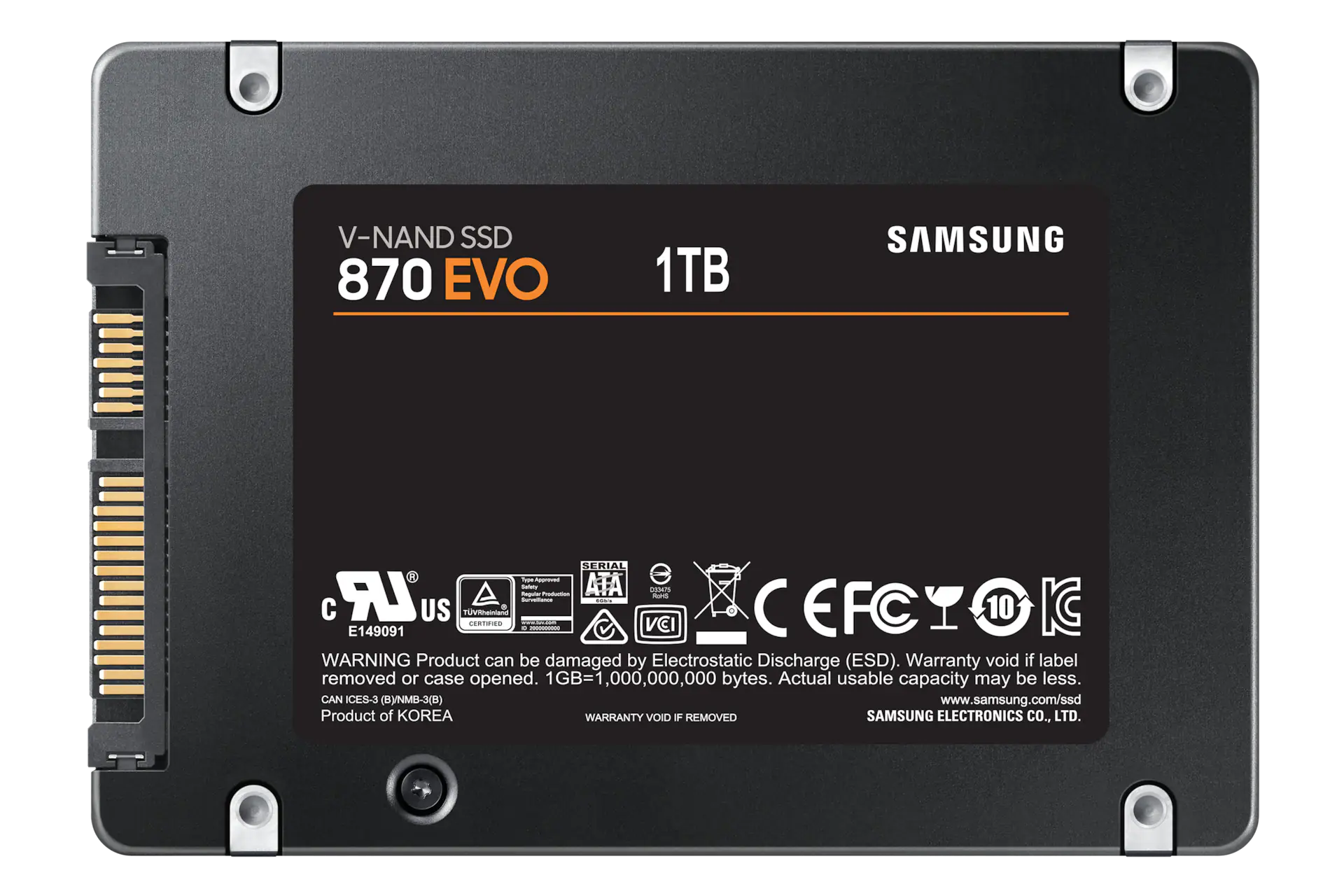
For SATA-constrained upgrade paths, the Samsung 870 EVO 1 TB (MZ-77E1T0B/AM) is a strong engineering choice because it pushes the interface close to its practical limit at 560/530 MB/s and 98,000/88,000 IOPS while still delivering 600 TBW with Samsung V-NAND 3-bit TLC. Compared with the older MZ7KM1T9HMJP-00005, it provides a newer-generation Samsung TLC V-NAND platform tuned for higher-capacity client and workstation deployments, giving you a better balance of throughput, endurance, and mainstream 1 TB SATA compatibility in the same 2.5-inch SSD class.
With an endurance rating of 600 TBW and 0.33 DWPD, the MZ-77E1T0B/AM can sustain writing about 164 GB per day for 10 years, which is well above the write volume of a typical OS, office, and general business workstation. In practical terms, for boot-drive and mainstream client workloads, this level of endurance provides long service life with comfortable headroom. Its rated UBER of 1.0E-15 and 1.5 million-hour MTBF indicate a mature, highly reliable SSD platform designed for stable day-to-day operation and low risk of uncorrectable read errors under normal use. This model does not include power-loss protection, so while it is a solid choice for client and non-transactional systems, applications with frequent sudden power interruptions or write-critical enterprise caching should use platforms with PLP for maximum data-in-flight protection.
1. The SATA 6.0 Gbps interface, paired with near bus-saturating sequential read performance, makes this drive a drop-in upgrade for legacy enterprise platforms that need faster boot, imaging, and large-file retrieval without changing storage infrastructure.
2. Its strong random read capability enables virtualization hosts, OLTP databases, and metadata-heavy applications to serve far more small-block requests with less queue buildup during peak demand.
3. The 0.33 DWPD endurance profile is well aligned with read-centric enterprise workloads such as content delivery, analytics serving, and boot-from-SAN cache layers where capacity efficiency matters more than sustained write intensity.
4. Samsung V-NAND 3-bit TLC balances flash density, power efficiency, and predictable cost, giving IT teams a practical medium for scaling read-focused storage tiers while maintaining enterprise-grade reliability controls.
5. With a typical latency of 45 µs, the drive helps reduce storage response time at the application layer, improving VM responsiveness, accelerating transaction lookups, and supporting tighter service-level consistency.
Lower capacity reference: 500 GB Higher capacity reference: 2 TB The 1 TB MZ-77E1T0B/AM sits at the sweet spot of the series. Compared with the 500 GB model, it gives much better headroom for OS images, application stacks, logs, and steady data growth, reducing the need for early capacity expansion. Compared with the 2 TB version, it delivers nearly the same sequential throughput and random IOPS while keeping acquisition cost and per-node storage budgets under tighter control. It is best suited for small to mid-sized deployments, such as 30 to 50 virtual desktops or several light database and application servers.
Q: Is MZ-77E1T0B/AM suitable for a write-heavy database server?
A: Not ideally. With 0.33 DWPD, 600 TBW, TLC NAND, and no power loss protection, this model is better for client, read-focused, or light mixed workloads than write-heavy database servers.
Q: How many full drive writes per day can it actually endure over its warranty period?
A: It is rated for 0.33 drive writes per day, meaning about one-third of its 1 TB capacity can be written daily over the warranty period, consistent with its 600 TBW endurance rating.
Q: Does it include power loss protection (PLP) and why is that critical?
A: No, it does not include PLP. Power loss protection is critical in servers because it helps prevent in-flight data loss and metadata corruption during unexpected power interruptions or system crashes.
Q: What RAID level is recommended for this SSD?
A: For general server use, RAID 1 or RAID 10 is typically recommended for better redundancy and performance. RAID 5 may work, but parity writes can increase write amplification and wear.