











 Secure payments
Standard refund policy
Trade Assurance
Secure payments
Standard refund policy
Trade Assurance
| Brand | Samsung |
|---|---|
| Model | 870 EVO |
| Capacity | 500 GB |
| Usage Class | Client / Consumer |
| Host Interface | SATA 6.0 Gbps |
|---|---|
| Total Interface Bandwidth | 6 Gb/s |
| Form Factor | 2.5" |
|---|
| NAND Flash | Samsung V-NAND 3-bit TLC |
|---|---|
| Drive Writes Per Day | 0.33 |
| Total Bytes Written | 300 TBW |
| Sequential Read | 560 MB/s |
|---|---|
| Sequential Write | 530 MB/s |
| Random Read IOPS | 98000 |
| Random Write IOPS | 88000 |
| Average Latency | 50 μs |
| Mean Time Between Failures | 1.5 Million Hours |
|---|---|
| Uncorrectable Bit Error Rate | 1.0×10⁻¹⁷ |
| Power Loss Protection | No |
| MPN | MZ7LH960HAJR-00005 |
|---|
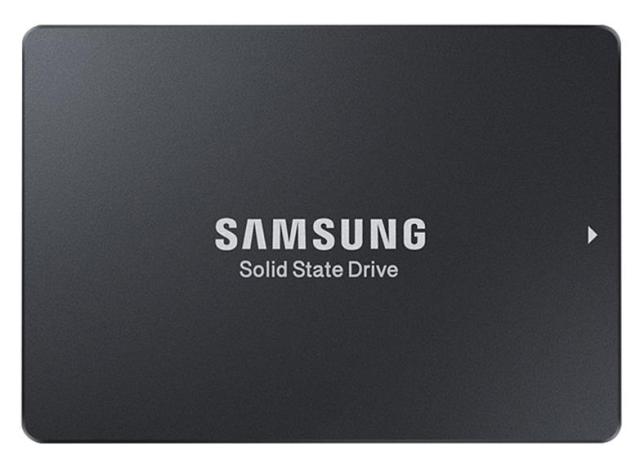
The Samsung 870 EVO 500GB (MZ-77E500BW) is a strong choice for SATA-limited systems that need near-interface-max performance, delivering 560/530 MB/s sequential throughput and up to 98,000/88,000 IOPS random performance with Samsung V-NAND 3-bit TLC and a 300 TBW endurance rating. Compared with the older MZ7LH960HAJR-00005 generation, MZ-77E500BW provides a more modern SATA platform tuned for higher client responsiveness and more efficient performance scaling in mainstream desktop, notebook, and upgrade workloads.
With a rated endurance of 300 TBW, this SSD can sustain about 82 GB of host writes per day for 10 years, or roughly 164 GB per day for 5 years, which is well above the write volume of a typical OS, office, and general business system drive. In practical procurement terms, that makes it a safe choice for client PCs, boot drives, and standard workstation use, where daily writes are usually far lower than the rated limit. Its UBER of 1.0E-15 indicates a very low unrecoverable read error rate, helping ensure strong data integrity during normal operation and large-volume reads. This model does not include power-loss protection (PLP), so while it is reliable for standard client and non-transaction-critical workloads, systems that must protect in-flight data during sudden power failure should use a UPS or consider a drive with onboard PLP.
1. The SATA interface enables drop-in deployment across widely used enterprise backplanes and servers, simplifying upgrades without changing existing storage infrastructure.
2. Its strong sequential read performance helps accelerate system boot, large file retrieval, and backup restore operations on SATA-based platforms.
3. The high random read capability is well suited for metadata-heavy databases, virtual desktop farms, and read-intensive application servers that demand fast small-block access.
4. Built on Samsung V-NAND TLC with read-focused endurance, it offers a practical balance of cost efficiency and reliability for enterprise boot, caching, and content delivery workloads.
5. The low typical latency helps maintain responsive service levels in virtualized and latency-sensitive environments, reducing wait time for transactional reads.
Lower capacity reference: 250 GB Higher capacity reference: 1 TB Typical performance reference within the same series: 250 GB: up to 560 MB/s read, 530 MB/s write, up to 98K/88K random read/write IOPS 500 GB: up to 560 MB/s read, 530 MB/s write, up to 98K/88K random read/write IOPS 1 TB: up to 560 MB/s read, 530 MB/s write, up to 98K/88K random read/write IOPS At 500 GB, the MZ-77E500BW sits at the sweet spot of the family. Compared with the 250 GB model, it gives much better headroom for OS images, application stacks, logs, and future data growth, reducing the risk of early capacity pressure. Compared with the 1 TB version, it keeps acquisition cost and fleet-wide budget under tighter control while delivering essentially the same everyday performance. This makes it a strong fit for small to mid-sized virtualization clusters, such as hosting boot and utility volumes for about 30 to 50 lightweight virtual machines.
Q: Is MZ-77E500BW suitable for a write-heavy database server?
A: MZ-77E500BW is generally not recommended for write-heavy database servers. Its 0.33 DWPD, 300 TBW rating, TLC NAND, and lack of PLP make it better for client or light mixed-use workloads.
Q: How many full drive writes per day can it actually endure over its warranty period?
A: This model is rated at 0.33 DWPD, meaning about one-third of its 500 GB capacity can be written daily over the warranty period, equivalent to roughly 165 GB of writes per day.
Q: Does it include power loss protection (PLP) and why is that critical?
A: No, this SSD does not include power loss protection. PLP is critical in server environments because it helps prevent in-flight data loss and metadata corruption during unexpected power interruptions.
Q: What RAID level is recommended for this SSD?
A: For this SSD, RAID 1 is commonly recommended for OS or light business workloads requiring redundancy. For higher performance and fault tolerance, RAID 10 is preferable over parity-based RAID in write-sensitive environments.