











 Secure payments
Standard refund policy
Trade Assurance
Secure payments
Standard refund policy
Trade Assurance
| Brand | Samsung |
|---|---|
| Model | PM897 |
| Capacity | 3.84TB |
| Usage Class | Mixed Use |
| Host Interface | SATA 6.0 Gbps |
|---|---|
| Total Interface Bandwidth | 6 Gb/s |
| Form Factor | 2.5-inch |
|---|
| NAND Flash | Samsung V6 (128-layer) TLC |
|---|---|
| Drive Writes Per Day | 3 |
| Total Bytes Written | 21024 TBW |
| Sequential Read | 550 MB/s |
|---|---|
| Sequential Write | 470 MB/s |
| Random Read IOPS | 97000 |
| Random Write IOPS | 32000 |
| Average Latency | 100 μs |
| Mean Time Between Failures | 2 Million Hours |
|---|---|
| Uncorrectable Bit Error Rate | 1.0×10⁻¹⁷ |
| Power Loss Protection | Yes |
| MPN | MZ7LH3T8HMLT |
|---|
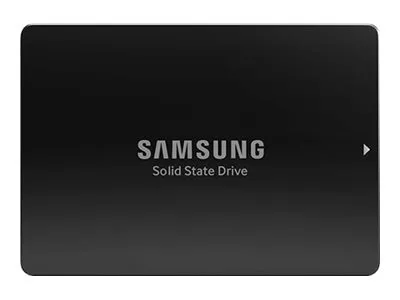
Compared with the previous-generation MZ7LH3T8HMLT, the Samsung PM897 MZ-7L33T8B advances to Samsung V6 128-layer TLC and combines 3.84TB capacity with 3 DWPD and 21,024 TBW while sustaining near-SATA-limit performance of up to 550/470 MB/s and 97K/32K IOPS. That gives it a clear advantage for write-intensive enterprise SATA deployments—such as mixed-transaction databases, boot storms, and virtualization tiers—where higher endurance density and stronger random-read responsiveness matter more than simply matching legacy SATA throughput.
With an endurance rating of 21,024 TBW and 3 DWPD, the MZ-7L33T8B is designed for sustained enterprise write workloads and can comfortably handle typical system-drive, virtualization, caching, or mixed-use server scenarios over many years of operation. In practical terms, this level of write endurance means buyers can expect long service life with substantial margin, making it a very safe choice for always-on business environments rather than light-duty client usage. For enterprise reliability, the drive includes Power Loss Protection (PLP), which helps preserve in-flight data and protects metadata integrity during an unexpected power interruption, reducing the risk of corruption and unclean shutdown issues. Its UBER of 1.0E-17 indicates an extremely low unrecoverable bit error rate, supporting high data integrity expectations in data center and mission-critical storage deployments.
1. The SATA interface makes this drive a drop-in upgrade for mainstream enterprise servers and storage arrays, delivering dependable compatibility without requiring a platform refresh.
2. Its near-SATA-limit sequential read performance accelerates boot storms, backup restores, and large file retrieval in read-heavy data center workloads.
3. Strong random read capability helps databases, virtualization clusters, and metadata-intensive applications respond faster under highly concurrent access patterns.
4. The enterprise endurance rating supports sustained daily rewrite activity, making it well suited for write-active workloads such as logging, caching, and transactional systems.
5. Samsung’s advanced V-NAND TLC and low typical latency combine to deliver consistent QoS, faster application responsiveness, and better rack-level efficiency for latency-sensitive services.
Lower capacity: 1.92TB Higher capacity: 7.68TB The 3.84TB model sits at the sweet spot of this enterprise SSD family. Compared with 1.92TB, it gives much better headroom for VM growth, database expansion, and longer refresh cycles without forcing early capacity upgrades. Compared with 7.68TB, it keeps acquisition cost and per-node storage spending under tighter control while delivering essentially the same mainstream enterprise performance profile in sequential throughput and random IOPS. This makes 3.84TB especially well suited for mid-scale virtualization clusters, such as hosting boot and application volumes for roughly 60 to 90 business workloads per server.
Q: Is MZ-7L33T8B suitable for a write-heavy database server?
A: Yes. The MZ-7L33T8B is well suited for write-heavy database workloads, thanks to its 3 DWPD endurance, 21,024 TBW rating, low 100 µs latency, and enterprise-grade Samsung V6 TLC NAND.
Q: How many full drive writes per day can it actually endure over its warranty period?
A: This model is rated for 3 full drive writes per day. With 3.84TB capacity, that equals about 11.52TB of writes daily throughout its supported warranty endurance period.
Q: Does it include power loss protection (PLP) and why is that critical?
A: Yes, it includes power loss protection. PLP helps preserve in-flight data and metadata during sudden outages, which is critical for preventing corruption and maintaining storage consistency in enterprise systems.
Q: What RAID level is recommended for this SSD?
A: RAID 10 is commonly recommended for this SSD in performance-sensitive and write-intensive environments, as it balances speed, redundancy, and rebuild efficiency better than RAID 5 for demanding enterprise workloads.