











 Secure payments
Standard refund policy
Trade Assurance
Secure payments
Standard refund policy
Trade Assurance
| Brand | Samsung |
|---|---|
| Model | PM893 |
| Capacity | 7.68 TB |
| Usage Class | Read Intensive |
| Host Interface | SATA 6.0 Gbps |
|---|---|
| Total Interface Bandwidth | 6 Gb/s |
| Form Factor | 2.5" |
|---|
| NAND Flash | Samsung V-NAND 6th-Gen 128-layer 3D TLC |
|---|---|
| Drive Writes Per Day | 1.3 |
| Total Bytes Written | 17520 TBW |
| Sequential Read | 550 MB/s |
|---|---|
| Sequential Write | 530 MB/s |
| Random Read IOPS | 98000 |
| Random Write IOPS | 30000 |
| Average Latency | 140 μs |
| Mean Time Between Failures | 2 Million Hours |
|---|---|
| Uncorrectable Bit Error Rate | 1.0×10⁻¹⁷ |
| Power Loss Protection | Yes |
| MPN | MZ7L37T6HBLA-00007 |
|---|
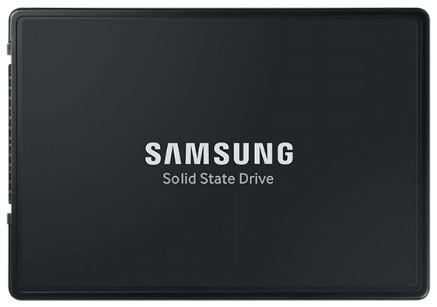
The Samsung PM893 MZ-7L37T600 is the stronger drop-in SATA refresh over MZ7L37T6HBLA-00007, moving to 6th-Gen 128-layer V-NAND to deliver a denser 7.68 TB footprint with 17,520 TBW endurance while sustaining near-SATA-limit performance at 550/530 MB/s and 98K/30K IOPS. Compared with the previous-generation part, it offers a more modern NAND platform and a better capacity-to-rack-slot ratio, making it a particularly solid choice for read-centric virtualization, scale-out storage, and mixed enterprise boot/data tiers that still standardize on SATA 6 Gb/s.
With an endurance rating of 17,520 TBW and 1.3 DWPD, the MZ-7L37T600 is designed for sustained enterprise write workloads and can comfortably handle typical mixed-use server or storage applications over many years. In practical terms, for lighter duties such as OS, boot, logging, or general-purpose application storage, this level of endurance provides long-term headroom and can support worry-free operation for up to a decade under normal workload conditions. Its enterprise reliability profile is further strengthened by power-loss protection, which helps preserve in-flight data and metadata during unexpected power interruptions, reducing the risk of corruption and unplanned recovery events. Combined with an ultra-low UBER of 1.0E-17 and a 2 million hour MTBF, this SSD is built to deliver very high data integrity and dependable service in business-critical environments.
1. The SATA 6.0 Gbps interface paired with 550 MB/s sequential read performance provides a drop-in upgrade for legacy enterprise servers and storage arrays, accelerating boot, backup, and large-file streaming without requiring a PCIe infrastructure refresh.
2. With 98,000 K IOPS in random reads and a typical latency of 140 µs, the drive helps databases, virtual desktop farms, and metadata-heavy workloads respond faster under mixed transactional pressure.
3. A 1.3 DWPD endurance rating gives enterprises the write resilience needed for always-on business applications, reducing replacement risk in steady-state 24/7 environments.
4. Samsung V-NAND 6th-Gen 128-layer 3D TLC enables higher bit density with mature enterprise flash behavior, balancing cost efficiency, power characteristics, and dependable sustained operation.
5. Overall, this specification set makes the MZ-7L37T600 well suited for read-centric enterprise tiers where predictable responsiveness, platform compatibility, and controlled TCO matter more than headline PCIe bandwidth.
Lower capacity reference: 3.84 TB. Higher capacity reference: 15.36 TB, used as an adjacent enterprise benchmark because 7.68 TB is typically the top capacity in this exact Samsung SATA family. At 7.68 TB, this model sits in the sweet spot of the lineup. Compared with 3.84 TB, it gives much better headroom for dataset growth, VM sprawl, and longer refresh cycles without changing the expected enterprise SATA performance profile. Compared with 15.36 TB, it usually offers a more attractive balance of acquisition cost, usable capacity, and steady-state efficiency. It is especially well suited for mid-scale virtualization clusters, such as hosting boot and application volumes for roughly 60 to 80 general-purpose virtual machines.
Q: Is MZ-7L37T600 suitable for a write-heavy database server?
A: Yes. With 1.3 DWPD, 17,520 TBW endurance, low 140 µs typical latency, and Samsung 6th-Gen 128-layer V-NAND TLC, it is well suited for write-intensive database and transactional workloads.
Q: How many full drive writes per day can it actually endure over its warranty period?
A: The rated endurance is 1.3 DWPD, meaning the 7.68 TB drive can sustain about 9.98 TB of writes per day across its warranty period, based on the manufacturer’s specification.
Q: Does it include power loss protection (PLP) and why is that critical?
A: Yes, it supports power loss protection. PLP helps preserve in-flight data and mapping tables during sudden outages, reducing corruption risk and improving reliability in enterprise and database environments.
Q: What RAID level is recommended for this SSD?
A: RAID 10 is commonly recommended for database workloads, as it balances performance, redundancy, and rebuild efficiency. For capacity-focused deployments, RAID 5 or RAID 6 may also be considered.