











 Secure payments
Standard refund policy
Trade Assurance
Secure payments
Standard refund policy
Trade Assurance
| Brand | Samsung |
|---|---|
| Model | PM1635a |
| Capacity | 1.6 TB |
| Usage Class | Mixed Use |
| Host Interface | SAS 12.0 Gbps |
|---|---|
| Total Interface Bandwidth | 12 Gb/s |
| Form Factor | 2.5" |
|---|
| NAND Flash | Samsung V-NAND 3D TLC |
|---|---|
| Drive Writes Per Day | 3 |
| Total Bytes Written | 8760 TBW |
| Sequential Read | 1400 MB/s |
|---|---|
| Sequential Write | 1150 MB/s |
| Random Read IOPS | 200000 |
| Random Write IOPS | 45000 |
| Average Latency | 90 μs |
| Mean Time Between Failures | 2 Million Hours |
|---|---|
| Uncorrectable Bit Error Rate | 1.0×10⁻¹⁷ |
| Power Loss Protection | Yes |
| MPN | MZQLB1T9HAJR-00007 |
|---|
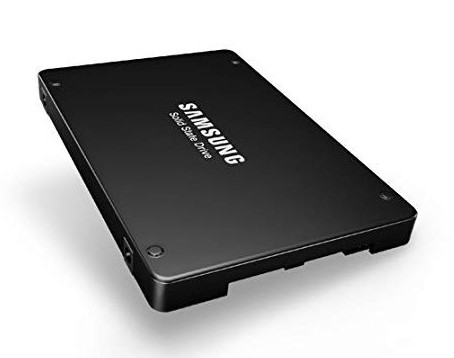
The Samsung PM1635a (MZ-ILS1T6N) delivers a strong enterprise balance of 1.6 TB capacity, 12 Gbps SAS connectivity, and Samsung V-NAND 3D TLC, with up to 1400/1150 MB/s and 200K/45K IOPS for latency-sensitive database, virtualization, and OLTP environments. Compared with MZQLB1T9HAJR-00007, it adds the operational advantages of enterprise SAS deployment—especially dual-port, high-availability storage integration—while pairing that with a robust 3 DWPD and 8,760 TBW endurance profile for more write-intensive, mission-critical workloads.
With an endurance rating of 8,760 TBW, the MZ-ILS1T6N is designed for sustained enterprise use and supports writing the full drive capacity about three times per day. In typical workloads such as OS, boot, application, and general server system-disk usage, this provides very large write headroom and can comfortably support long-term deployment, often making 10-year system-disk use a realistic expectation from an endurance perspective. Its built-in power-loss protection (PLP) helps preserve in-flight data and mapping-table integrity during unexpected power interruptions, reducing the risk of corruption and unplanned recovery events. Combined with an enterprise-class UBER of 1.0E-17 and a 2 million hour MTBF, it delivers a very low probability of unrecoverable read errors and the dependable behavior procurement teams expect for business-critical environments.
1. The SAS 12.0 Gbps interface provides proven enterprise interoperability and dual-port reliability, making it ideal for highly available storage arrays and mission-critical server backplanes.
2. With 1400 MB/s sequential read performance, the drive speeds up large-file access such as backup restores, virtual machine boot storms, and analytics data scans.
3. Its 200K random-read IOPS capability helps databases and virtualization platforms sustain fast response under heavy concurrent access.
4. Rated for 3 DWPD, this SSD is built for write-intensive enterprise workloads, allowing frequent full-drive overwrites without compromising service life.
5. Samsung V-NAND 3D TLC combined with 90 µs typical latency delivers a strong balance of capacity efficiency, power-optimized flash architecture, and consistently responsive application performance.
Lower capacity reference: 800 GB Higher capacity reference: 3.2 TB Capacity positioning analysis: In this enterprise SSD family, 1.6 TB is the practical sweet spot. Compared with the 800 GB model, it provides much better headroom for OS images, database growth, logging, and mixed virtualized workloads, reducing early capacity pressure and refresh frequency. Compared with the 3.2 TB version, it delivers nearly the same enterprise-class throughput and IOPS while keeping acquisition cost, power, and $/usable deployment risk better balanced. It is especially well suited for mid-scale clusters, such as a 3 to 5 node virtualization environment or a compact OLTP database tier.
Q: Is MZ-ILS1T6N suitable for a write-heavy database server?
A: Yes. With 3 DWPD endurance, 8,760 TBW, 12Gbps SAS, and 90 µs typical latency, the MZ-ILS1T6N is well suited for write-intensive database and enterprise transactional workloads.
Q: How many full drive writes per day can it actually endure over its warranty period?
A: This model is rated for 3 DWPD, meaning it can sustain three full 1.6 TB drive writes per day across its warranty term, equivalent to the specified 8,760 TBW endurance.
Q: Does it include power loss protection (PLP) and why is that critical?
A: Yes, it includes power loss protection. PLP helps preserve in-flight data and metadata during unexpected outages, reducing corruption risk and supporting data integrity in enterprise server and storage environments.
Q: What RAID level is recommended for this SSD?
A: RAID choice depends on your workload. For database servers, RAID 10 is commonly recommended for the best balance of performance, redundancy, and rebuild efficiency; RAID 5/6 prioritizes usable capacity.