











 Secure payments
Standard refund policy
Trade Assurance
Secure payments
Standard refund policy
Trade Assurance
| Brand | Samsung |
|---|---|
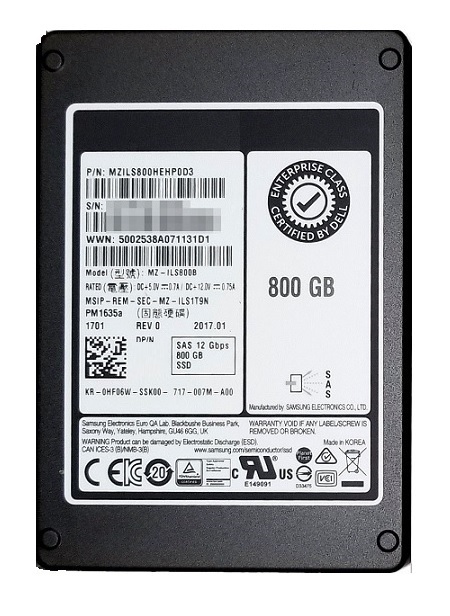
| Model | PM1635a |
| Capacity | 800GB |
| Usage Class | Enterprise |
| Host Interface | SAS 12Gb/s |
|---|---|
| Total Interface Bandwidth | 12 Gb/s |
| Form Factor | 2.5 |
|---|
| NAND Flash | Samsung V-NAND 3bit MLC (TLC) |
|---|---|
| Drive Writes Per Day | 3 |
| Total Bytes Written | 4380 TBW |
| Sequential Read | 1350 MB/s |
|---|---|
| Sequential Write | 1100 MB/s |
| Random Read IOPS | 190000 |
| Random Write IOPS | 35000 |
| Average Latency | 110 μs |
| Mean Time Between Failures | 2 Million Hours |
|---|---|
| Uncorrectable Bit Error Rate | 1.0×10⁻¹⁷ |
| Power Loss Protection | Yes |
| MPN | MZILS800HEGR |
|---|
Compared with the previous-generation MZILS800HEGR, the Samsung PM1635a (MZ-ILS800B) advances the platform with 12Gb/s SAS performance up to 1350/1100 MB/s and 190K/35K IOPS, while sustaining enterprise-class endurance at 3 DWPD and 4,380 TBW. For 800GB tier-1 storage in OLTP databases, virtualization clusters, and write-intensive server workloads, its Samsung V-NAND 3bit MLC (TLC) design delivers a stronger balance of throughput, endurance, and deployment longevity than the earlier part.
With an endurance rating of 4,380 TBW and 3 DWPD, the MZ-ILS800B is built to handle heavy daily write workloads over its service life. In typical enterprise or workstation use, this level of endurance means it can reliably serve as a system or application drive for many years without endurance concerns. The MZ-ILS800B also includes enterprise-class reliability features such as power loss protection (PLP), which helps preserve in-flight data and protect metadata integrity during unexpected power interruptions. Its UBER of 1.0E-17 and 2 million-hour MTBF indicate a very low probability of uncorrectable bit errors and strong long-term operational reliability, giving purchasers added confidence for business-critical deployments.
1. The SAS 12Gb/s interface paired with 1350 MB/s sequential read performance enables smooth integration into dual-port enterprise storage arrays while accelerating large-block workloads such as backup, restore, and data warehouse scans.
2. With 190,000 K IOPS random read capability, this SSD helps virtualized databases and high-concurrency application servers respond faster under heavy mixed-user access patterns.
3. A 3 DWPD endurance rating makes it well suited for write-intensive enterprise workloads, supporting sustained daily overwrites in environments like OLTP, logging, and cache tiers.
4. Samsung V-NAND 3bit MLC (TLC) provides a strong balance of cost efficiency, capacity scaling, and flash reliability, making it practical for enterprise deployments that need predictable performance at volume.
5. The 110 µs typical latency helps reduce storage wait time at the application layer, improving transaction responsiveness for latency-sensitive workloads such as real-time analytics and financial systems.
Lower capacity reference: 400GB Higher capacity reference: 1.6TB In this series, the 800GB model sits at the practical sweet spot. Compared with the 400GB version, it offers much better headroom for OS images, application binaries, logs, and steady data growth, reducing early capacity pressure. Compared with the 1.6TB option, it delivers nearly the same enterprise-class sequential and random performance while keeping acquisition cost and $/IO balance more controlled. This makes 800GB a strong fit for mid-sized virtualization clusters, database nodes, or hyperconverged infrastructure needing predictable latency without overprovisioning capacity.
Q: Is MZ-ILS800B suitable for a write-heavy database server?
A: Yes. With 3 DWPD, 4380 TBW endurance, 12Gb/s SAS, and 110 µs typical latency, the MZ-ILS800B is well suited for write-intensive database, logging, and transactional server workloads.
Q: How many full drive writes per day can it actually endure over its warranty period?
A: It is rated for 3 full drive writes per day. For an 800GB SSD, that equals about 2.4TB of writes daily across the warranty period, consistent with 4380 TBW.
Q: Does it include power loss protection (PLP) and why is that critical?
A: Yes, it includes power loss protection. PLP helps preserve in-flight data and metadata during unexpected outages, reducing corruption risk and improving reliability in enterprise and database environments.
Q: What RAID level is recommended for this SSD?
A: RAID 10 is generally recommended for this SSD in performance-critical servers, as it balances redundancy and write performance. RAID 1 or RAID 5/6 may fit capacity-focused or mixed workloads.