











 Secure payments
Standard refund policy
Trade Assurance
Secure payments
Standard refund policy
Trade Assurance
| Brand | Samsung |
|---|---|
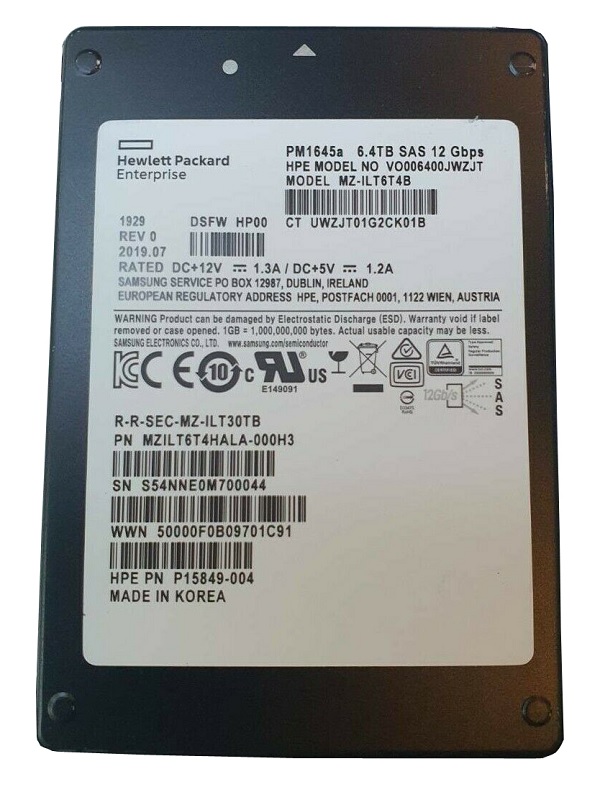
| Model | PM1645a |
| Capacity | 6.4 TB |
| Usage Class | Mixed Use |
| Host Interface | SAS 12Gb/s |
|---|---|
| Total Interface Bandwidth | 12 Gb/s |
| Form Factor | 2.5 |
|---|
| NAND Flash | Samsung V-NAND 3D TLC |
|---|---|
| Drive Writes Per Day | 3 |
| Total Bytes Written | 35040 TBW |
| Sequential Read | 2300 MB/s |
|---|---|
| Sequential Write | 2000 MB/s |
| Random Read IOPS | 440000 |
| Random Write IOPS | 90000 |
| Average Latency | 100 μs |
| Mean Time Between Failures | 2 Million Hours |
|---|---|
| Uncorrectable Bit Error Rate | 1.0×10⁻¹⁷ |
| Power Loss Protection | Yes |
| MPN | MZILS6T4HCHP-00007 |
|---|
Compared with the previous-generation MZILS6T4HCHP-00007, the Samsung PM1645a (MZ-ILT6T4B) delivers a clear generational step forward in mixed-enterprise SAS storage by pairing 6.4 TB of Samsung V-NAND 3D TLC with 2,300/2,000 MB/s sequential performance and up to 440K/90K IOPS for higher throughput and stronger transaction responsiveness in the same 12Gb/s SAS class. Its 3 DWPD endurance and 35,040 TBW make it a particularly strong fit for write-intensive virtualization, OLTP databases, and enterprise caching tiers, where it offers a better balance of endurance, capacity density, and sustained performance than the older MZILS6T4HCHP-00007.
With an endurance rating of 35,040 TBW and 3 DWPD, the MZ-ILT6T4B is built for sustained, write-intensive enterprise workloads over its full service life. In practical terms, this level of endurance is far beyond typical OS, application, and boot-drive usage, giving procurement teams confidence that it can serve as a system or infrastructure drive for many years without endurance concern under normal deployment conditions. For enterprise reliability, the drive includes Power Loss Protection (PLP), which helps preserve in-flight data and metadata during unexpected power interruptions, reducing the risk of corruption and unplanned recovery events. Its UBER of 1.0E-17, together with a 2 million hour MTBF, reflects a high-integrity enterprise design intended to minimize uncorrectable read errors and support dependable operation in business-critical environments.
1. The SAS 12Gb/s interface provides dual-port enterprise connectivity and broad server compatibility, enabling highly available storage paths for mission-critical systems.
2. With 2300 MB/s sequential read throughput, the drive accelerates large-block workloads such as backup recovery, data warehousing scans, and media stream ingestion.
3. Delivering 440,000 K IOPS random read performance, it supports dense virtualization and transactional databases by reducing storage bottlenecks under heavy concurrent access.
4. Rated for 3 DWPD endurance, the SSD is built for write-intensive enterprise applications that require sustained daily overwrite capacity throughout the service life of the drive.
5. Samsung V-NAND 3D TLC with 100 µs typical latency combines enterprise-grade flash density with consistently fast response times, helping improve application QoS in latency-sensitive environments.
Lower capacity reference: 3.2 TB Higher capacity reference: 12.8 TB Capacity positioning analysis: Within this enterprise SSD family, the 6.4 TB model sits in a clear sweet spot. Compared with the 3.2 TB version, it gives much better space headroom for OS images, application data, logs, and growth over a typical refresh cycle, reducing early capacity pressure. Compared with the 12.8 TB option, it usually delivers the best balance of acquisition cost, usable capacity, and steady enterprise-class performance without overcommitting budget. It is especially well suited for mid-scale virtualization clusters, such as shared storage for around 40 to 60 general-purpose virtual machines.
Q: Is MZ-ILT6T4B suitable for a write-heavy database server?
A: Yes. The MZ-ILT6T4B is well suited for write-heavy database workloads, thanks to its 3 DWPD endurance, 35,040 TBW rating, SAS 12Gb/s interface, and low 100 µs typical latency.
Q: How many full drive writes per day can it actually endure over its warranty period?
A: It is rated for 3 full drive writes per day. With 6.4 TB capacity, that equals about 19.2 TB of writes daily across the stated warranty period.
Q: Does it include power loss protection (PLP) and why is that critical?
A: Yes, it includes power loss protection. PLP helps preserve in-flight data and mapping tables during sudden outages, which is critical for maintaining data integrity and reducing corruption risk.
Q: What RAID level is recommended for this SSD?
A: For most enterprise deployments, RAID 10 is recommended for the best balance of performance, redundancy, and write efficiency. RAID 5 or 6 may suit capacity-focused environments with lower write demands.