











 Secure payments
Standard refund policy
Trade Assurance
Secure payments
Standard refund policy
Trade Assurance
| Brand | Samsung |
|---|---|
| Model | 850 EVO |
| Capacity | 500GB |
| Usage Class | Client |
| Host Interface | SATA |
|---|---|
| Total Interface Bandwidth | 6 Gb/s |
| Form Factor | M.2 2280 |
|---|
| NAND Flash | TLC V-NAND |
|---|---|
| Drive Writes Per Day | 0.16 |
| Total Bytes Written | 150 TBW |
| Sequential Read | 540 MB/s |
|---|---|
| Sequential Write | 500 MB/s |
| Random Read IOPS | 97000 |
| Random Write IOPS | 89000 |
| Average Latency | 50 μs |
| Mean Time Between Failures | 1.5 Million Hours |
|---|---|
| Uncorrectable Bit Error Rate | 1.0×10⁻¹⁷ |
| Power Loss Protection | No |
| MPN | MZ-N5E250 |
|---|
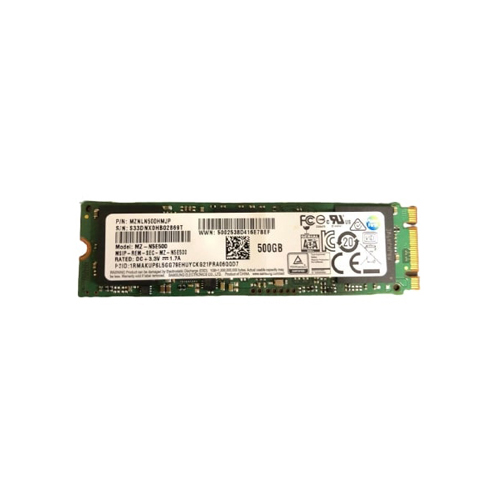
The Samsung 850 EVO MZ-N5E500 delivers a strong upgrade over the MZ-N5E250 by doubling usable capacity to 500GB while maintaining top-tier SATA performance at up to 540/500 MB/s and 97,000/89,000 IOPS for more demanding client and mixed desktop workloads. Its TLC V-NAND architecture and 150 TBW endurance give this MPN a clear value advantage in the SATA tier, enabling higher density and longer service life per drive without moving to a higher-cost interface.
With a rated endurance of 150 TBW, the MZ-N5E500 can sustain about 150,000 GB of total host writes, which is more than enough for typical OS, boot, and office workloads. In practical terms, a system writing 20–40 GB per day would remain well within the endurance rating for roughly 10 years or more, making it a dependable choice for light-duty system-drive use. From a reliability standpoint, the drive is specified at an UBER of 1.0E-15, meaning the risk of an unrecoverable bit error is very low and aligned with standard client SSD expectations, while its 1.5 million-hour MTBF supports confidence in long-term operational stability. It does not include power-loss protection (PLP), so although it is suitable for general computing and boot applications, environments with frequent unexpected power interruptions or critical in-flight write protection requirements should rely on system-level safeguards such as UPS backup or journaling file systems.
1. The SATA interface ensures broad drop-in compatibility with mainstream enterprise servers and storage arrays, making this drive a low-risk upgrade for refresh cycles and mixed-vendor environments.
2. With 540 MB/s sequential read performance, the SSD accelerates boot volumes, log scanning, and large-file retrieval in read-focused business workloads.
3. Delivering 97,000 random read IOPS, it helps databases, virtual desktops, and metadata-heavy applications stay responsive under highly fragmented access patterns.
4. Rated at 0.16 DWPD, this endurance profile is best suited to read-centric enterprise deployments such as content repositories, OS disks, and analytics nodes with modest daily write pressure.
5. Built on TLC V-NAND and featuring a typical latency of 50 µs, the drive balances flash density with consistently fast response time for scalable, cost-efficient enterprise storage.
Lower-capacity reference: 250GB Higher-capacity reference: 1TB In this series, the 500GB model is the practical sweet spot. Compared with the 250GB version, it gives much better headroom for OS growth, application updates, logs, and overprovisioning, reducing the risk of early capacity pressure. Compared with the 1TB option, it preserves nearly the same enterprise-class read/write behavior and random IOPS while keeping acquisition cost and fleet standardization more manageable. This makes 500GB especially well suited for mid-scale virtualization hosts, VDI pools, edge servers, or compact database nodes supporting roughly 25 to 40 mixed-workload instances.
Q: Is MZ-N5E500 suitable for a write-heavy database server?
A: No. The MZ-N5E500 is better suited for read-focused or mixed workloads. With 0.16 DWPD and 150 TBW, it is not recommended for sustained write-heavy database server environments.
Q: How many full drive writes per day can it actually endure over its warranty period?
A: It is rated at 0.16 DWPD, meaning about 16% of the 500GB capacity can be written daily on average over the warranty period, equivalent to roughly 80GB of writes per day.
Q: Does it include power loss protection (PLP) and why is that critical?
A: No, this model does not include power loss protection. PLP is important in enterprise systems because it helps prevent in-flight data loss and metadata corruption during unexpected power interruptions.
Q: What RAID level is recommended for this SSD?
A: For business use, RAID 1 or RAID 10 is generally recommended to improve redundancy and availability. RAID 10 is preferred when you need both fault tolerance and stronger overall performance.