











 Secure payments
Standard refund policy
Trade Assurance
Secure payments
Standard refund policy
Trade Assurance
| Brand | Samsung |
|---|---|
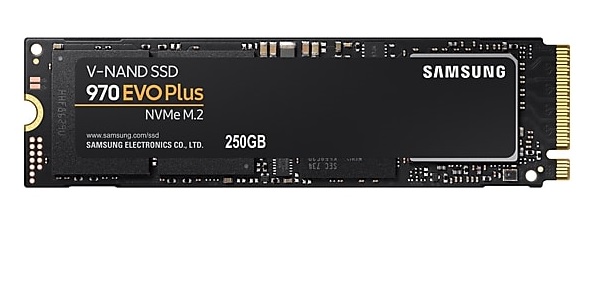
| Model | 970 EVO Plus |
| Capacity | 250GB |
| Usage Class | Client |
| Host Interface | NVMe PCIe Gen3 x4 |
|---|---|
| Total Interface Bandwidth | 32 Gb/s |
| Form Factor | M.2 (2280) |
|---|
| NAND Flash | Samsung V-NAND 3-bit MLC |
|---|---|
| Drive Writes Per Day | 0.3 |
| Total Bytes Written | 150 TBW |
| Sequential Read | 3500 MB/s |
|---|---|
| Sequential Write | 2300 MB/s |
| Random Read IOPS | 250000 |
| Random Write IOPS | 550000 |
| Average Latency | 100 μs |
| Mean Time Between Failures | 1.5 Million Hours |
|---|---|
| Uncorrectable Bit Error Rate | 1.0×10⁻¹⁷ |
| Power Loss Protection | No |
| MPN | MZ-V7E250 |
|---|
Compared with the MZ-V7E250, the MZ-V7S250 970 EVO Plus 250GB delivers a clear generational uplift with sequential write performance up to 2300 MB/s and random write performance up to 550,000 IOPS, while maintaining 3500 MB/s reads on the same NVMe PCIe Gen3 x4 interface. That combination of Samsung V-NAND 3-bit MLC, 150 TBW endurance, and stronger small-block write behavior makes this MPN a better fit for OS boot drives, developer workstations, and latency-sensitive client workloads that need faster write responsiveness in a compact 250GB tier.
With an endurance rating of 150 TBW and 0.3 DWPD, the MZ-V7S250 is well suited for typical client and light business workloads such as OS boot, office applications, web access, and everyday file storage. In practical terms, this level of endurance is generally more than sufficient for use as a system drive over many years under normal daily write volumes, giving buyers confidence in long-term stability for standard deployments. Its UBER rating of 1.0E-15 and 1.5 million-hour MTBF indicate a solid baseline of data integrity and operational reliability, meaning the drive is designed to maintain a very low rate of unrecoverable bit errors during normal use. This model does not include power loss protection (PLP), so while it is appropriate for general-purpose systems, it is best deployed in environments with controlled shutdown behavior or upstream power safeguards where in-flight write protection is not a critical enterprise requirement.
1. The NVMe over PCIe Gen3 x4 architecture provides a low-overhead, high-bandwidth data path that helps virtualized servers, analytics platforms, and database nodes respond faster under heavy parallel workloads.
2. Its strong sequential read capability accelerates large-file streaming and bulk data access, reducing wait time for backup restores, media processing, and dataset loading in enterprise environments.
3. High random read performance enables quick access to small, scattered data blocks, which is especially valuable for OLTP databases, VDI boot storms, and read-intensive application tiers.
4. The endurance profile is best suited to read-centric deployments, giving organizations a cost-effective option for content delivery, boot storage, and reference-data workloads with limited daily write pressure.
5. Samsung V-NAND 3-bit MLC combined with very low typical latency supports consistent responsiveness and efficient flash density, helping cloud and enterprise systems serve transactions with minimal delay while optimizing capacity per drive.
Reference capacities for MPN MZ-V7S250 (250GB): Lower capacity: None in the same MZ-V7S series; 250GB is the entry capacity Higher capacity: 500GB Capacity positioning analysis: Within the MZ-V7S family, 250GB sits at the practical sweet spot. As the smallest standard capacity in the series, it already offers enough headroom for OS images, logs, application binaries, and moderate growth, avoiding the tight free-space pressure common with sub-250GB deployments. Compared with the 500GB model, it preserves nearly the same day-to-day sequential and random performance profile while keeping acquisition cost lower and capacity utilization more efficient. It is best suited for small-to-medium virtualization clusters, such as hosting boot and utility volumes for about 30 to 50 lightweight virtual machines.
Q: Is MZ-V7S250 suitable for a write-heavy database server?
A: No. The MZ-V7S250 is not ideal for write-heavy database workloads. With 0.3 DWPD, 150 TBW, and no PLP, it is better suited for client or light mixed-use environments.
Q: How many full drive writes per day can it actually endure over its warranty period?
A: This model is rated at 0.3 DWPD, meaning it can sustain about 30% of its total capacity in writes per day over the warranty period, equivalent to roughly 75 GB daily.
Q: Does it include power loss protection (PLP) and why is that critical?
A: No, it does not include power loss protection. PLP is critical in server and database environments because it helps prevent in-flight data loss and metadata corruption during unexpected power failures.
Q: What RAID level is recommended for this SSD?
A: For this SSD, RAID 1 or RAID 10 is generally recommended when redundancy and performance are required. RAID 0 may improve speed, but it provides no data protection at all.