











 Secure payments
Standard refund policy
Trade Assurance
Secure payments
Standard refund policy
Trade Assurance
| Brand | Samsung |
|---|---|
| Model | 970 EVO Plus |
| Capacity | 2 TB |
| Usage Class | Client / Consumer |
| Host Interface | PCIe Gen3 x4 |
|---|---|
| Total Interface Bandwidth | 8 Gb/s |
| Form Factor | M.2 2280 |
|---|
| NAND Flash | Samsung V-NAND 3-bit MLC |
|---|---|
| Drive Writes Per Day | 0.33 |
| Total Bytes Written | 1200 TBW |
| Sequential Read | 3500 MB/s |
|---|---|
| Sequential Write | 3300 MB/s |
| Random Read IOPS | 620000 |
| Random Write IOPS | 560000 |
| Average Latency | 30 μs |
| Mean Time Between Failures | 1.5 Million Hours |
|---|---|
| Uncorrectable Bit Error Rate | 1.0×10⁻¹⁷ |
| Power Loss Protection | No |
| MPN | MZ7LH240HAHQ |
|---|
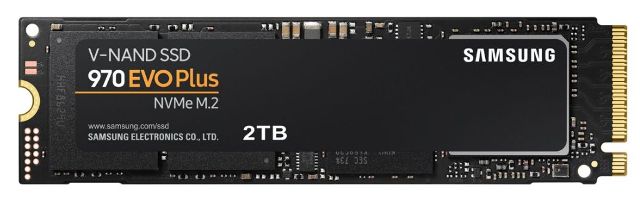
The MZ-V7S2T0BW (970 EVO Plus 2 TB) is a strong upgrade over the MZ7LH240HAHQ, moving from a SATA-class architecture to PCIe Gen3 x4 and delivering up to 3500/3300 MB/s sequential performance with 620,000/560,000 IOPS for dramatically faster boot, build, cache, and scratch-disk workloads. Its 2 TB capacity, 1200 TBW endurance, and Samsung V-NAND 3-bit MLC make it a better-balanced choice than the previous generation for high-intensity client workstations and prosumer systems that need much higher throughput without sacrificing write longevity.
With an endurance rating of 1200 TBW, this 2TB SSD is designed to handle a total of 1.2 petabytes of writes over its service life, which is roughly equivalent to about 330 GB of writes per day for 10 years or about 660 GB per day for 5 years. In typical client, workstation, or system-drive workloads, this provides a very comfortable endurance margin for OS, application, and daily business data use. An UBER of 1.0E-15 means the drive is specified for very low uncorrectable read error rates, supporting strong data integrity in normal operation, while the 1.5 million hour MTBF reflects solid long-term hardware reliability. This model does not include power-loss protection (PLP), so it is best deployed in systems with stable power or UPS support where in-flight write protection during sudden outages is not a strict enterprise requirement.
1. The PCIe Gen3 x4 interface, paired with strong sequential throughput, accelerates large database snapshots, VM image loads, and analytics dataset ingestion without saturating host-side storage lanes.
2. Its high random-read capability enables dense virtualization and read-heavy transactional workloads to serve far more concurrent requests with consistently fast application response.
3. The modest endurance rating makes it best suited for read-centric enterprise deployments such as boot, content delivery, reference data, and reporting tiers rather than sustained write-intensive logging or caching.
4. Samsung V-NAND triple-level-cell flash balances capacity, power efficiency, and operational stability, giving enterprise platforms a cost-effective medium for scaling predictable read-dominant storage.
5. The very low typical latency helps reduce tail-response times, improving SLA consistency for latency-sensitive services such as metadata access, index lookups, and high-frequency query execution.
Lower capacity reference: 1TB Higher capacity reference: No larger standard capacity exists in the same MZ-V7S series; 2TB is the top SKU. In the MZ-V7S lineup, 2TB sits at the sweet spot for buyers who need more headroom than the 1TB model without changing the series or performance class. It gives materially better space flexibility for OS images, active datasets, logs, and overprovisioning, reducing capacity pressure in steady enterprise-style use. At the same time, because there is no larger in-series step, 2TB effectively represents the best balance of cost, usable capacity, and near-constant sequential and random performance. It is well suited for a compact virtualization host running roughly 40 to 60 light-duty virtual desktops.
Q: Is MZ-V7S2T0BW suitable for a write-heavy database server?
A: Not ideal for write-heavy database servers. With 0.33 DWPD, 1200 TBW, and no PLP, it is better suited for client, read-focused, or mixed workloads than intensive enterprise writes.
Q: How many full drive writes per day can it actually endure over its warranty period?
A: It supports about 0.33 full drive writes per day, equal to roughly 660 GB of writes daily on a 2 TB drive, assuming the standard 5-year warranty period.
Q: Does it include power loss protection (PLP) and why is that critical?
A: No, it does not include power loss protection. PLP is critical in servers because it helps prevent in-flight data loss, metadata corruption, and application inconsistency during unexpected power failures.
Q: What RAID level is recommended for this SSD?
A: For critical deployments, RAID 1 or RAID 10 is recommended for redundancy and better fault tolerance. RAID 0 may improve speed, but it is not advised for important data.