











 Secure payments
Standard refund policy
Trade Assurance
Secure payments
Standard refund policy
Trade Assurance
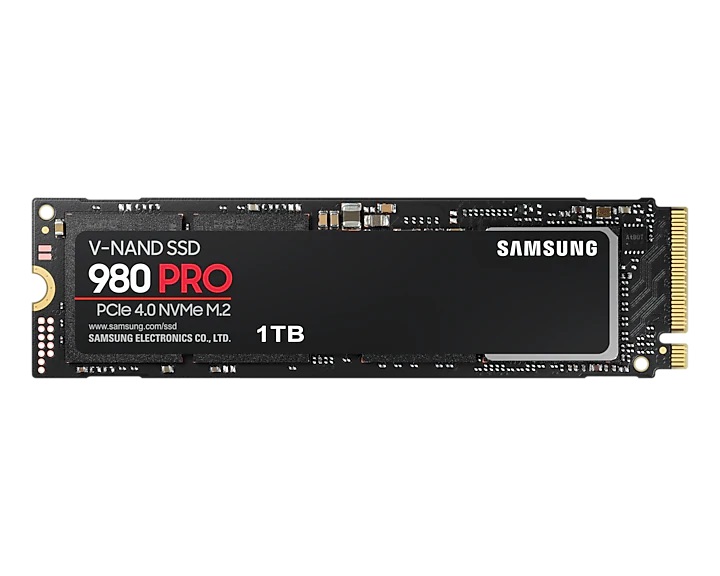
| Brand | Samsung |
|---|---|
| Model | 980 PRO |
| Capacity | 1 TB |
| Usage Class | Client / Consumer |
| Host Interface | PCIe 4.0 x4 |
|---|---|
| Total Interface Bandwidth | 16 Gb/s |
| Form Factor | M.2 (2280) |
|---|
| NAND Flash | Samsung V-NAND 3-bit TLC |
|---|---|
| Drive Writes Per Day | 0.33 |
| Total Bytes Written | 600 TBW |
| Sequential Read | 7000 MB/s |
|---|---|
| Sequential Write | 5000 MB/s |
| Random Read IOPS | 1000000 |
| Random Write IOPS | 1000000 |
| Average Latency | 60 μs |
| Mean Time Between Failures | 1.5 Million Hours |
|---|---|
| Uncorrectable Bit Error Rate | 1.0×10⁻¹⁷ |
| Power Loss Protection | No |
| MPN | MZILT800HAHQ0D3 |
|---|
Compared with the older MZILT800HAHQ0D3, the Samsung 980 PRO 1 TB (MZ-V8P1T0BW) makes a clear generational leap to PCIe 4.0 x4, delivering up to 7000/5000 MB/s and 1,000,000/1,000,000 IOPS for substantially higher throughput and lower latency in workstation boot, code-build, and content-creation pipelines. Its Samsung V-NAND 3-bit TLC paired with 600 TBW endurance gives this drive a stronger performance-per-watt and responsiveness profile than typical PCIe 3.0-class predecessors, making it an especially strong choice for high-intensity desktop and prosumer scratch workloads.
With an endurance rating of 600 TBW and 0.33 DWPD, this 1TB SSD can sustain about 164 GB of writes per day for five years, which is more than enough for typical OS, office, and general business workloads. In practical terms, for use as a boot drive or standard workstation system disk, its write endurance is unlikely to be a limiting factor even over many years of normal operation. From a reliability perspective, the specified UBER of 1.0E-15 means the drive is designed for a very low rate of unrecoverable bit errors, supporting dependable data reads in everyday use. This model does not include power-loss protection (PLP), so while it is well suited to client and standard business applications, it is best paired with stable power conditions or higher-level system safeguards if write-in-flight protection is required.
1. The PCIe 4.0 x4 interface gives this drive enough host bandwidth to keep virtualized databases, analytics nodes, and GPU servers fed without the storage bus becoming the bottleneck.
2. Its class-leading sequential read performance shortens dataset staging, backup restore, and large model load times, helping enterprise platforms reach production readiness faster.
3. The exceptionally high random read capability enables dense VM farms, metadata-heavy applications, and read-intensive OLTP workloads to sustain responsive service under heavy parallel access.
4. Its modest endurance profile makes it best suited for read-centric enterprise deployments such as content delivery, boot acceleration, reference data, and inference-serving tiers rather than sustained write-heavy logging or caching.
5. Samsung V-NAND 3-bit TLC, paired with very low typical latency, delivers a strong balance of flash density, cost efficiency, and fast response time for scale-out infrastructure that depends on predictable application performance.
Lower capacity reference: 500 GB (MZ-V8P500BW) Higher capacity reference: 2 TB (MZ-V8P2T0BW) Capacity positioning analysis: Within this series, the 1 TB model sits at the practical sweet spot. Compared with the 500 GB version, it gives meaningfully better headroom for OS images, application stacks, logs, and growth over a normal refresh cycle, reducing the risk of early capacity pressure. Compared with the 2 TB option, it delivers a more balanced cost-to-performance profile while maintaining broadly similar sequential throughput and random IOPS for mainstream enterprise-style workloads. It is best suited for small to mid-size deployments, such as boot and application storage for 30-50 virtual machines or several lightly loaded edge nodes.
Q: Is MZ-V8P1T0BW suitable for a write-heavy database server?
A: MZ-V8P1T0BW is not ideal for a write-heavy database server. Its 0.33 DWPD and 600 TBW are better suited to client, read-focused, or mixed-use workloads than sustained intensive writes.
Q: How many full drive writes per day can it actually endure over its warranty period?
A: This SSD is rated for 0.33 DWPD, meaning about one-third of its 1 TB capacity can be written daily over the warranty period, equivalent to roughly 330 GB of writes per day.
Q: Does it include power loss protection (PLP) and why is that critical?
A: No, it does not include power loss protection. PLP is critical in server environments because it helps prevent in-flight data loss and metadata corruption during unexpected power interruptions.
Q: What RAID level is recommended for this SSD?
A: For this SSD, RAID 1 or RAID 10 is generally recommended for better redundancy and performance. RAID 5 or 6 may increase write amplification, which is less suitable for this endurance class.