











 Secure payments
Standard refund policy
Trade Assurance
Secure payments
Standard refund policy
Trade Assurance
| Brand | Samsung |
|---|---|
| Model | 990 EVO |
| Capacity | 2TB |
| Usage Class | Client |
| Host Interface | NVMe PCIe Gen4 x4 / Gen5 x2 |
|---|---|
| Total Interface Bandwidth | 64 Gb/s |
| Form Factor | M.2 (2280) |
|---|
| NAND Flash | Samsung V-NAND 3-bit MLC |
|---|---|
| Drive Writes Per Day | 0.3 |
| Total Bytes Written | 1200 TBW |
| Sequential Read | 5000 MB/s |
|---|---|
| Sequential Write | 4200 MB/s |
| Random Read IOPS | 700000 |
| Random Write IOPS | 800000 |
| Average Latency | 80 μs |
| Mean Time Between Failures | 1.5 Million Hours |
|---|---|
| Uncorrectable Bit Error Rate | 1.0×10⁻¹⁷ |
| Power Loss Protection | No |
| MPN | MZ-V8V2T0 |
|---|
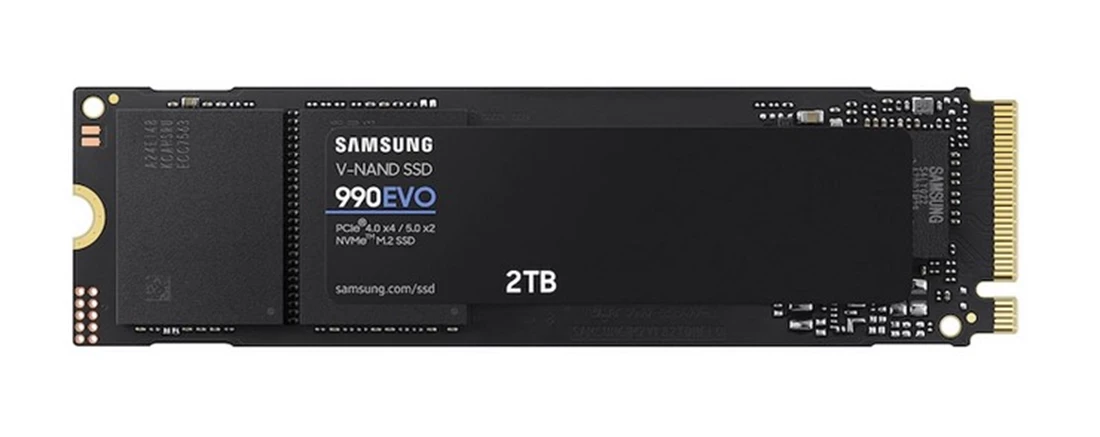
Compared with the previous-generation MZ-V8V2T0, the Samsung 990 EVO 2TB (MZ-V9E2T0B) upgrades to NVMe PCIe Gen4 x4 / Gen5 x2 and delivers up to 5000/4200 MB/s plus 700,000/800,000 IOPS, providing a clear generational gain in both sequential transfer and mixed random workloads. With 1200 TBW endurance on Samsung V-NAND 3-bit MLC, it offers a well-balanced value point for client workstations, gaming builds, and creator systems that need higher bandwidth and broader host compatibility than its predecessor without moving to a higher-cost flagship SSD tier.
With an endurance rating of 1200 TBW and 0.3 DWPD, this SSD can sustain about 1,200 terabytes of total writes over its service life, which is more than sufficient for typical OS, application, and general business data workloads. In practical terms, for a 2TB drive used mainly as a system or mixed-use boot/application drive, this level of endurance supports many years of normal operation without endurance-related concern. From a reliability perspective, the specified UBER of 1.0E-15 means the drive is designed for a very low rate of unrecoverable bit errors, helping maintain data integrity during normal read operations, while the 1.5 million-hour MTBF indicates solid expected hardware reliability in steady-state use. This model does not include power-loss protection (PLP), so while it is well suited for environments with controlled shutdown procedures or UPS coverage, it is best positioned for applications where in-flight write protection during sudden power interruption is not a strict enterprise requirement.
1. The NVMe interface over PCIe Gen4 x4, with flexibility for Gen5 x2 lane mapping, gives this drive broad server compatibility while preserving the low-overhead, high-parallelism behavior needed for dense virtualized and scale-out enterprise platforms.
2. Its 5000 MB/s sequential read capability accelerates large-block data movement, reducing wait time for database snapshots, analytics scans, and VM image loading during peak operations.
3. With 700,000 random-read IOPS, the drive can sustain highly concurrent small-block access, making it well suited for metadata-heavy workloads, read-centric databases, and fast boot storms in VDI environments.
4. A 0.3 DWPD endurance profile, backed by Samsung V-NAND 3-bit MLC, aligns well with read-dominant enterprise deployments where cost-efficient flash density matters more than intensive daily overwrite cycles.
5. The 80 µs typical latency helps keep application response times predictable, which is especially valuable for transaction processing, caching tiers, and latency-sensitive service chains.
Lower-capacity reference: 1TB Higher-capacity reference: 4TB In this SSD family, the 2TB model is the sweet-spot capacity. Compared with the 1TB version, it gives much better headroom for OS images, application growth, logs, and snapshot retention, reducing the risk of early capacity pressure. Compared with the 4TB option, it usually delivers the best balance of acquisition cost, usable endurance per dollar, and near-identical real-world performance for mainstream enterprise workloads. It is especially well suited for medium-scale virtualization, such as hosting boot and application volumes for about 40 to 60 general-purpose virtual machines.
Q: Is MZ-V9E2T0B suitable for a write-heavy database server?
A: Not ideal for a write-heavy database server. With 0.3 DWPD, 1200 TBW, and no PLP, it is better suited for client, workstation, or read-dominant mixed workloads.
Q: How many full drive writes per day can it actually endure over its warranty period?
A: This model is rated at 0.3 DWPD, meaning about 0.3 full 2TB drive writes per day over the warranty period, equivalent to roughly 600GB of writes daily.
Q: Does it include power loss protection (PLP) and why is that critical?
A: No, it does not include power loss protection. PLP is critical in server environments because it helps prevent in-flight data loss and metadata corruption during sudden power interruptions.
Q: What RAID level is recommended for this SSD?
A: RAID 1 or RAID 10 is generally recommended for better redundancy and performance balance. Since this SSD lacks PLP, avoid relying on RAID alone for write consistency protection.