











 Secure payments
Standard refund policy
Trade Assurance
Secure payments
Standard refund policy
Trade Assurance
| Brand | Samsung |
|---|---|
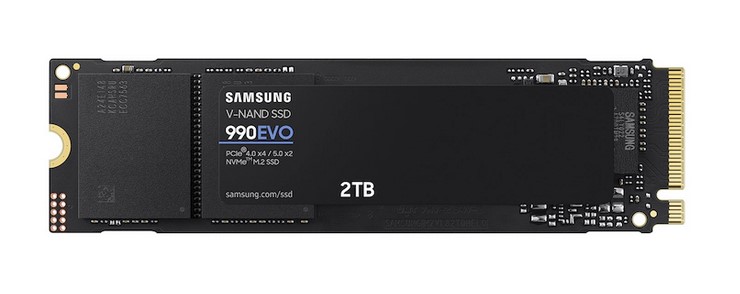
| Model | 990 EVO |
| Capacity | 2 TB |
| Usage Class | Client |
| Host Interface | PCIe Gen4 x4 / Gen5 x2 |
|---|---|
| Total Interface Bandwidth | 64 Gb/s |
| Form Factor | M.2 2280 |
|---|
| NAND Flash | Samsung V-NAND 3-bit TLC |
|---|---|
| Drive Writes Per Day | 0.3 |
| Total Bytes Written | 1200 TBW |
| Sequential Read | 5000 MB/s |
|---|---|
| Sequential Write | 4200 MB/s |
| Random Read IOPS | 700000 |
| Random Write IOPS | 80000 |
| Average Latency | 70 μs |
| Mean Time Between Failures | 1.5 Million Hours |
|---|---|
| Uncorrectable Bit Error Rate | 1.0×10⁻¹⁷ |
| Power Loss Protection | No |
| MPN | MZ-V8V2T0BW |
|---|
The Samsung 990 EVO 2 TB (MZ-V9E2T0BW) is a clear generational upgrade over MZ-V8V2T0BW, adding dual PCIe Gen4 x4 / Gen5 x2 platform compatibility while delivering up to 5,000/4,200 MB/s sequential performance and 1,200 TBW endurance from Samsung V-NAND 3-bit TLC. Its unique value in this class is the combination of forward-compatible host flexibility, strong 700,000 random-read IOPS, and client-grade efficiency, making it a better fit than its predecessor for mixed workstation, gaming, and mobile high-capacity boot-drive deployments.
With an endurance rating of 1200 TBW and 0.3 DWPD, this 2TB SSD can sustain about 328GB of writes per day for 10 years, which is well above the write volume of a typical OS, office, and general business workload. In practical terms, for use as a boot drive, application drive, or light-to-moderate workstation storage, this endurance level provides strong long-term headroom and should comfortably support years of normal operation. From a reliability perspective, the 1.0E-15 UBER indicates a low uncorrectable bit error rate consistent with dependable data reads in standard client and commercial environments, while the 1.5 million-hour MTBF further supports stable, continuous service. This model does not include power-loss protection (PLP), so while it is a solid choice for PCs and non-transaction-critical systems, applications requiring guaranteed in-flight data protection during sudden power failure should use a drive with PLP or be paired with system-level power backup.
1. The PCIe Gen4 x4 / Gen5 x2 host interface gives this drive flexible deployment across current and next-generation server platforms, enabling fast data paths for virtualized workloads and dense compute nodes without overprovisioning lanes.
2. Its sequential read performance accelerates large-block data streaming, helping analytics clusters, backup appliances, and media pipelines move massive datasets with less wait time.
3. Strong random read capability makes it well suited for latency-sensitive databases, VDI boot storms, and high-concurrency lookup workloads where consistent small-block access drives user experience.
4. The 0.3 DWPD endurance profile fits read-centric enterprise use cases such as content delivery, reference data stores, and scale-out storage tiers where capacity and efficiency matter more than heavy daily overwrite rates.
5. Samsung V-NAND 3-bit TLC balances flash density, power efficiency, and predictable enterprise reliability, giving operators a cost-effective medium for scaling read-optimized infrastructure.
Lower capacity reference: 1 TB (MZ-V9E1T0BW) Higher capacity reference: Not available in the same MZ-V9E series; 2 TB is the top capacity point Capacity positioning analysis: At 2 TB, the MZ-V9E2T0BW sits at the sweet spot of the series. Compared with the 1 TB model, it gives meaningfully more headroom for OS images, application stacks, logs, and growth, reducing the chance of early capacity pressure in always-on environments. Since there is no larger in-series option, 2 TB also represents the best balance of spend and performance consistency without stepping into a higher product tier. It is especially well suited for small-to-mid virtualization clusters, such as hosting boot and utility volumes for roughly 40 to 60 light-duty VMs.
Q: Is MZ-V9E2T0BW suitable for a write-heavy database server?
A: MZ-V9E2T0BW is not ideal for write-heavy database servers. With 0.3 DWPD, 1200 TBW, TLC NAND, and no PLP, it is better suited for client, workstation, or mixed-read workloads.
Q: How many full drive writes per day can it actually endure over its warranty period?
A: This SSD is rated for 0.3 drive writes per day, meaning about 0.6 TB of writes daily on the 2 TB model over the warranty period, within its 1200 TBW endurance limit.
Q: Does it include power loss protection (PLP) and why is that critical?
A: No, it does not include power loss protection. PLP is critical in servers because it helps prevent in-flight data loss and metadata corruption during unexpected outages or sudden power interruptions.
Q: What RAID level is recommended for this SSD?
A: For this SSD, RAID 1 is commonly recommended for OS or light server workloads needing redundancy. For higher capacity and fault tolerance, RAID 10 is preferred over parity RAID in write-sensitive environments.