











 Secure payments
Standard refund policy
Trade Assurance
Secure payments
Standard refund policy
Trade Assurance
| Brand | Samsung |
|---|---|
| Model | 990 PRO |
| Capacity | 1 TB |
| Usage Class | Consumer/High-Performance |
| Host Interface | PCIe 4.0 x4, NVMe 2.0 |
|---|---|
| Total Interface Bandwidth | 64 Gb/s |
| Form Factor | M.2 (2280) |
|---|
| NAND Flash | Samsung V8 (236L) TLC |
|---|---|
| Drive Writes Per Day | 0.3 |
| Total Bytes Written | 600 TBW |
| Sequential Read | 7450 MB/s |
|---|---|
| Sequential Write | 6900 MB/s |
| Random Read IOPS | 1200000 |
| Random Write IOPS | 1550000 |
| Average Latency | 75 μs |
| Mean Time Between Failures | 1.5 Million Hours |
|---|---|
| Uncorrectable Bit Error Rate | 1.0×10⁻¹⁷ |
| Power Loss Protection | No |
| MPN | MZ-V8P1T0BW |
|---|
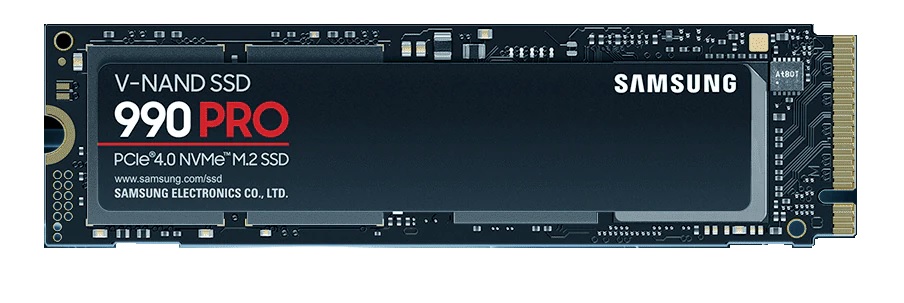
The Samsung 990 PRO 1TB (MZ-V9P1T0) stands out as a top-tier PCIe 4.0 client SSD by combining Samsung V8 236-layer TLC with up to 7,450/6,900 MB/s sequential throughput and 1.2M/1.55M IOPS, making it especially well-suited for high-intensity gaming, content creation scratch workloads, and latency-sensitive workstation boot drives. Compared with the previous-generation MZ-V8P1T0BW, it delivers about 38% higher sequential write performance, 20% higher random read, 55% higher random write, and up to 50% better power efficiency while maintaining the same 600 TBW endurance rating.
With an endurance rating of 600 TBW and 0.3 DWPD, the MZ-V9P1T0 can sustain about 164 GB of host writes per day over a 10-year period, which is more than sufficient for typical OS, office, and general business application workloads. In practical terms, for use as a system drive or standard client/workstation boot drive, this level of endurance provides comfortable headroom for long-term daily operation without endurance-related concern under normal write patterns. From a reliability standpoint, the drive is rated at 1.5 million hours MTBF and an UBER of 1.0E-17, meaning the expected unrecoverable bit error rate is extremely low and aligned with dependable data handling in everyday business use. It does not include power-loss protection (PLP), so while it is well suited for client and non-transactional workloads, systems with frequent sudden power interruption risk or strict write-in-flight protection requirements should use a stable power environment or consider a model with PLP.
1. The PCIe 4.0 x4 interface with NVMe 2.0 gives this drive the parallel bandwidth and low-overhead command path needed to keep virtualization hosts, analytics nodes, and edge servers highly responsive under heavy I/O demand.
2. With sequential read performance of 7450 MB/s, it can accelerate large dataset staging, VM image loading, and backup recovery workflows, reducing wait time for data-intensive enterprise applications.
3. Delivering 1,200,000 random read IOPS with a typical latency of 75 µs, it is well suited for metadata-heavy databases, high-concurrency web services, and read-biased AI inference environments where fast small-block access matters most.
4. The 0.3 DWPD endurance profile makes it a strong fit for read-centric enterprise deployments such as content delivery, boot volumes, and analytic read caches, where efficiency and stable long-term operation matter more than sustained write intensity.
5. Built on Samsung V8 236-layer TLC NAND, the drive combines high-density flash with mature TLC reliability, helping enterprises balance capacity, predictable performance, and cost for mainstream server storage tiers.
Note: MPN MZ-V9P1T0 is generally associated with the Samsung 990 PRO 1 TB, which is a high-end client/prosumer NVMe SSD rather than a true enterprise SSD. Same-series capacity references: Lower capacity: No official lower-capacity SKU is commonly listed in the 990 PRO family below 1 TB Current model: 1 TB Higher capacity: 2 TB Typical same-family performance positioning: 1 TB: up to 7,450 MB/s read, 6,900 MB/s write, with random IOPS in the same top-tier range as the 2 TB model 2 TB: essentially the same headline sequential and random IOPS performance as 1 TB Capacity positioning analysis: Within the 990 PRO family, 1 TB is the practical sweet spot. Since there is no widely available official sub-1 TB model in this series, 1 TB already delivers meaningful headroom for operating systems, application binaries, active project data, logs, and cache growth. Compared with the 2 TB version, it retains nearly the same top-line throughput and IOPS while keeping acquisition cost much tighter. That makes it the best balance of usable capacity, performance consistency, and budget efficiency for small-to-medium edge nodes or around 25 to 40 mixed application VMs.
Q: Is MZ-V9P1T0 suitable for a write-heavy database server?
A: Not ideally. With 0.3 DWPD, 600 TBW, TLC NAND, and no PLP, MZ-V9P1T0 is better suited for client or read-focused workloads than write-heavy database server environments.
Q: How many full drive writes per day can it actually endure over its warranty period?
A: Its endurance rating is 0.3 drive writes per day, meaning roughly 300 GB of writes daily for a 1 TB model over the stated warranty period.
Q: Does it include power loss protection (PLP) and why is that critical?
A: No, it does not include PLP. That matters in servers because sudden power loss can leave in-flight data or metadata uncommitted, increasing corruption or consistency risks.
Q: What RAID level is recommended for this SSD?
A: For most deployments, RAID 1 or RAID 10 is recommended to improve redundancy and read performance. Avoid relying on a single drive, especially since this model lacks PLP.