











 Secure payments
Standard refund policy
Trade Assurance
Secure payments
Standard refund policy
Trade Assurance
| Brand | Samsung |
|---|---|
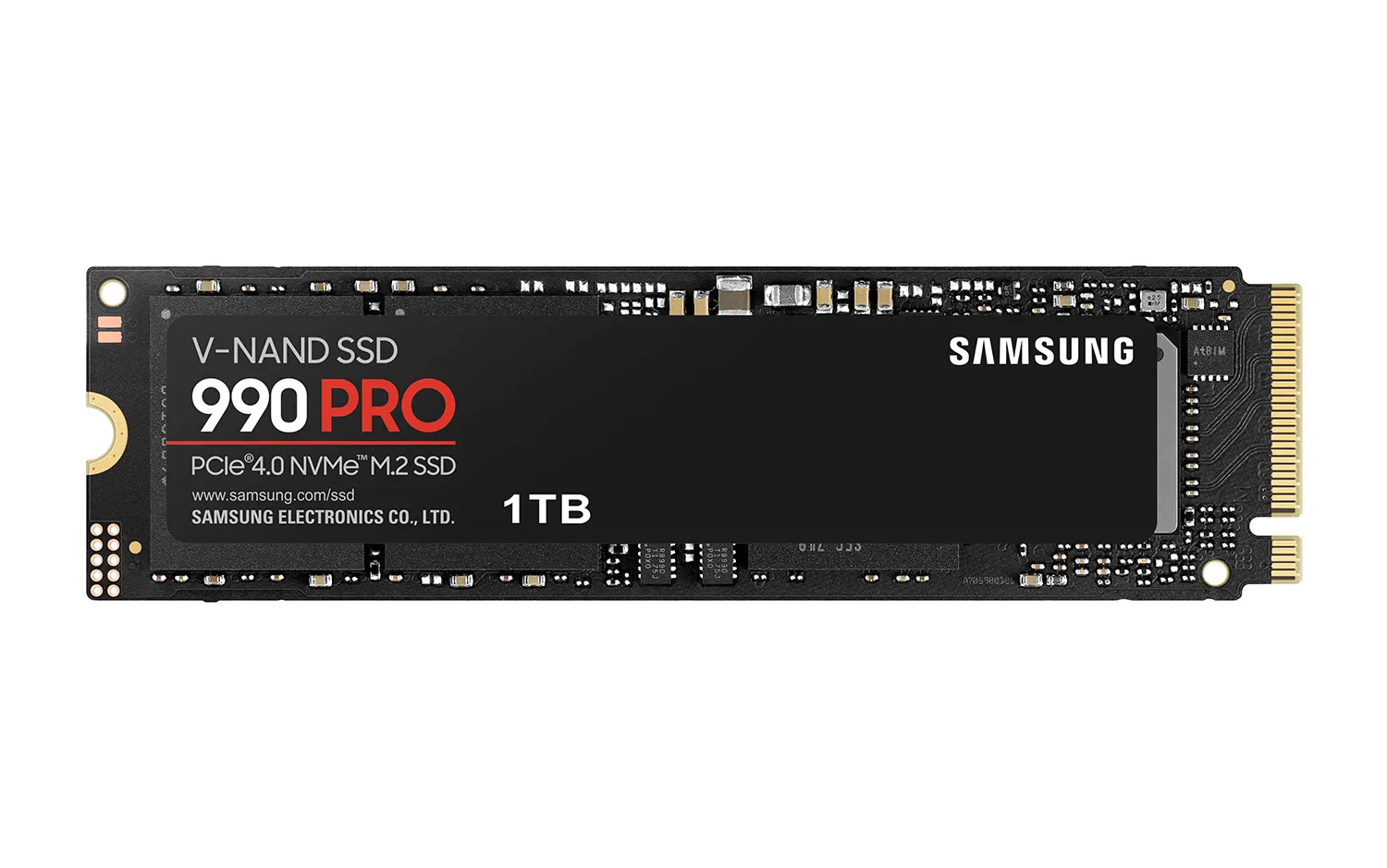
| Model | 990 PRO |
| Capacity | 1 TB |
| Usage Class | Consumer/High-Performance |
| Host Interface | PCIe 4.0 x4, NVMe 2.0 |
|---|---|
| Total Interface Bandwidth | 64 Gb/s |
| Form Factor | M.2 80mm (2280) |
|---|
| NAND Flash | Samsung V-NAND 3-bit MLC (TLC) |
|---|---|
| Drive Writes Per Day | 0.3 |
| Total Bytes Written | 600 TBW |
| Sequential Read | 7450 MB/s |
|---|---|
| Sequential Write | 6900 MB/s |
| Random Read IOPS | 1200000 |
| Random Write IOPS | 1550000 |
| Average Latency | 50 μs |
| Mean Time Between Failures | 1.5 Million Hours |
|---|---|
| Uncorrectable Bit Error Rate | 1.0×10⁻¹⁷ |
| Power Loss Protection | No |
| MPN | MZ-V8P1T0B/AM |
|---|
For high-performance client workstations and gaming rigs, the Samsung 990 PRO 1TB (MZ-V9P1T0B/AM) delivers up to 7,450/6,900 MB/s sequential and 1.2M/1.55M IOPS random performance on PCIe 4.0 x4, making it especially strong for latency-sensitive game asset streaming, large project loads, and scratch-disk workloads. Compared with the previous-generation MZ-V8P1T0B/AM, it raises sequential write speed by up to 38%, improves random read/write throughput by up to 20%/55%, and boosts power efficiency by up to 50% while maintaining the same 600 TBW endurance.
With a rated endurance of 600 TBW and 0.3 DWPD, this 1TB SSD can sustain writing about 600 terabytes of data over its service life, which is more than sufficient for typical client and office workloads. In practical terms, when used as an OS boot drive or general business workstation drive with normal daily write volumes, it can comfortably support many years of operation, often up to around 10 years under light-to-moderate usage patterns. From a reliability perspective, the specified UBER of 1.0E-15 indicates a very low unrecoverable bit error rate, helping ensure dependable data reads during normal operation, while the 1.5 million hour MTBF reflects solid expected hardware reliability. This model does not include power loss protection (PLP), so while it is well suited for desktops, notebooks, and standard business systems, it is not intended for write-critical enterprise environments where protection against sudden power interruption is required.
1. The PCIe 4.0 x4 interface with NVMe 2.0 gives this drive the bandwidth and command efficiency needed to keep virtualized databases, analytics nodes, and GPU servers fed without creating a storage bottleneck.
2. With sequential read performance up to 7450 MB/s, the SSD accelerates large-file ingestion, backup restore, and dataset loading so enterprise applications spend less time waiting on bulk data movement.
3. Random read capability of 1,200,000 K IOPS makes it well suited for latency-sensitive workloads such as high-concurrency OLTP, VDI boot storms, and heavily indexed search platforms.
4. A 0.3 DWPD endurance profile paired with Samsung V-NAND 3-bit MLC (TLC) is best aligned with read-centric enterprise environments where cost efficiency, dense capacity, and stable long-term operation matter more than heavy daily overwrites.
5. The typical latency of 50 µs helps reduce storage response time at the transaction level, improving application consistency for caching tiers, real-time querying, and fast user-facing services.
Lower capacity: N/A — 1 TB is effectively the entry capacity in the Samsung 990 PRO standard lineup for this MPN family. Higher capacity: 2 TB At 1 TB, the Samsung 990 PRO sits in the series sweet spot. Compared with a hypothetical smaller tier, it gives meaningfully more room for OS images, active datasets, logs, and overprovisioning headroom, reducing early capacity pressure. Compared with the 2 TB model, it preserves nearly the same class of sequential and random performance while keeping acquisition cost and fleet replacement budgets tighter. This makes 1 TB especially well suited for mid-scale virtualization hosts, edge analytics nodes, or a 25 to 40-seat VDI pilot cluster.
Q: Is MZ-V9P1T0B/AM suitable for a write-heavy database server?
A: No. With 0.3 DWPD, 600 TBW, TLC NAND, and no power loss protection, this model is better suited for client, boot, cache-light, or read-focused workloads than write-heavy databases.
Q: How many full drive writes per day can it actually endure over its warranty period?
A: It is rated for 0.3 DWPD, meaning about 0.3 full 1 TB drive writes per day over the warranty period, equivalent to roughly 300 GB of writes daily.
Q: Does it include power loss protection (PLP) and why is that critical?
A: No, it does not include PLP. PLP is critical in server or database environments because it helps protect in-flight data and mapping tables during unexpected power interruptions.
Q: What RAID level is recommended for this SSD?
A: For general use, RAID 1 is recommended for redundancy, while RAID 10 is preferred for better performance and fault tolerance. Avoid parity-heavy RAID for sustained write-intensive workloads.