











 Secure payments
Standard refund policy
Trade Assurance
Secure payments
Standard refund policy
Trade Assurance
| Brand | Samsung |
|---|---|
| Model | 9100 PRO |
| Capacity | 4TB |
| Usage Class | Client / Consumer |
| Host Interface | NVMe PCIe Gen5 x4 |
|---|---|
| Total Interface Bandwidth | 32 Gb/s |
| Form Factor | M.2 (2280) |
|---|
| NAND Flash | Samsung V-NAND TLC |
|---|---|
| Drive Writes Per Day | 0.3 |
| Total Bytes Written | 2400 TBW |
| Sequential Read | 14500 MB/s |
|---|---|
| Sequential Write | 12500 MB/s |
| Random Read IOPS | 1550000 |
| Random Write IOPS | 1600000 |
| Average Latency | 45 μs |
| Mean Time Between Failures | 1.5 Million Hours |
|---|---|
| Uncorrectable Bit Error Rate | 1.0×10⁻¹⁷ |
| Power Loss Protection | No |
| MPN | MZ-V9P4T0BW |
|---|
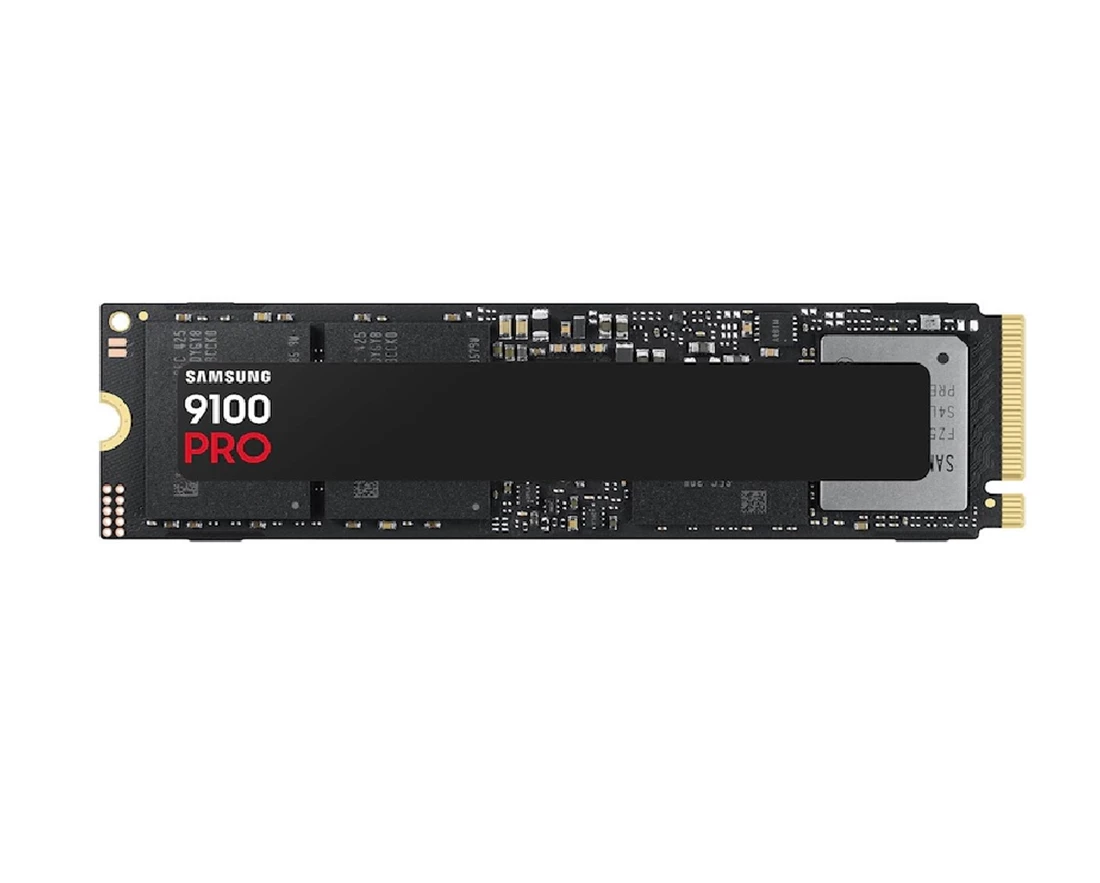
Compared with MZ-V9P4T0BW, the 9100 PRO 4TB (MZ-VAP4T0BW) advances to NVMe PCIe Gen5 x4, effectively doubling host-interface bandwidth and delivering up to 14,500/12,500 MB/s sequential throughput with 1.55M/1.60M random IOPS for materially faster scratch, build, and AI data-staging workloads. Its 4TB capacity built on Samsung V-NAND TLC also preserves prosumer-class endurance at 0.3 DWPD and 2,400 TBW, making it a stronger choice than the prior generation when you need Gen5-level performance without stepping into enterprise power and cost envelopes.
With an endurance rating of 2400 TBW and 0.3 DWPD, this 4 TB SSD is well suited to typical boot, application, and read-heavy business workloads, allowing roughly 1.3 TB of host writes per day over a 5-year usage model. In practical terms, for use as a system drive or in general-purpose enterprise read-centric deployments, this level of endurance provides substantial headroom for many years of normal operation. Its UBER specification of 1.0E-15 means the drive is designed to keep uncorrectable read errors extremely rare, helping support data integrity in routine enterprise use. This model does not include power-loss protection (PLP), so while it remains a dependable choice for standard environments, systems with frequent unexpected power interruptions or write-in-flight protection requirements should use external power safeguarding such as a UPS or select a PLP-equipped SSD.
1. The NVMe over PCIe Gen5 x4 interface gives this drive the bandwidth headroom to eliminate storage bottlenecks in GPU servers, high-frequency analytics clusters, and next-generation virtualization platforms.
2. Its sequential read performance is built for data-hungry enterprise workloads, accelerating AI model loading, large database scans, and rapid checkpoint recovery in mission-critical environments.
3. The exceptionally high random read capability enables ultra-responsive access to massive small-block datasets, making it ideal for OLTP databases, metadata-intensive file systems, and large-scale VDI farms.
4. A 0.3 DWPD endurance profile is well suited to read-centric enterprise deployments, delivering predictable lifecycle management and lower cost per terabyte for content delivery, analytics, and inference-heavy infrastructure.
5. Samsung V-NAND TLC combined with a typical latency of just 45 µs provides a strong balance of flash density, efficiency, and near-instant response times for consistently low-latency service delivery.
Lower capacity reference: 2TB Higher capacity reference: 8TB Capacity positioning analysis: Within this enterprise SSD family, the 4TB model sits in the sweet spot for mainstream production deployment. Compared with the 2TB version, it offers much better headroom for data growth, snapshot retention, mixed application workloads, and safer capacity planning without increasing drive count too quickly. Compared with the 8TB option, it delivers a more balanced acquisition cost, simpler budget control, and nearly the same class of enterprise sequential and random performance. It is especially well suited for mid-sized virtualization clusters, such as hosting boot, log, and active dataset storage for around 40 to 60 business application servers.
Q: Is MZ-VAP4T0BW suitable for a write-heavy database server?
A: Not ideally. With 0.3 DWPD and 2400 TBW, MZ-VAP4T0BW is better suited for read-intensive or mixed workloads than sustained write-heavy database server environments.
Q: How many full drive writes per day can it actually endure over its warranty period?
A: Its endurance rating is 0.3 DWPD, meaning approximately 30% of the 4TB capacity can be written daily over the warranty period, equivalent to about 1.2TB writes per day.
Q: Does it include power loss protection (PLP) and why is that critical?
A: No, it does not include PLP. This matters because PLP helps protect in-flight data and metadata during sudden power failure, reducing corruption risk in enterprise or transactional workloads.
Q: What RAID level is recommended for this SSD?
A: RAID 1, 10, or 5 may be selected depending on performance and redundancy needs. For transactional workloads, RAID 10 is generally preferred for balanced speed, resilience, and rebuild behavior.